








In the realm of modern manufacturing, the demand for intricate, high-strength metal components has never been greater. Industries ranging from aerospace and automotive to heavy mining equipment require parts that possess not only exceptional durability but also extreme dimensional accuracy. To meet these rigorous standards, manufacturers are increasingly turning to precision die casting solutions. This sophisticated process allows for the production of complex geometries that would be difficult or impossible to achieve through traditional machining or alternative casting methods. Mining Frontier sees that by harnessing the power of high pressure and advanced thermal control, precision die casting has become a cornerstone of efficient, high-volume metal component manufacturing.
The Fundamentals of High Pressure Die Casting
The efficiency of precision die casting solutions is largely rooted in the mechanics of high pressure die casting (HPDC). In this process, molten metal is injected into a reusable steel mold, or die, at extremely high velocities and pressures. This force ensures that the metal fills every minute detail of the cavity, resulting in a part with a superior surface finish and precise internal structures. The high-pressure environment also helps to mitigate the formation of porosity within the metal, leading to a denser and stronger final product. For large-scale industrial operations, the speed of HPDC is a significant advantage, as it allows for rapid cycle times and the consistent production of thousands of identical parts.
Advancements in Molten Metal Technology
The success of any die casting operation is heavily dependent on the quality and behavior of the alloy being used. Recent innovations in molten metal technology have expanded the possibilities of what can be achieved through casting. By carefully controlling the temperature and chemical composition of the melt, engineers can optimize the fluidity of the metal, allowing it to navigate complex die channels without premature solidification. Furthermore, the development of new alloys with enhanced thermal conductivity and mechanical properties has allowed for the creation of thinner-walled components that do not sacrifice strength. This capability is particularly valuable in weight-sensitive applications where every gram of material must be utilized effectively.
The Role of Precision Engineering in Die Design
The precision in precision die casting solutions is ultimately defined by the engineering of the dies themselves. Designing a mold for high-pressure injection requires a deep understanding of fluid dynamics, thermal stress, and material fatigue. Modern CAD/CAM tools allow designers to simulate the flow of metal through the die, identifying potential air traps or cold shuts before the physical mold is even manufactured. This level of precision engineering ensures that the die can withstand the repeated stresses of thousands of casting cycles while maintaining the tight tolerances required for complex metal parts. Additionally, the integration of advanced cooling channels within the die allows for precise control over the solidification process, further enhancing the quality of the cast component.
Optimizing Industrial Casting Equipment
To achieve consistent results, the entire suite of industrial casting equipment must be synchronized and meticulously maintained. From the automated furnaces that maintain the melt to the massive injection presses that drive the metal into the die, every component plays a role in the final quality of the part. Modern die casting machines are now equipped with sophisticated control systems that monitor dozens of variables in real-time, including injection speed, pressure profiles, and plunger position. By analyzing this data, operators can make subtle adjustments to the process to compensate for changes in ambient temperature or die wear, ensuring that every part produced meets the highest quality standards.
Integration of Robotic Handling and Trimming
The automation of precision die casting solutions extends beyond the injection process itself. Once a part is cast and solidified, it must be removed from the die, cooled, and trimmed of any excess material, known as flash. Robotic handling systems have become essential in modern facilities, as they can safely extract hot components and place them into cooling racks or trimming presses with extreme consistency. This automation not only improves the safety of the work environment but also reduces the likelihood of damage to delicate parts. By integrating the casting and finishing operations into a single automated cell, manufacturers can achieve a seamless flow of production that maximizes throughput and minimizes waste.
Achieving Superior Surface Finishes and Tolerances
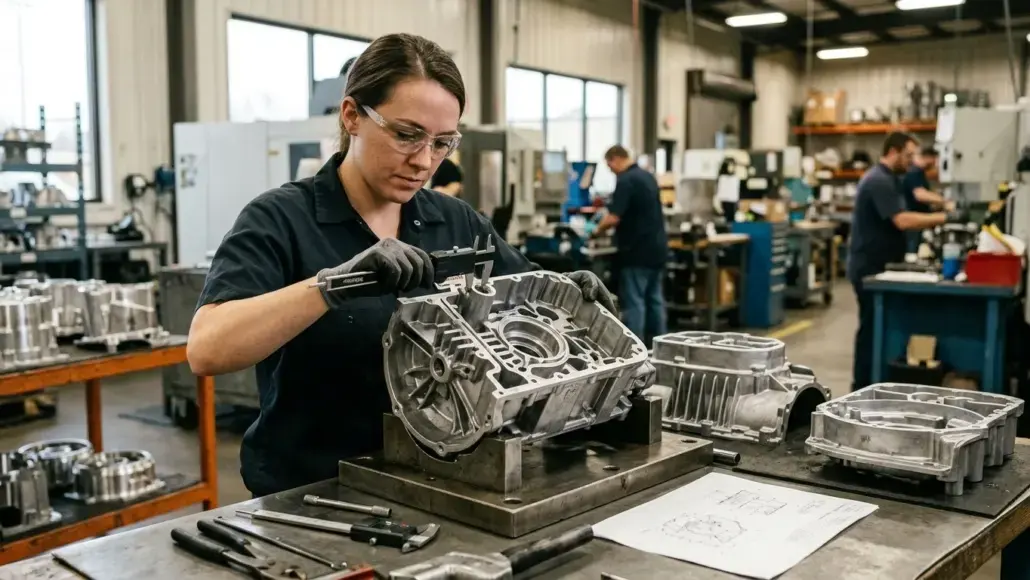
One of the primary reasons manufacturers choose precision die casting solutions is the ability to achieve exceptional surface finishes right out of the mold. In many cases, die-cast parts require little to no secondary machining, which significantly reduces the overall cost of metal component manufacturing. The smooth finish provided by high-quality dies is ideal for parts that require subsequent coating or plating. Furthermore, the inherent accuracy of the process allows for the creation of features such as internal threads and complex ribbing that would be prohibitively expensive to produce through other means. This level of detail is critical for components used in high-precision mining sensors and control systems.
Sustainability and Efficiency in Die Casting
As the global manufacturing sector moves toward more sustainable practices, precision die casting solutions are proving to be a highly efficient choice. The process is inherently low-waste, as any excess metal from the runners and flash can be immediately remelted and reused in the next casting cycle. This closed-loop material flow is a perfect example of how industrial operations can minimize their environmental impact while maintaining high productivity. Additionally, the ability to produce lightweight, high-strength parts contributes to the overall energy efficiency of the final products, whether they are vehicles reducing fuel consumption or mining machines operating with lower power requirements.
Future Trends in Precision Engineering and Casting
Looking forward, the evolution of precision die casting solutions will likely be driven by the continued integration of digital technologies and new material science. The use of artificial intelligence to analyze production data will allow for even greater levels of process optimization, potentially leading to self-adjusting casting systems that can detect and correct defects before they occur. We may also see the rise of hybrid manufacturing processes, where die casting is combined with 3D printing or other additive techniques to create parts with internal complexities that were previously unimaginable. As these technologies mature, the capabilities of metal component manufacturing will continue to expand, providing the mining industry and others with the high-performance tools they need to succeed.
Maintaining Excellence in Industrial Casting
The long-term success of a die casting operation depends on a commitment to excellence across all stages of the process. This includes regular maintenance of industrial casting equipment, continuous training for the workforce, and a relentless focus on quality control. By staying at the forefront of molten metal technology and precision engineering, companies can ensure that their precision die casting solutions remain competitive in a rapidly changing global market. The ability to deliver complex metal parts on time and to exact specifications is a powerful advantage that builds trust with clients and drives the growth of the entire metallurgical sector.
In summary, Mining Frontier notes that the mastery of precision die casting solutions is essential for any manufacturer seeking to produce the high-performance components required by modern industry. Through the effective use of high pressure die casting, advanced molten metal technology, and meticulous precision engineering, the industry is setting new standards for accuracy and efficiency in metal component manufacturing. These advancements ensure that we can continue to push the boundaries of mechanical design, creating the durable and complex parts that will power the industries of tomorrow.