










International financiers have gone ahead with funding $1.3bn for Zambia Rail Project connecting copper-producing areas of Zambia to global export markets, a project that might transform mineral supply chains and boost the contribution of Africa to the energy transition.
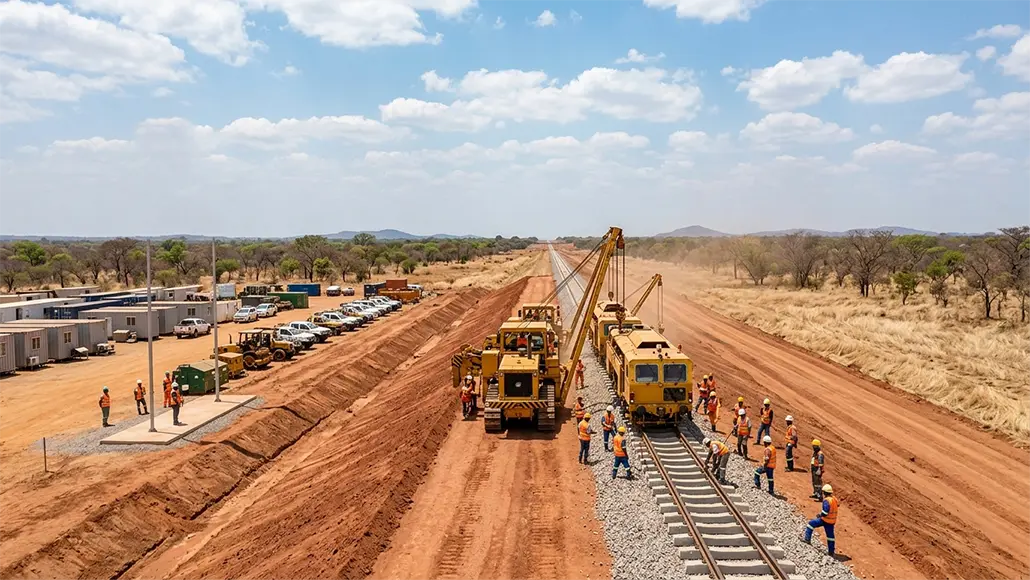
Funding $1.3bn for Zambia Rail Project will support the creation of an 830-kilometre link between Zambia’s north-western copper belt and the Atlantic port of Lobito in Angola, an essential part of the Lobito Corridor. The route is intended to offer a quicker, more direct export route for critical minerals like copper and cobalt.
The sponsors of the project say the financing package involves $500 million each from the Africa Finance Corporation – AFC as well as the African Development Bank, with Italy putting in an additional $320 million.
When completed, the railway is expected to substantially decrease transport times for mineral exports from as much as 16 days to roughly seven days, minimising logistics costs and boosting the competitive edge of mining companies that operate in Zambia.
The project comes against a backdrop of increasing global demand when it comes to critical minerals utilised in electric vehicles and renewable energy systems as well as defence technologies. Analysts say that investment in infrastructure like the Lobito Corridor is becoming just as crucial as the minerals themselves, as nations and businesses seek safe and effective supply chains.
As per industry watchers, this is not just infrastructure, this is managing the flow of strategic resources. These industry watchers cite growing international rivalry over African mineral exports.
It is well to be noted that Zambia is the second-largest copper producer in Africa and has multiple large-scale mining projects underway or scheduled, putting it in an advantageous position to capitalise on growing demand. More production has led to an a greater need for efficient transport networks in order to bring minerals to global markets.
The railway is additionally anticipated to diversify export paths by decreasing dependence on longer, crowded corridors to ports on the eastern coast of Africa. The project will provide a direct link to the Atlantic and thus open up shortened shipping routes to Europe along with North America.
But the $1.3 billion pledge only covers an element of the railway’s projected $5 billion total cost, and more funding needs to be raised. Construction is due to start in 2026 itself and is scheduled to be completed by 2030.
The project will have to be financially viable with developers securing enough freight volumes from mining companies. Current commitments are close to one million tonnes a year, short of a projected demand of as much as three million tonnes.
The railway is, nonetheless, seen as a transforming investment that could cut transport costs, facilitate new mining projects, and encourage regional integration.
More broadly, the project is part of a wider trend in the mining sector in Africa, where infrastructure corridors are increasingly becoming essential drivers of economic growth as well as global competitiveness in the quest for energy transition minerals.