







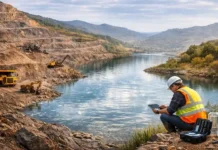
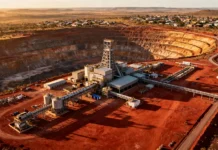
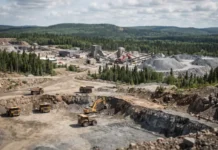
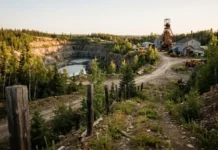

Given the circumstances surrounding this activity, mineral exploration has been an extremely hard fight against the natural world. Dense vegetation, persistent meteorological cloud cover, and highly rugged and inaccessible terrains have been common obstacles when it comes to locating and extracting the mineral wealth stored in underground deposits.
Luckily, Synthetic Aperture Radar (or SAR) has emerged as a key tool to ease how geologists and extraction companies search for these resources. Unlike optical systems, SAR operates around the clock, in any weather, and through the very same obstacles mentioned before. As the global race for some minerals, like lithium, copper, and gold intensifies, this revolution in satellite mining monitoring represents more than purely a technological upgrade.
How SAR sees through the vegetation and other obstacles
The most common obstacle in mineral exploration is getting a clear view of the ground. Optical and multispectral sensors depend on reflected sunlight, which is a fine solution in ideal conditions, but this is rarely the case. Cloud systems persisting for months or an impenetrable green mass in the form of a tree canopy make rock-type mapping almost impossible.
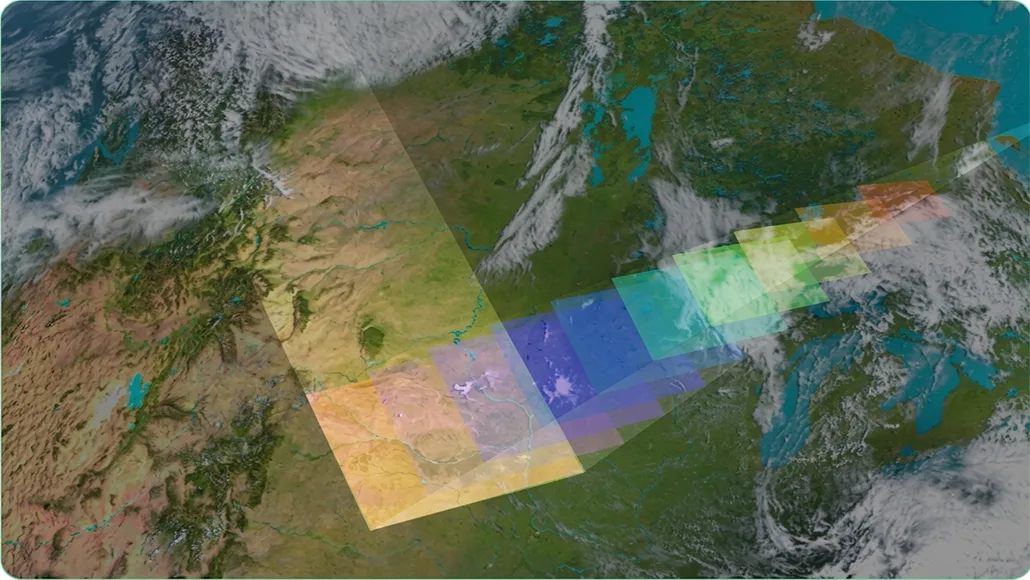
This is where SAR technology overcomes this core limitation. Its long-wavelength radar pulses can penetrate through cloud cover, haze, or forest canopies, making mining remote monitoring feasible in areas that were off-limits in the past. In places like Southeast Asia, where persistent cloud cover renders optical satellite imagery for mining useless for weeks, SAR has become the tool to identify structural features associated with gold mineralisation.
Recent advancements have taken this a step further, moving from orbital platforms to drone-style SAR systems. It has been tested successfully in Brazil in 2025. The system produced 3D subsurface profiles that matched drilling data with high consistency a proof of concept that satellite data analytics for mining needs will not remain anchored to space-based platforms alone.
From Structure to Alteration: SAR’s Core Exploration Applications
SAR’s usefulness extends well beyond seeing through clouds. It also works flawlessly at two important tasks in exploration: structural mapping and lithological identification. Because SAR is highly sensitive to surface roughness, geometry, and topography, it can map these subtle linear features and broader structural trends with great precision.
SAR is also able to identify what those structures might be hosting. By analysing variations in the radar backscatter, it becomes possible to distinguish between different rock types according to their roughness, texture and moisture content, each of which produces a distinctive radar signature. Newer processing techniques, such as discrete wavelet transformation, are being refined to extract these subtle differences from dual-polarisation SAR data, sharpening the accuracy of lithological classification. When paired with hyperspectral remote sensing, this combination is fast becoming one of the most valuable tools in the toolkit, helping geologists narrow down where to drill long before any equipment reaches the site.
Smarter Exploration Through AI and Data Fusion
The sensor is only part of this. The real transformation in modern satellite mining exploration lies in what happens once the data meets the analysis algorithm. The massive volume of information produced by satellites cannot be handled manually. The Horizon Europe MultiMiner project illustrates how computer analysis and the combination of different technologies make a difference. By combining mining monitoring workflows with ML and high-resolution SAR data, the project accelerated both mine monitoring and environmental oversight.
Interferometric SAR, commonly referenced as InSAR, has been used to monitor structural deformation in open-pit walls and dam infrastructure, producing robust results even in snow-covered environments. The advantages for satellite images mining environmental impact are considerable: near-real-time stability surveillance at scale, without the cost of conventional ground-based instruments.
The biggest frontier of modern exploration lies in multi-source data fusion. A 2026 study from a Chinese gold-mining region demonstrated a deep mineral prediction model that integrated WorldView-3 hyperspectral satellite imagery, 1 m resolution TerraSAR-X radar data and UAV LiDAR point clouds into a unified analytical system. This combined approach successfully delineated three earlier undetected ore bodies at depths between 800 and 1,500 metres a discovery that conventional geophysical methods could not have found.
Synthetic Aperture Radar (SAR) has engineered a quiet revolution in mineral exploration. Where geologists were once limited to what clear skies and open terrain could reveal, they can now map subsurface structures through tropical canopies, monitor open-pit walls for millimetric deformation, and track the environmental footprint of extraction sites from orbit. With the technology combinations and advances in drone-style SAR, AI and multi-sensor data, the capacity for new discovery and a more responsible mining monitoring has never been greater. The future of finding what the modern world needs, from the depths of the Earth to the surfaces it disturbs, will be shaped by the pulses of radar satellites watching from above.