




















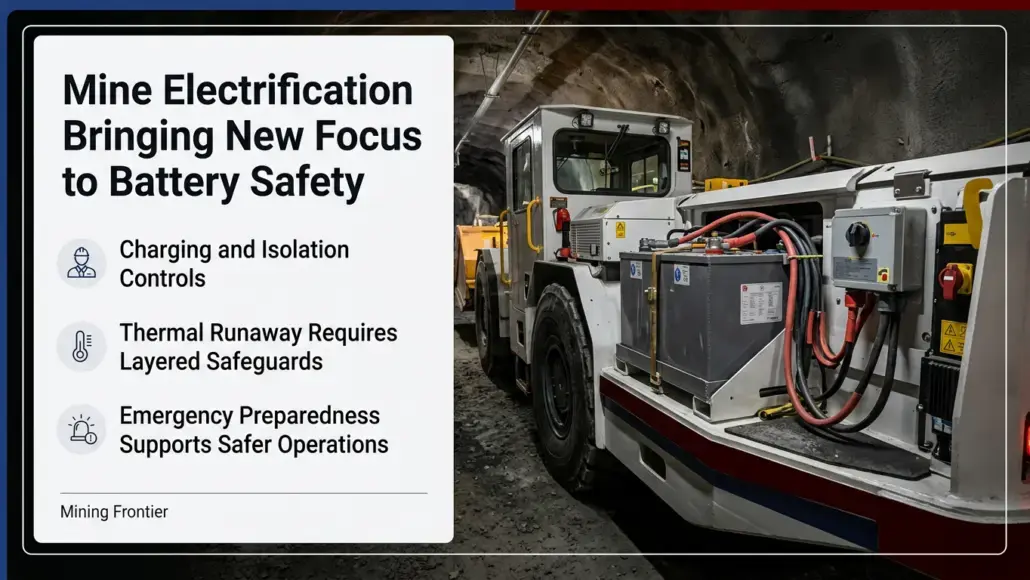

As mining operations introduce more battery-powered equipment, battery safety is becoming an increasingly important consideration in equipment design, charging infrastructure, maintenance and emergency preparedness. Lithium-ion batteries can support electrification, but faults involving cells, electrical connections or thermal management can create hazards such as overheating, smoke, hazardous gas release and fire. The implications depend on the battery chemistry, pack design, operating environment and circumstances of the failure. Managing these risks requires more than selecting suitable equipment. Operators must understand how batteries behave throughout their working life and how the mine will respond if a fault develops.
Battery Protection Requires Mine-Specific Risk Assessment
Mining Frontier observes that the expansion of battery-electric vehicles in mining is making safety a system-level responsibility. The Global Mining Guidelines Group’s Recommended Practices for Battery Electric Vehicles in Underground Mining, Version 3 addresses risks associated with mine layout, charging, maintenance, fire safety and emergency response. These considerations are particularly important underground, where confined spaces, ventilation arrangements and restricted access can affect the consequences of an incident.
Thermal runaway presents a specific concern. It occurs when a battery cell undergoes uncontrolled self-heating, potentially initiating further reactions that generate additional heat. In some circumstances, the failure can spread to neighbouring cells and release flammable or hazardous gases. A 2025 study by the National Institute for Occupational Safety and Health (NIOSH) examined lithium-ion battery thermal runaway inside a modified explosion-proof enclosure. Researchers observed flames escaping through enclosure joints and deformation beyond specified allowable limits. The findings demonstrate a limitation in the tested configuration, not proof that every battery enclosure will fail under similar circumstances.
Operational experience also illustrates why the initiating fault matters. Agnico Eagle Mines presented six battery-related fire cases recorded at its Macassa operation in Canada during 2022 and 2023. The cases involved different circumstances, including a damaged battery connection and a separate storage incident involving suspected water ingress. The operator’s findings highlight the importance of inspection, isolation, handling and storage practices alongside battery design.
These issues also connect battery protection with high-voltage maintenance and isolation procedures, particularly when personnel inspect, service or isolate damaged electrical equipment.
Priorities for Battery Risk Management
- Fault detection: Monitor appropriate battery parameters and investigate abnormal temperatures, electrical conditions or visible damage.
- Charging and storage: Establish suitable arrangements for charging, handling and storing batteries under site conditions.
- Risk assessment: Integrate battery safety into equipment selection, mine design and emergency planning.
- Incident learning: Investigate failures and use documented findings to review operating procedures and protective measures.
Thermal Runaway and Containment Require Appropriate Controls
Effective battery safety depends on managing both the initiating fault and its possible consequences. Battery management systems can monitor relevant operating conditions and identify certain abnormalities, while electrical protection and thermal-management arrangements can help control specific failure pathways. However, monitoring cannot guarantee that every internal cell fault will be detected before the situation escalates.
Mechanical protection and containment also require application-specific assessment. The NIOSH-linked enclosure study illustrates why equipment designed to contain one hazard should not automatically be assumed to manage another. Battery failure can involve heat, pressure and gas release that challenge enclosure joints and surrounding structures. The suitability of an enclosure therefore depends on the battery configuration, expected failure conditions and relevant testing.
Engineering and Operating Controls
- Electrical protection: Assess insulation, connections, isolation arrangements and short-circuit protection.
- Thermal management: Consider operating temperatures, cooling requirements and potential heat propagation between cells.
- Mechanical integrity: Evaluate battery protection against vibration, impact, moisture and other site-specific exposures.
- Containment: Confirm that protective arrangements address the relevant failure modes rather than relying on a general equipment rating alone.
Charging and Emergency Preparedness Extend Beyond the Battery Pack
Charging areas, maintenance facilities and battery storage locations require their own risk assessments. A pack removed from a vehicle may still present hazards if damaged, unstable or improperly isolated. Procedures should address abnormal battery conditions, restricted access, inspection, safe storage and involvement of appropriately equipped personnel. The correct response depends on the battery technology and the mine’s approved emergency arrangements.
A 2026 study in Reliability Engineering and System Safety examined battery-fire risk through modelling of equipment, haulage activity and ventilation at an underground mine. Its system-level approach reinforces the importance of considering interactions between operating practices and environmental conditions rather than assessing the battery alone. The findings are model-based and should not be presented as observed incident rates across the mining industry.
For operators, battery safety therefore requires coordination between equipment suppliers, electrical specialists, maintenance teams and emergency responders. Site procedures must reflect the actual fleet, infrastructure and operating environment. Industrial battery standards can provide an important technical foundation, but they do not independently establish the suitability of an entire mine installation.
Operational Safeguards
- Charging controls: Use suitable equipment, defined procedures and appropriate fault-response arrangements.
- Emergency readiness: Account for potential heat, smoke and hazardous gas release when developing site-specific response plans.
- Maintenance: Inspect battery packs and connections, document abnormalities and follow manufacturer requirements.
- System validation: Review protective functions and operating procedures when equipment or infrastructure changes.
Integrated Safety Supports Mine Electrification
Battery-electric deployment requires coordinated engineering, maintenance and emergency planning. The Macassa cases show the value of investigating real incidents, while laboratory research demonstrates why battery containment and protective arrangements must be tested for their intended hazards. Modelling can add insight into interactions between equipment, operating practices and mine conditions.
- Design: Match battery protection to the technology and operating environment.
- Operations: Manage charging, storage, inspection and fault isolation throughout the equipment lifecycle.
- Preparedness: Validate emergency arrangements against site-specific risks.
Effective battery safety is not guaranteed by a single component or standard. It depends on how the complete system is designed, maintained and operated as electrification expands across mining.
References
- Agnico Eagle Mines – Battery Fires: Summary, Macassa Mine – 2024
- Thomas H. Dubaniewicz – Explosion-Proof Enclosure Failure to Contain a Lithium-Ion Battery Thermal Runaway – Mining, Metallurgy & Exploration – 2025
- Sultan Elcin Eroglu, Muhammed Kahraman and H. Sebnem Duzgun – Integrated Simulation and Network Analysis of Battery Fire Risk in Underground Mining Systems – Reliability Engineering and System Safety – 2026
- Global Mining Guidelines Group – Recommended Practices for Battery Electric Vehicles in Underground Mining, Version 3 – 2022
- International Electrotechnical Commission – IEC 62619:2022: Secondary Cells and Batteries Containing Alkaline or Other Non-Acid Electrolytes – Safety Requirements for Secondary Lithium Cells and Batteries, for Use in Industrial Applications – 2022