











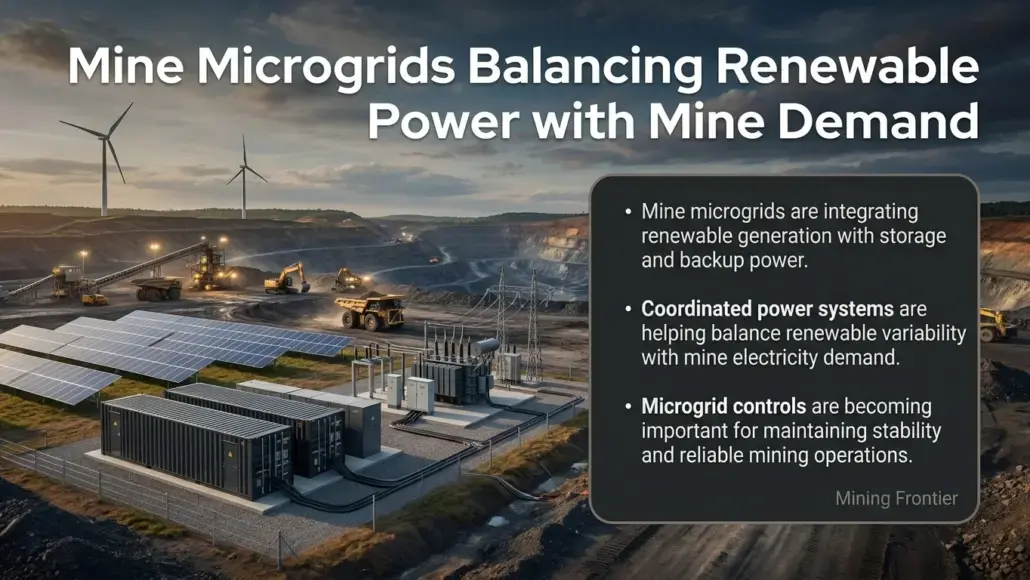

Mining power systems are becoming more complex as renewable generation, battery storage and electrified operations expand. A mine that once relied mainly on grid electricity or dispatchable generation now may need to coordinate several sources whose availability and operating characteristics differ. This is making mine microgrids increasingly relevant, particularly for remote operations where reliable grid connections may be limited.
The central challenge is not simply increasing renewable capacity. Solar and wind output can vary while mine demand can remain high or change according to production schedules. A microgrid provides a framework for bringing generation, storage, backup power and mine loads into one coordinated electrical system. Recent modelling of mining operations shows that hybrid microgrids need to balance renewable penetration, cost, emissions and reliability rather than optimise any one measure in isolation.
Microgrid Components Shaping Mine Power Strategy
The architecture of mine microgrids is generally built around several interconnected elements:
- Renewable generation from solar or wind
- Battery energy storage for balancing and reserve
- Dispatchable generation for periods of insufficient renewable output
- Control systems that coordinate supply with mine demand
- Electrical infrastructure capable of maintaining stable power delivery
The interaction between these components determines how effectively a mine can use renewable electricity. Storage can absorb surplus generation and provide power when renewable output falls, while dispatchable generation can provide additional security when storage or renewable resources are insufficient.
Renewable Penetration Meeting Reliability Requirements
The trade-off becomes more important as renewable penetration rises. Higher renewable shares can reduce fossil-fuel dependence, but they can also increase the need for forecasting, storage and frequency control. Research into autonomous mining microgrids has found that frequency stability must be explicitly incorporated into planning, with battery storage playing an important role in maintaining system performance during power imbalances.
A recent modelling study covering 135 Australian copper deposits provides a useful industry-level illustration. Its optimal configuration produced approximately 80% renewable-energy penetration, with an 84% reduction in median specific carbon emissions compared with baseline diesel generation and a minimum modelled levelized cost of electricity of $0.32/kWh. These are modelled results for the study scenario rather than universal outcomes for mining operations.
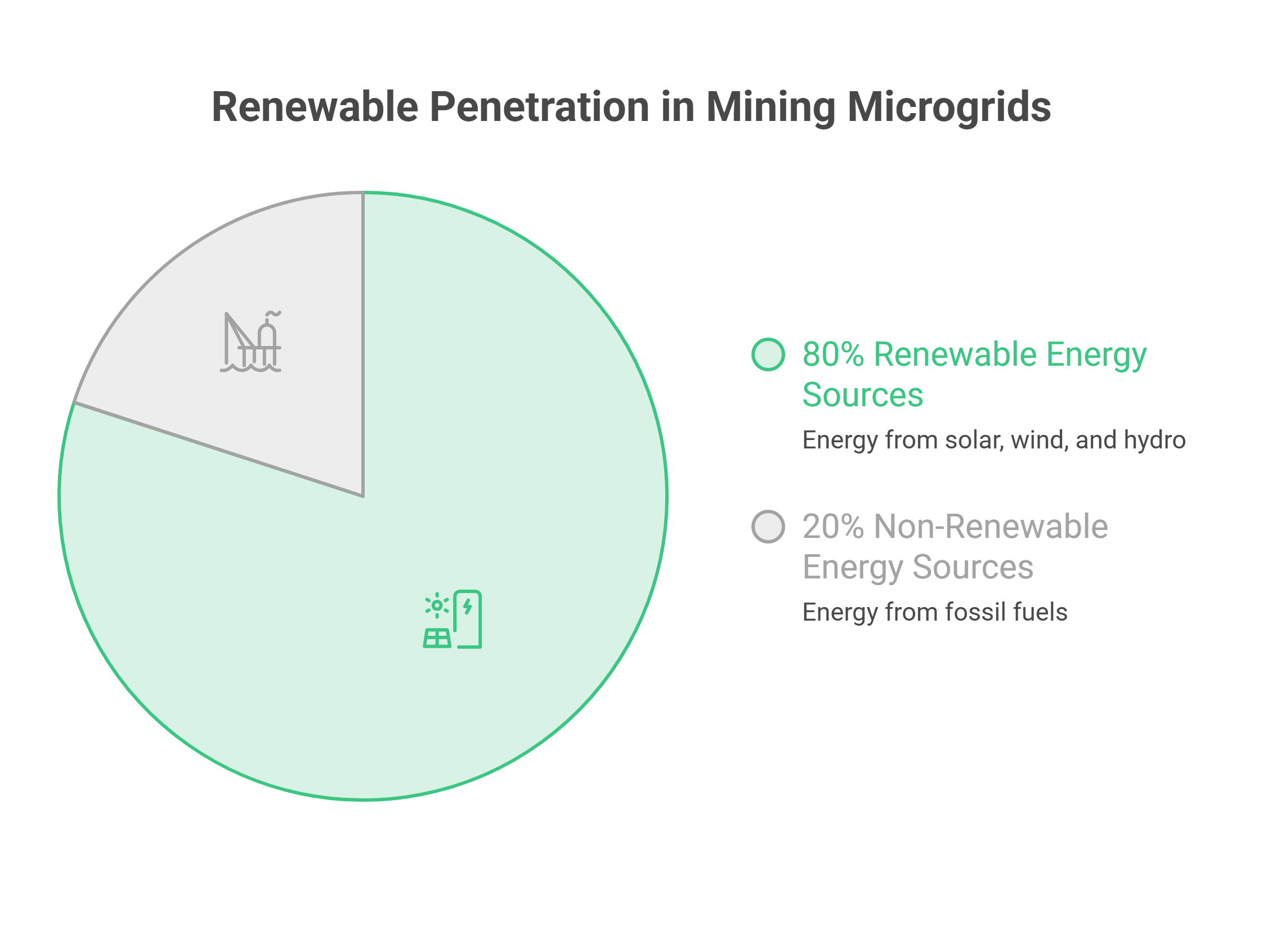
Approximately 80% renewable penetration can therefore be achievable within a designed microgrid framework, but the appropriate configuration depends on the mine’s demand profile, storage requirements, renewable resources and reliability constraints. Mine microgrids are consequently becoming less about adding individual power technologies and more about coordinating them as one operating system.
Storage Becoming the Balancing Layer
The effectiveness of mine microgrids depends on how well storage and dispatchable generation can respond when renewable output changes. Solar and wind can reduce dependence on fossil-fuel generation, but their output does not necessarily coincide with periods of highest mine demand. Battery storage can bridge some of these gaps by absorbing excess electricity and releasing it when generation falls, while conventional generation can remain available as reserve capacity.
This makes storage a balancing resource rather than simply an additional source of electricity. Its value depends on the relationship between renewable output, mine demand and the required level of system security. Recent modelling of mining microgrids assesses these elements together, showing that higher renewable penetration requires coordinated decisions on storage, generation and demand rather than renewable capacity alone.
Key storage functions include:
- Shifting renewable electricity from periods of high generation to higher-demand periods
- Providing short-duration reserve during changes in renewable output
- Supporting system stability when generation or demand changes rapidly
- Reducing the need to keep all conventional generation online continuously
This coordination becomes more important as renewable penetration increases. A battery that is fully charged when solar output is high may have limited value later unless its state of charge is managed around expected demand and generation conditions. Designing mine microgrids therefore involves deciding not only how much storage is required, but also how it should be dispatched.
Microgrid Controls Protecting Mine Reliability
Storage alone cannot guarantee reliable operation. The control architecture has to coordinate batteries, renewable generation, dispatchable generators and mine loads while maintaining acceptable electrical conditions. Frequency and voltage performance become particularly important because sudden changes in supply or demand can affect sensitive equipment and essential mine services.
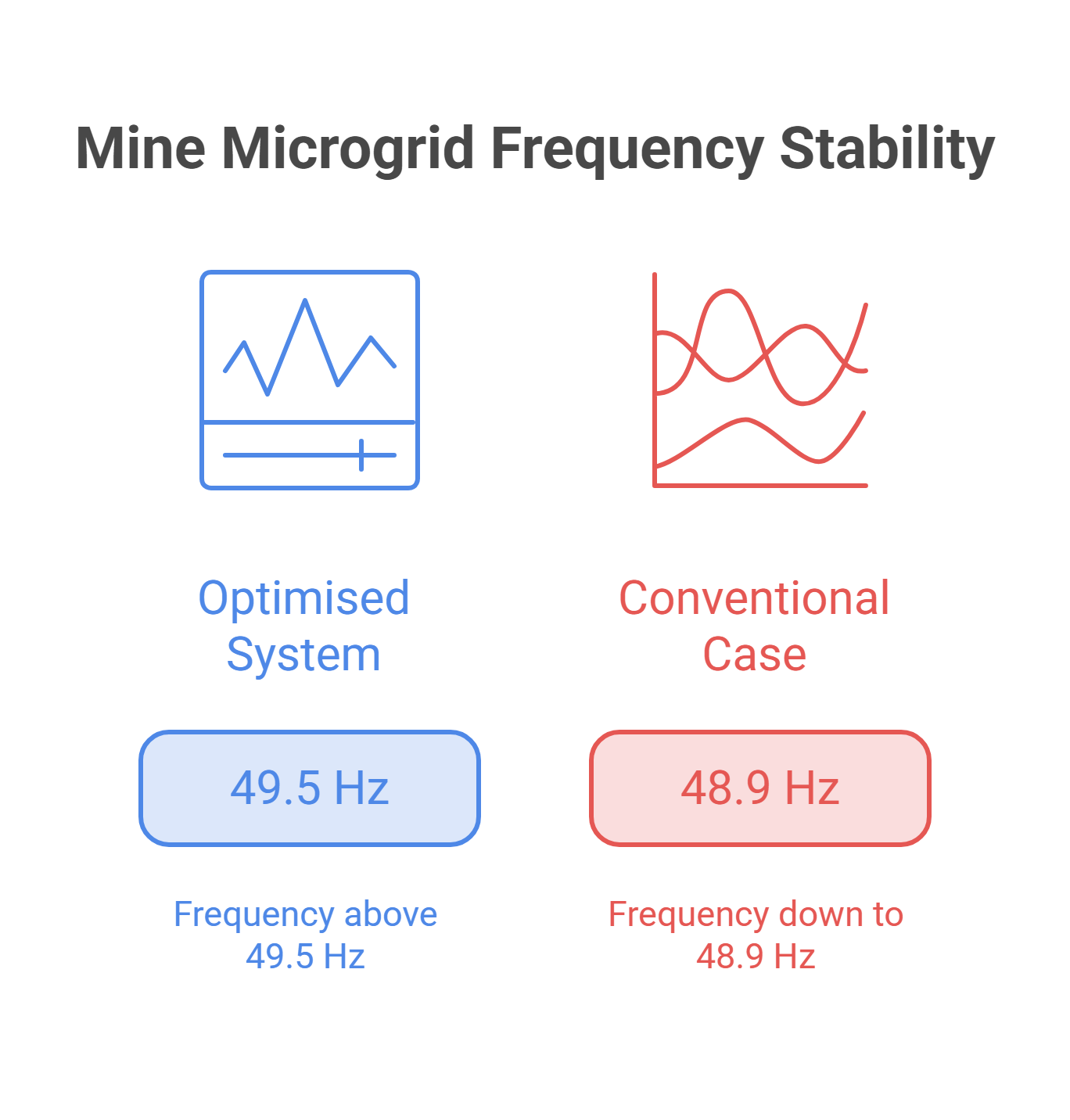
Research on autonomous mining microgrids shows the importance of incorporating frequency constraints into planning. In the studied system, the optimised configuration maintained frequency above 49.5 Hz and rate of change of frequency (RoCoF) below 0.5 Hz per second. The conventional comparison experienced severe frequency deviations during 60% of the simulated period, with frequency reaching 48.9 Hz and RoCoF reaching 0.875 Hz per second.
Reliability Requirements
- Frequency regulation during supply-demand changes
- Voltage control across the mine electrical network
- Reserve capacity for sudden disturbances
- Protection of critical and safety-related loads
- Coordinated dispatch of storage and conventional generation
The evidence indicates that mine microgrids must be designed as controlled electrical systems, not simply collections of renewable generators and batteries. The next challenge is how this integrated power architecture can improve the efficiency of electricity-intensive mining processes.
Mine Microgrids Becoming an Integrated Power Strategy
The role of mine microgrids is expanding as mining operations seek to balance renewable generation with continuous and often demanding electricity requirements. The central value lies in coordinating renewable power, storage, dispatchable generation and mine loads within a single system rather than treating each component separately.
For this model to work effectively, mines need to balance several priorities:
- Renewable utilisation and curtailment
- Storage availability and dispatch
- Electrical stability and reliability
- Production requirements and critical loads
The evidence shows that there is no universal renewable or storage configuration for mining. Site conditions, demand profiles and system requirements determine the appropriate balance. As mines gain greater control over these integrated power systems, the next challenge moves into the energy-intensive processes that consume much of that electricity. This makes energy-efficient processing a natural next step in the decarbonisation pathway.
References
- Hanrong Huang, Fiacre Rougieux and Seher Ata – Key enablers for techno-economic optimisations of microgrids in advancing the decarbonisation of mineral processing operations in Australia: The case of copper – Energy Conversion and Management: X – 2026
- Hossein Ranjbar, Hirad Assimi, S. Ali Pourmousavi and Wen L. Soong – Frequency-constrained autonomous microgrid planning for mining industry applications – Applied Energy – 2025