








Mining investment is facing a more complex capital requirement as companies seek to expand mineral supply while also reducing the emissions intensity of existing and new operations. Renewable power, electrification, energy efficiency, methane reduction and other transition measures can require substantial upfront expenditure, creating a financing challenge alongside the investment needed for mine development itself. Decarbonisation finance is becoming relevant within this wider capital equation as investors and governments consider how to support projects that combine mineral supply with lower emission production.
The challenge is becoming more pronounced as market conditions remain uncertain. The International Energy Agency reported that critical mineral investment declined by 9 percent in 2025, while capital spending on battery metals fell by more than 20 percent. Lithium focused companies reduced investment by around 40 percent, even as long term demand for critical minerals continues to grow.
Mining Projects Facing a Wider Capital Requirement
Decarbonisation finance sits alongside conventional mine development finance rather than replacing it. A project may require capital for extraction, processing and infrastructure while also needing investment in renewable electricity, energy storage, electrified equipment or emissions management systems.
• New mine development and expansion
• Processing and material handling infrastructure
• Renewable electricity and grid infrastructure
• Electrified equipment and energy systems
• Emissions measurement and reduction technologies
The OECD estimates a financing gap of USD 180 billion to USD 270 billion for critical mineral mining projects between 2022 and 2030. Copper accounts for 36 percent of the identified gap and nickel for 16 percent. The estimate represents the broader financing requirement for critical mineral mining, rather than a dedicated decarbonisation funding gap.
Public Capital Taking a Larger Risk Sharing Role
The role of decarbonisation finance is also becoming connected with greater public involvement in mining investment. The IEA reports that public finance commitments for critical minerals in advanced economies reached around USD 65 billion in 2025, more than four times the level recorded in 2023. Public support can reduce specific project risks and help attract private capital, although commitments do not automatically translate into funds being deployed.
• Public and development finance
• Concessional lending
• Guarantees and risk sharing
• Private investment mobilisation
• Long term project bankability
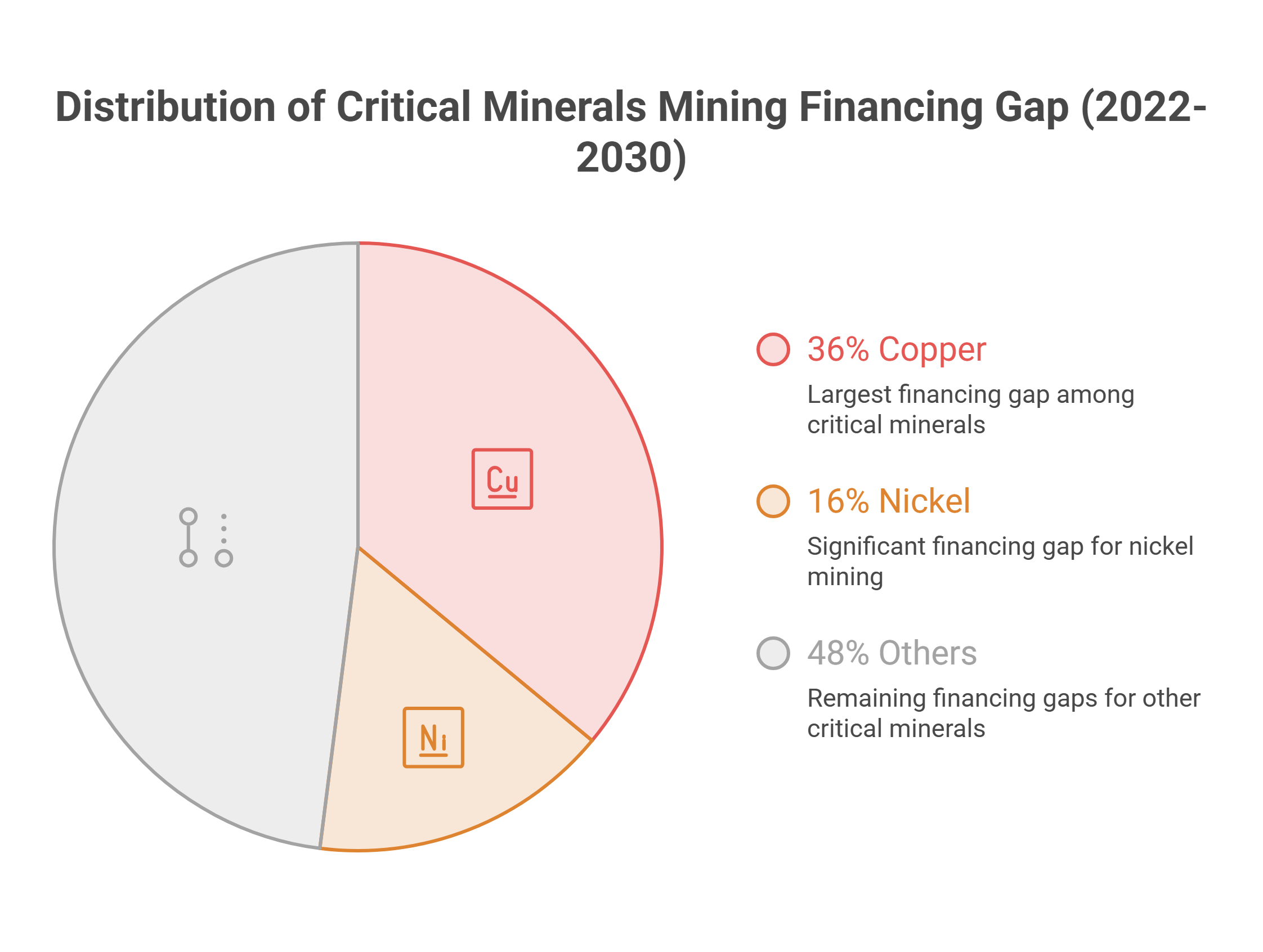
The financing gap highlights the scale of capital required for new mineral supply before additional transition investment is considered.
Project Risk Shaping the Cost of Mining Capital
The availability of capital is only one part of the financing challenge. Mining projects also have to demonstrate that expected returns can withstand commodity price changes, construction delays, infrastructure constraints, regulatory uncertainty and technology risk. These considerations become more significant when projects include lower emission equipment or energy systems whose financial benefits may emerge gradually. Decarbonisation finance can become more useful when financial structures are designed around these risks rather than treating transition investment as a separate expenditure category.
The risk profile can vary significantly between projects, making standard financing approaches less suitable for some new developments.
• Commodity price volatility can affect expected project revenue
• Technology maturity can influence capital and operating risk
• Infrastructure gaps can increase development and delivery costs
• Regulatory conditions can affect long term project certainty
• Environmental and social risks can influence financing decisions
The OECD identifies these factors among the conditions that influence critical mineral investment and notes that development finance can help address risks that commercial investors may not be able to manage alone.
Risk Sharing Expanding the Mining Financing Toolkit
Decarbonisation finance is increasingly connected with a wider set of instruments that can improve project bankability. Public institutions, development lenders and private investors can combine different forms of capital according to the risk and maturity of a project. The objective is not simply to lower borrowing costs, but to reduce specific barriers that prevent commercially viable projects from attracting investment.
Decarbonisation finance can therefore involve structures such as:
• Grants and concessional loans for early stage development
• Guarantees that reduce selected financing risks
• Blended finance combining public and private capital
• Offtake support that improves revenue predictability
• Equity participation for projects requiring higher risk tolerance
The OECD also stresses that blended finance should address a genuine market gap and mobilise commercial investment rather than permanently substitute for private capital. This distinction is important for mining because projects need financing structures that remain viable after initial public support is introduced.
The financing decision is consequently shifting toward a broader assessment of project resilience. A lower emission mining project may become more investable when its technology, infrastructure, revenue model and transition benefits are evaluated together rather than through a single measure of upfront cost.
Mining Finance Becoming More Closely Linked with Decarbonisation Performance
The financing challenge for mining is becoming broader as projects seek to secure mineral supply while also addressing emissions, infrastructure and operational risks. Decarbonisation finance can support this transition when funding structures reflect the long term nature of mining assets and the different risks associated with new technologies and infrastructure. The most important considerations are:
• Credible transition plans
• Transparent emissions performance
• Viable project economics
• Appropriate risk sharing
• Long term market demand
The role of finance is therefore extending beyond providing capital for mine development. Public finance, development institutions and private investors can contribute different forms of risk sharing, helping selected projects become more financially viable while maintaining commercial discipline.
As stronger carbon information becomes available, it can also influence investment decisions through renewable power investment in mining. This closes the series by returning to the role of renewable electricity in supporting mining decarbonisation.
References
- International Energy Agency: Global Critical Minerals Outlook 2026: 2026
- OECD: The Potential of Development Finance to Unlock Investments in the Critical Minerals Value Chain: 2026