












Mining electrification is changing the capabilities required to operate and maintain modern mine sites. Battery-electric vehicles, electrically driven equipment, charging infrastructure and more sophisticated power systems are adding new electrical interfaces to environments traditionally supported by diesel-powered machinery and established maintenance practices. Mining Frontier observes that as these systems expand, high voltage skills are becoming an increasingly important part of workforce readiness, particularly where electrical faults can disrupt production or expose workers to serious hazards.
The transition is not simply about replacing mechanical components with electrical alternatives. Mines must also ensure that technicians, electricians, engineers and equipment operators understand how electrified systems behave, how their hazards differ from conventional equipment, and which tasks require specialist authorisation. Training must therefore develop alongside equipment deployment rather than being treated as a later operational adjustment.
Electrification Changes the Maintenance Skill Mix
Diesel equipment maintenance has historically involved extensive mechanical, hydraulic and engine-related work. Electrified fleets retain many familiar mechanical systems, but they also introduce traction batteries, power converters, electric motors, electronic controls, high-energy electrical connections and charging interfaces. Maintenance teams must understand how these components interact and recognise when a fault requires specialist intervention.
The Global Mining Guidelines Group (GMG), an industry collaboration focused on improving mining practices, has identified workforce upskilling, safety protocols, operational readiness and maintenance capability as important considerations for battery-electric vehicle adoption. Its work on surface mining electrification also highlights the need to address unfamiliar voltage hazards, charging requirements and maintenance practices as deployment expands.
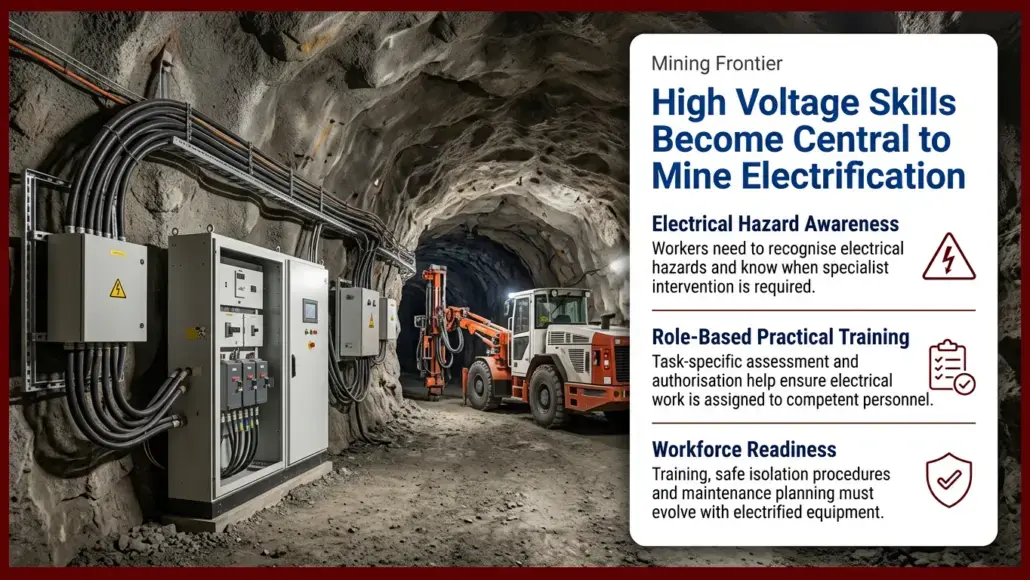
Building high voltage skills consequently requires more than classroom awareness. Workers need role-specific training, practical assessment and a clear understanding of the equipment installed at their site. A technician responsible for routine mechanical servicing does not automatically have the qualifications or authorisation to open an electrical enclosure, test an energised circuit or work on a traction battery system.
Where workforce capability needs to deepen
- Electrical hazard recognition: Personnel need to identify warning labels, damaged cables, exposed conductors, isolation points and other conditions that require work to stop and specialist assistance.
- Isolation and verification: Authorised workers must follow site procedures for disconnecting electrical supplies, controlling stored energy, applying lockout and tagout, and verifying a safe state before permitted work begins.
- Equipment-specific diagnostics: Maintenance teams need to understand manufacturer-approved procedures for battery systems, electric drives, charging equipment, sensors and electronic controls.
- Role-based authorisation: Employers must distinguish general electrical awareness from the assessed competence required to test, repair or maintain particular equipment.
These capabilities support both immediate safety and long-term operational reliability. Electrification creates value only when the workforce can maintain new systems without introducing unacceptable risks or avoidable equipment downtime.
Turning Training into Practical Electrical Competence
Mine operators need a structured approach that connects training requirements to the equipment, tasks and hazards present at individual sites. A general electrical safety course can establish awareness, but it cannot substitute for task-specific instruction, competency assessment or the legal qualifications required in the jurisdiction where a mine operates.
For example, a worker may need to recognise a damaged charging connection and isolate the area without being authorised to dismantle the charger. A qualified technician may have a different scope of responsibility, including inspection and testing under approved procedures. These distinctions should be documented so that workers understand when they can act independently and when specialist intervention is required.
High voltage skills development should therefore combine technical knowledge with practical demonstrations, supervised work and periodic reassessment. Training should reflect the equipment’s operating instructions, site electrical rules and applicable mining regulations rather than relying on a generic definition of electrical competence.
Building a role-based capability framework
- Operators and general mine personnel: Provide hazard recognition, reporting procedures, access restrictions and emergency-response awareness relevant to their work areas.
- Maintenance technicians: Develop competence in approved inspection routines, electrical isolation, fault identification, safe handover and manufacturer-defined service procedures within their authorised scope.
- Electrical specialists and engineers: Provide deeper training in protection systems, testing, power distribution, earthing and grounding, equipment commissioning and fault investigation as relevant to their responsibilities.
- Supervisors and planners: Ensure maintenance permits, isolation records, contractor responsibilities and competency records align with the risks of each task.
Integrating Competence into Mine Operations
Training programmes are more effective when they are connected to maintenance planning and operational change management. Introducing a new electric vehicle or charging system should trigger a review of job descriptions, authorisation requirements, spare-parts procedures, emergency arrangements and the training needed before equipment enters routine service.
The International Electrotechnical Commission (IEC) standard IEC 60204-11:2018 addresses electrical equipment of machines operating above 1,000 volts alternating current or 1,500 volts direct current, up to 36 kilovolts, within its defined scope. It provides relevant technical context for certain industrial machinery, but it does not replace mine-specific regulations or equipment-specific maintenance instructions. Operators must determine which standards and rules apply to each installation.
High voltage skills should also be supported by clear records of training, practical assessments, authorisations and refresher requirements. These records help supervisors assign work to appropriately qualified personnel and identify capability gaps before they become operational problems.
This approach also connects workforce development with equipment lifecycle management. Reliable information about service interventions and battery condition can help maintenance teams plan future work: battery lifecycle data guiding replacement planning. Linking these processes helps ensure that technical capability, maintenance decisions and replacement planning develop together as mine fleets become more electrified.
Making Workforce Readiness Part of Electrification Planning
Electrical competence must be treated as an operational requirement rather than a training activity completed after equipment has arrived. A 2020 fatality investigation by the U.S. Mine Safety and Health Administration found that inadequate training and procedures for de-energising, isolating, locking out, tagging and testing a high-voltage enclosure contributed to a fatal incident. The case illustrates why written procedures must be reinforced through competent execution and effective supervision.
To expand electrified operations responsibly, mine operators should assess capability gaps before deployment, define task-specific authorisations, verify competence in practice and update training as equipment and operating conditions change. High voltage skills are not the responsibility of electricians alone; they must be supported by operators, supervisors, maintenance planners and management.
Ultimately, workforce readiness will influence whether electrification can be scaled safely and reliably. Integrating technical training, authorisation, practical assessment and maintenance planning gives mines a stronger foundation for adopting electrical systems without overlooking the human capabilities that keep them operating.
References
- Global Mining Guidelines Group. Implementation of Battery Electric Vehicles in Surface Mining. Industry guideline development project.
- Global Mining Guidelines Group. Recommended Practices for Battery Electric Vehicles in Underground Mining, Version 3. 2022.
- U.S. Mine Safety and Health Administration. July 9, 2020 Fatality – Final Report. 2020.
- International Electrotechnical Commission. IEC 60204-11:2018: Safety of Machinery – Electrical Equipment of Machines – Part 11: Requirements for Equipment for Voltages Above 1,000 V AC or 1,500 V DC and Not Exceeding 36 kV. 2018.
- Mining and Automotive Skills Alliance. Mining Research Bulletin – February 2026. 2026.