
























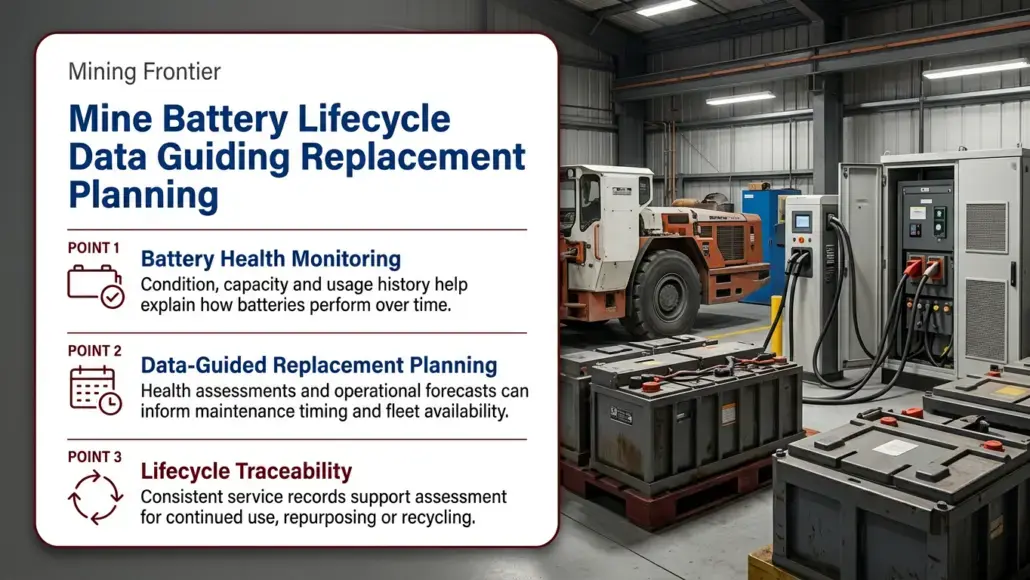

As battery-electric equipment becomes more common in mining, operators must decide when battery packs can no longer meet operational requirements. Capacity and power delivery change with use, charging practices, temperature exposure and degradation. Initial specifications cannot show how a pack will perform after extended service in a mine duty cycle.
Battery lifecycle data can help teams connect observed condition with maintenance, equipment availability and replacement decisions. This is particularly important where charging opportunities, payloads, gradients and production schedules differ across a fleet, making a single battery-life assumption unsuitable for every machine. Early replacement can waste remaining capacity while delayed replacement can disrupt production and procurement.
Monitoring Battery Condition Beyond Initial Specifications
Battery state of health (SoH) estimates condition against a defined reference, while state of charge (SoC) indicates the charge available relative to the battery’s capacity. They answer different questions and should not be used interchangeably. The Global Mining Guidelines Group’s Recommended Practices for Battery Electric Vehicles in Underground Mining, Version 3 (2022) explains that battery capacity affects how far a vehicle can travel or how much work it can complete between charges.
It also recommends collecting and analysing performance data once an electric mine is operating. The guideline notes that charging and battery-swapping arrangements can affect equipment availability and utilisation. Therefore, battery lifecycle data is most useful when interpreted alongside the task a battery must perform, the way the fleet is charged and the operating conditions recorded over time.
A measurement should also be interpreted using the battery’s chemistry, measurement method and service history, because apparent changes can reflect differences in conditions as well as underlying degradation. Operators must distinguish an estimate of remaining capacity from the power a machine requires during demanding parts of a duty cycle.
Indicators to Track
- Condition: Record state-of-health estimates, remaining capacity and available power to assess whether a pack still meets the machine’s requirements.
- Use and charging: Preserve charge-discharge history, cycle counts and energy throughput to give context to observed changes.
- Operating conditions: Review temperature exposure, state-of-charge patterns and fault events when investigating performance.
- Service and assignment: Link inspections, repairs and equipment allocation to individual packs.
Keeping battery lifecycle data connected to the battery’s identity helps teams interpret its history instead of treating isolated readings as a complete diagnosis. Where information is incomplete, the appropriate response is further inspection and verification, not an automatic replacement decision.
Turning Health Forecasts into Maintenance Decisions
Battery monitoring becomes useful when findings inform maintenance, fleet availability and procurement. Health estimates and forecasts can help identify packs that need closer inspection, plan interventions and anticipate replacement demand before a failure disrupts production. A 2023 Journal of Energy Storage study tested state-of-health forecasting with battery-pack data from a fleet of 550 battery-electric vehicles.
The study found usage data could support forecasting under different charging strategies. The study was not a mining-fleet validation, so it should be treated as relevant evidence rather than proof of equivalent accuracy in mine conditions. Battery lifecycle data should inform decisions alongside equipment requirements, technical inspection and uncertainty in the forecast. Forecasts are not guarantees; changing duty cycles and incomplete records can reduce their usefulness.
Applying Forecasts to Fleet Planning
- Schedule assessment: Use trends to identify when a battery needs inspection or a replacement plan, rather than relying on one reading.
- Protect availability: Consider production schedules, charging capacity, spare-pack access and replacement lead times together.
- Validate predictions: Compare forecasts with observed performance and reassess them when duty cycles, charging practices or operating conditions change.
Maintaining Records Across the Battery Lifecycle
Information can be divided among battery management systems, charging infrastructure, equipment telemetry, supplier platforms and maintenance databases. Inconsistent identifiers, formats or access arrangements can make service history difficult to reconstruct. The European Union’s Batteries Regulation requires battery passports from 18 February 2027 for covered electric-vehicle batteries, light means of transport batteries and industrial batteries with capacity above 2 kWh placed on the market or put into service within its scope.
Consistent battery lifecycle data can improve continuity between monitoring and maintenance decisions. Requirements vary by battery category and data field; the passport framework does not mean every operational measurement must be publicly available. The regulation divides access according to the information concerned and the role or legitimate interest of the person seeking it. Mines should therefore establish data-sharing arrangements rather than assume that all supplier-held diagnostics will automatically be available.
Priorities for Traceability
- Identification: Link each pack to its equipment assignment, service history and relevant operating records, using consistent identifiers.
- Access and consistency: Agree how authorised teams and service providers can retrieve comparable information and preserve it when platforms or service partners change.
- Lifecycle transfer: Retain relevant battery lifecycle data when a pack is repaired, reassigned or assessed for another use, while observing applicable access and data-sharing rules.
Connecting Replacement with End-of-Life Decisions
A battery removed from one mining application is not automatically ready for a second life, nor is it necessarily at the end of its useful life. Its suitability for continued use, repair, repurposing or recycling depends on condition, safety status, remaining performance and intended application. Battery lifecycle data can preserve the usage, fault and maintenance history needed for that assessment, but it cannot replace technical inspection.
Operators should:
- Retain battery identifiers and service records.
- Compare remaining performance with the requirements of a proposed new application.
- Maintain traceability when batteries move into recovery or recycling.
Mining Frontier observes that replacement planning therefore connects with battery recycling supporting critical mineral recovery. Consistent records help inform the next decision, while qualified assessment establishes what a battery can safely support. This makes replacement one stage in a wider battery-management process as needs evolve.
References
- Global Mining Guidelines Group. Recommended Practices for Battery Electric Vehicles in Underground Mining, Version 3. 2022.
- von Bülow, Friedrich; Wassermann, Markus; and Meisen, Tobias. State of Health Forecasting of Lithium-Ion Batteries Operated in a Battery Electric Vehicle Fleet. Journal of Energy Storage, Volume 72, Article 108271, 2023.
- European Parliament and Council of the European Union. Regulation (EU) 2023/1542 Concerning Batteries and Waste Batteries. 2023, as amended.