





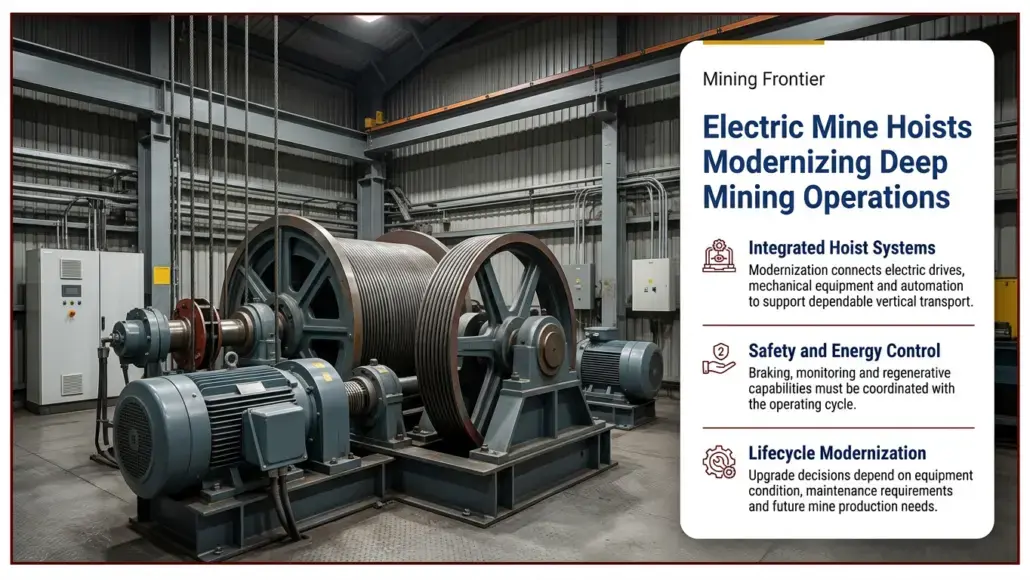

Modern electric mine hoists are essential to vertical transport in deep underground mines, moving ore, personnel and equipment between underground levels and surface facilities. As mines deepen and existing infrastructure ages, operators face increasing pressure to maintain reliable transport while managing equipment condition, safety and production requirements. Mining Frontier observes that modernization offers a way to upgrade critical components without necessarily replacing the entire hoisting installation. The scope can include electric drives, braking systems, automation, safety controls and monitoring, depending on the existing equipment and the mine’s future operating needs.
Modernization Extends Beyond the Hoist Drive
The modernization of electric mine hoists involves coordinating mechanical, electrical and control systems rather than replacing a motor in isolation. At Sweden’s Kiruna iron ore mine, operated by LKAB, ABB completed major upgrades to seven of the mine’s 13 hoists in 2025. The project incorporated mechanical, electrical and automation improvements to support continued production from a depth of 1,365 metres. ABB stated that the modernization was designed to support reliable and safe operation for at least the next 25 years.
Australia’s Renison Tin Mine provides another example. In September 2025, ABB announced a modernization programme for the main production hoist, replacing a legacy system installed in the 1990s. The planned scope included a new direct-current (DC) converter, brake stands, hydraulic power equipment, shaft communications and updated safety controls. These components illustrate how modernization decisions extend across the full hoisting system.
The electrical drive is an important part of this integration. Drive controls regulate motor speed, torque, acceleration and deceleration, while the braking and protection systems must respond appropriately to operating conditions. This connects hoist modernization with electric drive and power conversion systems, particularly where operators assess upgrades to legacy electrical equipment.
Priorities for Hoist Modernization
- System compatibility: Assess the condition of the motor, drive, brakes, ropes, controls and associated mechanical equipment.
- Safety functions: Review braking, speed monitoring, emergency stopping and protection arrangements.
- Production continuity: Plan shutdowns, installation and commissioning around mine operating requirements.
- Equipment life: Align modernization scope with the remaining service life of the mine and its production plans.
Drive Control and Braking Shape Hoist Performance
Modernization of electric mine hoists requires careful coordination between electrical drives and mechanical braking systems. The selected drive architecture influences speed control, torque management, power demand and the way the hoist responds throughout its operating cycle. Older installations may use direct-current drives, while newer systems often employ alternating-current (AC) variable-speed drives. However, the appropriate solution depends on the original installation, its electrical supply and the requirements of the upgrade.
Safety systems are equally important. Brake controls, position and speed monitoring, fault detection and emergency stopping must work together under normal and abnormal conditions. ABB’s Safety Plus hoist protection technology includes certified safety functions for braking and hoist monitoring. Such certification applies to specified functions and systems, not automatically to an entire mine installation. Modernization therefore requires appropriate commissioning, testing and verification of the complete system.
Safety and Maintenance Requirements
- Brake performance: Verify controlled stopping and suitable responses to abnormal operating conditions.
- Protection systems: Assess monitoring, fault response and the necessary safety functions.
- Maintenance planning: Coordinate electrical servicing with mechanical inspections and component replacement.
- Commissioning: Test updated controls, braking and protection functions before returning the equipment to service.
Energy Recovery and Monitoring Support Modernization
The operating cycle of electric mine hoists can create opportunities for energy recovery. During controlled lowering, a suitable drive may operate regeneratively, converting mechanical energy into electricity that can be returned to the electrical network or captured for later use. A documented Australian mine-winder project involving RUC Mining, Rockwell Automation and Energy Power Systems Australia combined a 710-kilowatt drive system with battery storage to recover and reuse energy. The reported savings were estimates for that specific installation, not a universal outcome for mine hoists.
Digital monitoring is another area of development. In 2026, ABB and Point Laz announced work to explore integration of three-dimensional shaft scanning into hoisting services. Such systems can support shaft inspection and condition assessment, complementing drive diagnostics and scheduled maintenance. They do not remove the need for required physical inspections or safety testing.
The benefits of these technologies depend on the installation, the operating cycle and the quality of the maintenance programme. Modernization must therefore be evaluated across reliability, safety, energy management and lifecycle requirements rather than through individual components alone.
Lifecycle Planning Determines Modernization Value
Upgrading hoisting infrastructure can help deep mines preserve critical transport systems while adapting equipment to evolving production and safety requirements. The Kiruna project demonstrates how mechanical, electrical and automation upgrades can be combined, while the Renison programme illustrates the complexity of modernizing legacy equipment within an existing installation.
- Infrastructure: Match the upgrade to the shaft, electrical network and future operating requirements.
- Reliability: Consider equipment condition, maintenance support and production availability.
- Investment: Evaluate upgrade costs against shutdown requirements and the remaining mine life.
The case for electric mine hoists ultimately depends on the complete system. Modern drives, braking, monitoring and energy recovery can support improved control and maintainability, but the results must be validated against the installation’s operating requirements. For mining operators, the priority is to modernize critical infrastructure through a coordinated engineering and lifecycle strategy.
References
- ABB – Swedish Mining Company LKAB Set for Future After Major ABB-Led Hoists Upgrade at Kiruna – 2025
- ABB – Bluestone Mines Tasmania JV Selects ABB to Modernize Hoist System at Australia’s Largest Tin Mine – 2025
- Rockwell Automation – RUC Mining and Rockwell Automation Harness Energy-Generating Potential of Underground Mine Winders – 2024
- ABB – ABB and Point Laz Collaborate to Support Safer Mine Hoist Inspections with 3D Scanning – 2026
- ABB – Product Release: ABB Ability Safety Plus Hoist Protector, Version 3.0 – 2024