









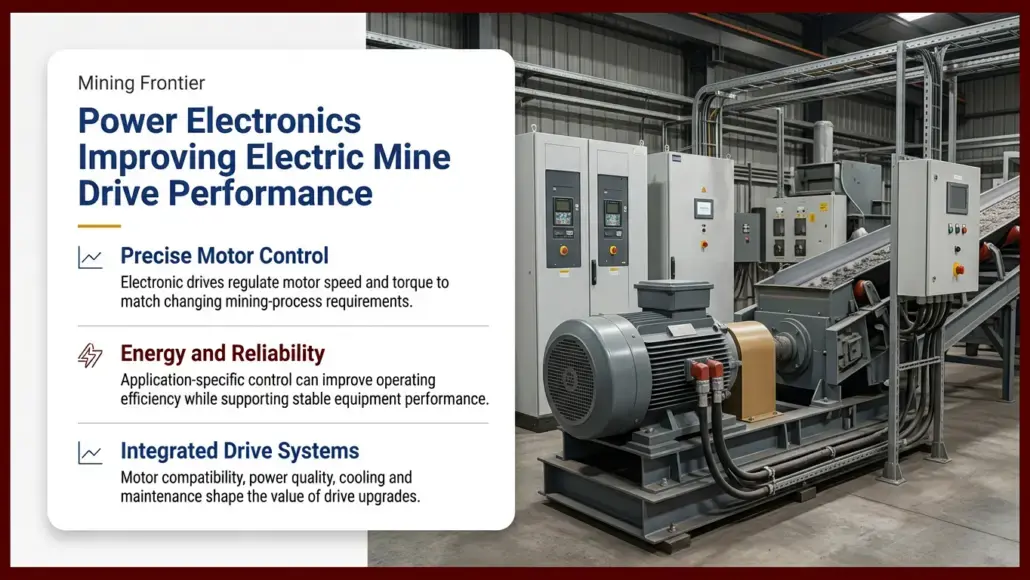

Mining operations rely on electric motors to power crushers, grinding mills, conveyors, pumps, fans and other essential equipment. How these motors receive and use electrical energy can influence process control, equipment stress, power consumption and production stability. Power electronics enable operators to regulate electrical power according to operating requirements, allowing motors to respond to changing loads instead of relying exclusively on fixed-speed operation or mechanical control. As mining companies modernize electrical infrastructure, drive technology is becoming an important consideration in equipment upgrades and new processing installations.
Motor Control Becoming Central to Mining Performance
Variable-speed drives (VSDs) use electronic power conversion to regulate motor speed and torque. A typical variable-frequency drive converts incoming alternating-current (AC) electricity into direct-current (DC) power before an inverter produces a controlled AC output at the required frequency and voltage. This allows connected equipment to operate according to process demand, where variable-speed control is appropriate.
The application varies across the mine. Crushers may require controlled starting and torque management under changing material loads, while grinding mills need drive systems that can respond to variations in ore characteristics and mill loading. Conveyors benefit from coordinated acceleration and stopping, whereas ventilation fans and pumps can adjust output as operating requirements change. These applications demonstrate how power electronics connect electrical control with the practical requirements of mineral production.
The commercial significance is also visible in major project decisions. In October 2025, ABB received an order for grinding-drive systems for Australia’s planned Eva Copper Mine Project. The announced equipment included a 24-megawatt gearless drive for a semi-autogenous grinding (SAG) mill and an 18-megawatt variable-speed drive for a ball mill. The specifications illustrate the scale of electrical demand in modern processing facilities, although the order does not establish operating performance or realized energy savings.
Applications Shaping Drive Performance
- Process control: Adjust motor output to suit the requirements of crushers, mills and material-handling systems.
- Mechanical protection: Manage acceleration, deceleration and torque to reduce unnecessary stress on selected components.
- Energy management: Match motor speed to demand in suitable applications, particularly ventilation and pumping.
- System coordination: Integrate drives with motors, control systems and production equipment to support stable operation.
Variable-Speed Operation Connects Energy Use with Process Demand
The energy benefits of power electronics depend on how the connected equipment operates. In applications such as centrifugal fans and pumps, reducing motor speed can substantially reduce power demand when the process can operate at a lower flow rate. A similar reduction cannot be assumed for every mining machine because constant-torque loads, variable-torque loads and grinding applications behave differently.
A Danfoss case study reports that its variable-speed drives reduced energy consumption by 30% across Yamana Gold’s underground ventilation and pumping systems. This is a supplier-reported result for the specified installation, not an industry-wide benchmark. It illustrates why drive selection should begin with an understanding of the existing control method, operating profile and required production output.
Factors Affecting Drive Efficiency
- Load profile: Determine whether the motor operates continuously at full capacity or experiences substantial changes in demand.
- Equipment compatibility: Match drive characteristics to motor design, gearbox requirements and process conditions.
- Control strategy: Configure speed and torque according to the connected machine’s operational requirements.
- Performance measurement: Compare energy consumption while accounting for output, operating hours and production conditions.
Electrical Integration and Monitoring Influence Reliability
Drive performance also depends on the wider electrical network. Converters can introduce harmonic distortion, while reactive power, transformer capacity and voltage conditions influence system design. Mining installations with multiple high-power drives must assess these factors to avoid treating each motor as an isolated electrical load. Appropriate converter selection, filtering and power-quality management may therefore form part of a modernization project.
Digital services are extending drive management beyond the electrical cabinet. In June 2026, ABB announced Grinding Connect, a service platform designed to combine condition-monitoring information, diagnostics, service records and remote expert support for gearless mill drives (GMDs). The announcement builds on ABB’s installed product experience, but the service launch does not itself prove quantified reductions in downtime.
Where drive systems support controlled deceleration or regenerative operation, energy recovery during downhill haulage becomes a related consideration. Regeneration depends on the drive configuration and operating cycle, and its application to haulage requires separate assessment.
Infrastructure and Maintenance Priorities
- Power quality: Evaluate harmonics, reactive power and the capacity of the electrical network.
- Thermal management: Provide appropriate cooling and protection for drives operating in demanding environments.
- Condition monitoring: Use available diagnostics to identify abnormalities and inform maintenance planning.
- Lifecycle support: Assess servicing, spare parts and compatibility with existing equipment before upgrading.
Application-Specific Evidence Determines Upgrade Value
Power electronics can improve control over electric mining equipment, but their contribution depends on the application and the wider operating system. Documented cases involving grinding mills, conveyors, ventilation and pumping show that drive upgrades can address different requirements, from process responsiveness to energy use and maintenance.
- Equipment fit: Select drive technology according to the motor, load profile and production requirements.
- Electrical integration: Consider power quality, cooling, protection and control-system compatibility.
- Measured results: Verify energy and reliability improvements against the actual operating baseline.
For mining operators, the objective is not simply to install newer electronic equipment. It is to ensure that electrical control supports reliable production and delivers a justified lifecycle benefit. Upgrades should therefore be assessed through application-specific engineering and operating evidence.
References
- ABB – Drives in Mining – Year Not Stated
- Schneider Electric – Variable Speed Drives for Mining Power Systems Applications – 2023
- Schneider Electric – Power Factor Correction and Harmonic Mitigation in Mining Power System – 2021
- Danfoss – Optimize Your Mining Operations – Year Not Stated
- ABB – ABB Launches Grinding Connect to Accelerate Digitalization of Gearless Mill Drives – 2026
- ABB – ABB Grinding Technology to Strengthen Future Metals Supply Through Major Mining Development in Australia – 2025