




















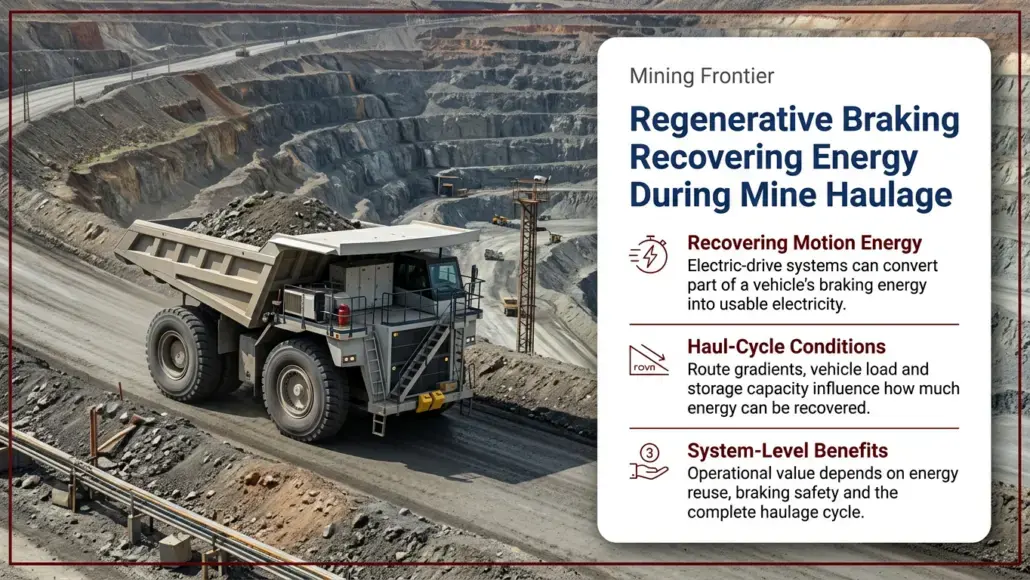

Mining haulage consumes substantial energy as heavy vehicles transport material across changing elevations and demanding routes. During downhill travel, a loaded truck can build up considerable kinetic and gravitational potential energy that must be managed safely as the vehicle slows or controls its speed. Regenerative braking offers a way to recover part of this energy rather than dissipating it entirely as heat through conventional friction braking. In suitable electric and hybrid systems, the recovered energy can be stored or reused, reducing the energy required during other stages of the haul cycle.
Electric Drives Turning Braking Energy into Usable Power
In an electric-drive system, the traction motor can operate as a generator during deceleration or downhill travel. The vehicle’s motion drives the motor, which converts mechanical energy into electrical energy. A compatible power-conversion system then directs that energy towards a battery, another energy-storage device or an electrical network, depending on the system architecture. The amount recovered depends on the vehicle’s mass, speed, gradient, operating cycle, storage capacity and conversion losses.
A documented example comes from Türkiye, where ABB and Nuh Cement converted a Euclid R85B haul truck to battery-electric propulsion. The limestone mine’s haul route includes a loaded downhill journey on an average gradient of 18–20%. ABB reported that the truck charges its battery during descent and can return uphill after unloading using the previously recovered electrical energy. The project demonstrates how route characteristics can shape the practical value of regenerative braking, although its reported operating arrangement should not be generalised to every mine or vehicle.
The example also illustrates why energy recovery must be considered alongside vehicle design and haul-cycle planning. A route with repeated elevation changes presents different opportunities from relatively level haul roads. The objective is not to create energy, but to recapture a portion of energy already present in the moving vehicle and make it available for useful work.
Conditions Influencing Energy Recovery
- Route gradient: Repeated downhill travel can create opportunities to recover energy from a loaded vehicle.
- Vehicle load: Vehicle mass and payload influence the energy available during deceleration and descent.
- Storage capacity: Batteries or other compatible systems must be able to accept the recovered electricity.
- Control and safety: Recovery must operate within the vehicle’s braking, traction and stability requirements.
Haul-Cycle Design Determines the Practical Benefit
The operating value of regenerative braking depends on how recovered energy fits into the complete haul cycle. A loaded truck descending a steep ramp may have an opportunity to recover more energy than one operating on a relatively flat route. However, the available energy varies with speed, payload, elevation change and the proportion of braking handled electrically.
System design must also account for storage limits and conversion losses. A battery that cannot accept additional charge at a particular moment may limit the energy captured. Similarly, recovered energy has limited operational value if the vehicle cannot reuse it effectively during subsequent travel. Engineers must therefore evaluate the route, vehicle controls, energy-storage system and intended operating schedule together.
Engineering and Operating Requirements
- Energy management: Match the recovery system’s capacity to the expected braking and downhill operating cycle.
- Battery condition: Consider state of charge, temperature and charging limits.
- Braking coordination: Ensure electrical recovery works alongside the vehicle’s required mechanical braking systems.
- Route planning: Evaluate gradients, speeds, payloads and repeated travel patterns under actual mine conditions.
Fuel Displacement and System Economics Require Evidence
For diesel-electric or hybrid haul trucks, recovered energy may be used to reduce engine demand during acceleration or uphill travel. Battery-electric vehicles can use it to replenish stored electrical energy, supporting subsequent operation. These outcomes depend on the vehicle’s powertrain and control architecture rather than on braking alone.
A 2019 study in Mining Technology examined onboard energy-recovery systems for surface-mine haul trucks, including battery-based and flywheel approaches. It considered potential savings alongside added equipment cost and the effect of system mass on payload and haulage economics. This highlights an important trade-off: the recovery system itself requires components, space and maintenance, which can offset some benefits.
Regenerative braking should therefore be assessed through measured energy recovery, fuel or electricity consumption, vehicle availability and lifecycle costs. A system may recover useful energy without necessarily delivering the same financial return under every operating condition.
Factors Shaping the Investment Case
- Energy reuse: Determine how much recovered energy can be used during later stages of the haul cycle.
- System weight: Account for any payload or vehicle-design implications.
- Maintenance: Include the energy-storage system, power electronics and associated components.
- Operating economics: Compare investment and servicing costs with measured energy or fuel savings.
Energy Recovery Depends on the Complete Haul System
Energy recovery can help mining operators use haulage energy more effectively, particularly where routes involve repeated elevation changes. The available evidence shows that suitable electric systems can capture energy during downhill travel, but the practical benefit depends on route design, vehicle architecture, storage capacity and operating conditions.
- Route suitability: Evaluate gradients and haul-cycle patterns before selecting a recovery system.
- Technical integration: Coordinate motors, power electronics, storage and braking controls.
- Commercial validation: Measure energy savings and lifecycle costs under actual operating conditions.
For mining operators, the objective is to recover useful energy without compromising braking safety, payload or production availability. As electrification expands, the related issue of battery safety and operational controls becomes important where recovered energy is stored in battery systems. Energy recovery is ultimately an application-specific engineering decision, not a guaranteed source of savings.
References
- ABB – Nuh Cement and ABB Complete Retrofit of Haul Truck from Diesel to Zero-Emission, Fully Electric Propulsion – 2024
- Terblanche, D. et al. – Potential of On-Board Energy Recovery Systems to Reduce Haulage Costs Over the Life of a Deep Surface Mine – Mining Technology – 2019
- Journal of Energy Storage – Theoretical Study on Energy Recovery Rate of Regenerative Braking for Hybrid Mining Trucks with Different Parameters – 2021