















Mining companies are testing battery electric haulage to determine whether electric trucks can meet the demanding production requirements of large-scale mining. Unlike smaller underground vehicles, surface haul trucks transport heavy payloads across extensive routes, often under changing gradients, weather conditions and operating schedules. Replacing diesel propulsion therefore requires more than demonstrating that a truck can move under battery power. Operators must assess energy consumption, charging requirements, reliability, safety and productivity across the complete haul cycle.
Mine-Site Trials Establishing Operational Readiness
Trials across Australia, Zambia and Mongolia illustrate different approaches to validating electric haulage systems. At Jimblebar in Western Australia, BHP, Rio Tinto and Caterpillar began testing two Cat 793 XE Early Learner battery-electric haul trucks. Their June 2026 update reported more than 100 operating hours and over 200 test laps during early-phase testing. In Zambia, Hitachi Construction Machinery and First Quantum Minerals completed a full-battery dump-truck feasibility trial at Kansanshi between June 2024 and August 2025. The manufacturer reported more than 4,000 kilometres travelled and over 30,000 tonnes transported. At Mongolia’s Oyu Tolgoi mine, Rio Tinto and SPIC Qiyuan introduced a battery-swapping trial involving eight trucks with a 91-tonne payload rating. Together, these cases show why battery electric haulage trials must assess different vehicle configurations, charging arrangements and operating conditions rather than rely on specifications alone.
Evidence Required From Haulage Trials
- Energy performance: Measure electricity consumption against payload, route conditions and completed haul cycles.
- Charging compatibility: Assess whether charging or battery exchange fits the required production schedule.
- Operational validation: Distinguish early testing and feasibility results from sustained commercial performance.
Charging Strategies Shape Haulage Performance
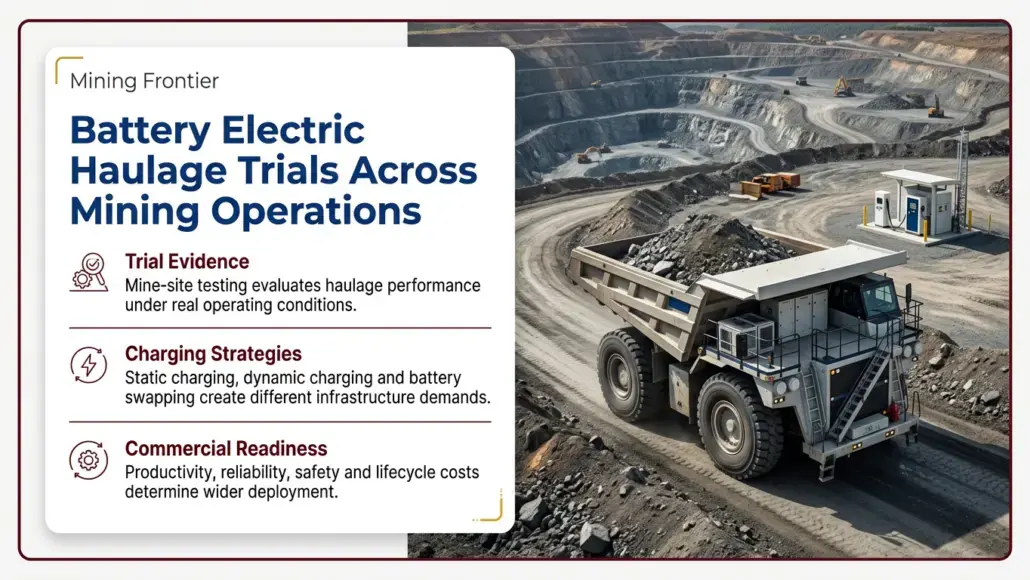
For battery electric haulage, the charging arrangement can influence equipment availability as much as the truck’s battery capacity. Static charging requires scheduled periods when vehicles can connect to a charger. Dynamic charging supplies electrical power while compatible trucks travel along equipped routes. Battery swapping replaces a discharged pack with a charged one, shifting part of the operating requirement towards spare batteries, exchange facilities and charging-station capacity.
The Jimblebar programme is evaluating static and dynamic charging approaches, while Oyu Tolgoi’s trial includes a battery-swapping station and static charging infrastructure. These examples demonstrate different ways to manage energy supply, but they do not establish that one approach is universally superior.
Infrastructure and Charging Considerations
- Static charging: Coordinate charging windows with haul cycles and production schedules.
- Dynamic charging: Evaluate route suitability, electrical connections, infrastructure investment and operational safety.
- Battery swapping: Plan battery inventory, charging capacity, exchange procedures and equipment compatibility.
- Site power: Assess grid capacity, electrical distribution and the additional load created by charging multiple trucks.
Productivity and Reliability Determine Commercial Readiness
A successful trial must demonstrate more than vehicle movement or distance travelled. Operators need evidence that the trucks can transport the required material consistently without unacceptable reductions in availability. For battery electric haulage, useful measures include cycle time, payload, tonnes transported, energy use, maintenance interventions, charging interruptions and battery condition.
Mine routes also influence the results. Gradient, rolling resistance, road condition, load and travel distance affect energy requirements. Performance observed under one set of conditions cannot automatically be applied to another mine with different production demands.
Safety and maintenance readiness are equally important. High-energy electrical systems require appropriate isolation procedures, monitoring, trained personnel and emergency-response arrangements. Battery thermal management and fault detection must be assessed alongside mechanical maintenance and overall fleet reliability.
- Comparable testing: Use appropriate diesel baselines and consistent operating conditions when comparing productivity.
- Maintenance readiness: Track faults, service interventions and component availability throughout the trial.
- Safety validation: Assess electrical controls, battery monitoring and emergency procedures.
- Lifecycle economics: Include charging infrastructure, electricity costs, maintenance, downtime and expected equipment life.
These measures help distinguish technical feasibility from operational readiness. A trial can demonstrate that a truck functions under site conditions without yet proving that it can support a full production fleet economically.
Operational Evidence Guides Wider Deployment
The expansion of electric haulage depends on the ability to demonstrate reliable production performance, suitable charging infrastructure and an acceptable lifecycle cost. Trials in Australia, Zambia and Mongolia show that operators are testing different configurations rather than following a single deployment model. Their reported milestones establish technical progress, but broader adoption requires sustained evidence on productivity, reliability, safety and infrastructure performance.
- Performance: Validate results across representative operating conditions.
- Infrastructure: Match charging and power supply to the required haul cycle.
- Investment: Assess commercial viability using site-specific operating data.
Mining Frontier believes that for mining companies, the next stage of electrification will depend on converting trial findings into operating decisions. Similar considerations apply to electric mine hoist drive systems, although vertical transport has different technical and operational requirements.
References
- Rio Tinto – BHP, Rio Tinto and Caterpillar Launch Battery-Electric Haul Truck Trial in the Pilbara – 2026
- Hitachi Construction Machinery – Full Battery Dump Truck Technical Demonstration for Mining Customers Held in Zambia – 2026
- Rio Tinto – Rio Tinto and China’s State Power Investment Corporation Launch Battery Swap Truck Trial Fleet at Oyu Tolgoi Mine – 2025
- Global Mining Guidelines Group – Implementation of Battery Electric Vehicles in Surface Mining – Year Not Stated