










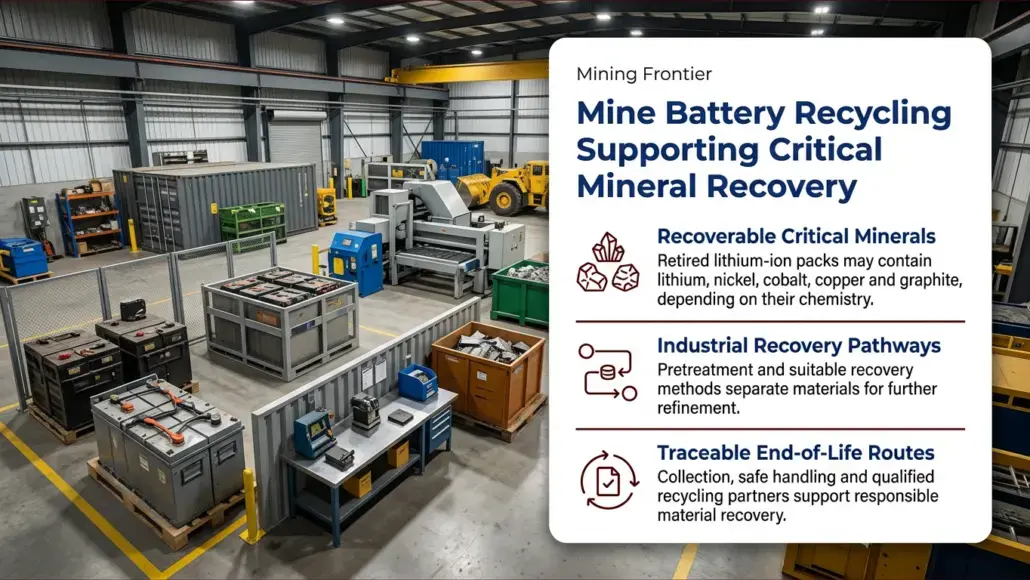

Electrification is changing how mines manage equipment throughout its service life. As battery-electric vehicles and machinery are retired, their packs become both a safety responsibility and a potential source of recoverable materials. Lithium-ion batteries can contain lithium, nickel, cobalt, copper and graphite, although composition varies by chemistry and design. Battery recycling can return some of these materials to industrial supply chains, adding a secondary source of inputs for battery production and other applications. The opportunity depends on collection, safe handling, suitable processing and demand for recovered products; retirement alone does not guarantee recovery.
Turning Retired Batteries into Secondary Resources
The International Energy Agency (IEA) explains in Recycling of Critical Minerals that recovery can strengthen mineral supply security and reduce some environmental pressures associated with primary production, but it does not eliminate the need for mining. The IEA’s Global Critical Minerals Outlook 2026 also describes recovery capacity as geographically concentrated, making access to collection and downstream processing important for supply resilience.
For mining companies, battery recycling should be planned before packs reach end of service, rather than improvised after removal. This also connects battery retirement with electrified mineral-processing equipment. These dependencies should be assessed before sourcing new equipment and battery packs.
Priorities for Mine Operators
- Identification and collection: Retain pack identifiers, chemistry information and ownership records so retired units can be routed to an appropriate provider and are not treated as interchangeable based on appearance alone.
- Safe handling: Assess damaged or suspect packs, establish suitable storage and transport arrangements, and assign specialist activities to qualified providers, including isolation, packaging and incident-response requirements appropriate to the battery’s condition.
- Suitable recovery routes: Consider chemistry and pack design when selecting a processing pathway, because no single method recovers every material equally; confirm that the facility can process the specific chemistry and pack construction.
- Logistics and partners: Plan for remote-site transport distances, low collection volumes and facility access; coordinate responsibilities with equipment manufacturers, battery suppliers and recyclers before replacement cycles begin. Agreed acceptance criteria can prevent delays and unsafe interim storage.
- Traceability: Record transfers, receiving facilities and treatment destinations so the end-of-life route can be verified, audited and connected with downstream material verification. Here, battery recycling is a supply-chain decision as well as a waste-management task, requiring clarity about responsibility and which materials a chosen processor can recover.
How Recycling Processes Recover Materials
Lithium-ion battery recycling involves collection, assessment and pretreatment before materials are separated and refined. Mechanical processing can produce an intermediate material known as black mass, a mixture containing electrode materials and other battery constituents. Black mass is not a finished metal product; it requires further processing before recovered materials can enter suitable downstream uses.
The United States Environmental Protection Agency (EPA) describes these approaches but does not suggest that one method is optimal for every battery chemistry. Battery recycling outcomes depend on feedstock composition, plant design, recovery objectives and the quality required by buyers. Comparisons should define whether recovery rates measure input mass, recovered material or a particular metal, and report losses and residuals consistently; otherwise, headline percentages can appear comparable while describing different outcomes. This distinction matters for procurement and downstream quality checks.
Main Recovery Pathways
- Pyrometallurgy: High-temperature processing can recover metals such as nickel and cobalt, while lithium and other materials may require additional treatment of remaining streams.
- Hydrometallurgy: Leaching and related chemical steps can recover materials including lithium, nickel, cobalt and manganese, followed by purification to meet downstream specifications.
- Direct recycling: This approach aims to preserve and restore useful electrode structures rather than breaking them down fully into constituent metals. It remains less established commercially than conventional routes.
Economics, Regulation and Operating Constraints
Battery chemistry also influences commercial value. Nickel- and cobalt-bearing chemistries can contain valuable recoverable metals, while lithium iron phosphate (LFP) batteries have a different composition and generally lower recoverable nickel and cobalt value. That makes efficient collection, processing and appropriate commercial arrangements important, particularly when material values fluctuate.
The European Union’s Batteries Regulation sets material-recovery targets for covered recycling activities, including rising targets for lithium, cobalt, copper and nickel by 2031. These requirements apply within the regulation’s scope; they are not global targets for every mine. For operators, battery recycling planning should therefore combine applicable legal obligations with supplier arrangements, transport access, processor qualifications and documented downstream destinations.
Factors That Shape Viability
- Feedstock and scale: Recyclers need reliable battery volumes and consistent information about chemistry and condition.
- Safety and logistics: Damaged batteries may need specialist packaging, storage and transport to reduce fire and handling risks.
- Recovered-material demand: Processing is commercially useful only when the output can be refined and sold or reused in an appropriate application.
- Compliance and traceability: Records should identify the battery, transfer arrangements and receiving facility.
Making Recovery Part of Battery Lifecycle Planning
Recycling can recover useful materials from retired mining batteries, but its contribution depends on the entire chain from collection and safe handling to processing, refining and demand for recovered products. It supplements primary mineral supply rather than replacing it. Mines should make end-of-life arrangements before batteries are retired and verify that receiving partners can manage the relevant chemistry and condition.
- Maintain pack identifiers and service records through transfer.
- Use qualified providers and documented safety and transport procedures.
- Confirm the destination and treatment pathway for retired batteries.
Mines should define responsibilities early and verify that downstream partners can handle each battery chemistry and condition safely. Mining Frontier believes that battery recycling can ultimately support more resilient material supply chains when recovery is technically suitable, commercially viable and traceable. It should be treated as a planned part of electrification, not as an automatic outcome of replacing a battery.
References
- International Energy Agency. Recycling of Critical Minerals: Strategies to Scale Up Recycling and Urban Mining. 2024.
- International Energy Agency. Global Critical Minerals Outlook 2026. 2026.
- United States Environmental Protection Agency. Lithium-Ion Battery Recycling.
- European Parliament and Council of the European Union. Regulation (EU) 2023/1542 Concerning Batteries and Waste Batteries. 2023, as amended.