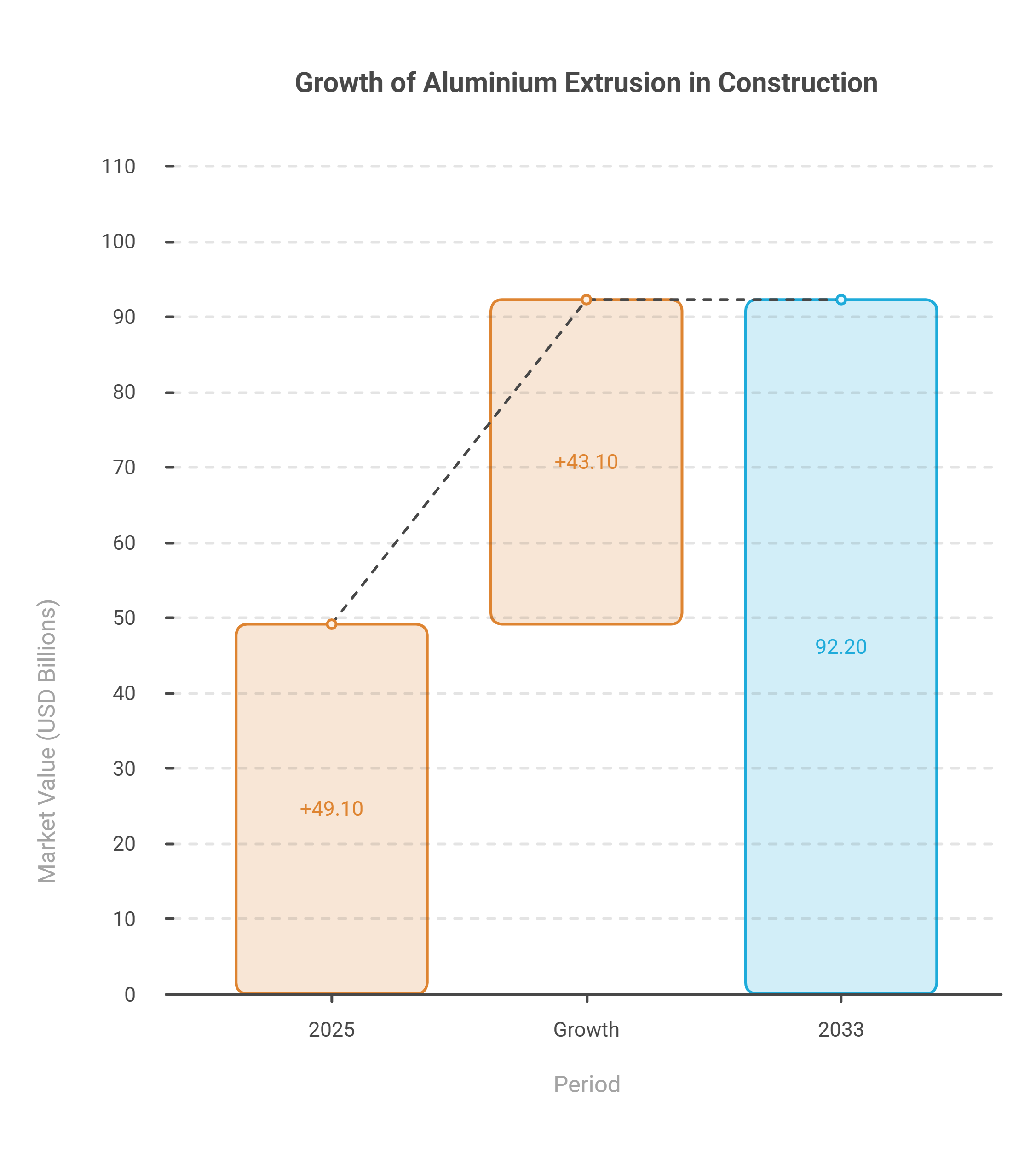
Key Takeaway: The building and construction segment is projected to expand substantially through 2033, reinforcing construction’s importance to the global extrusion industry.
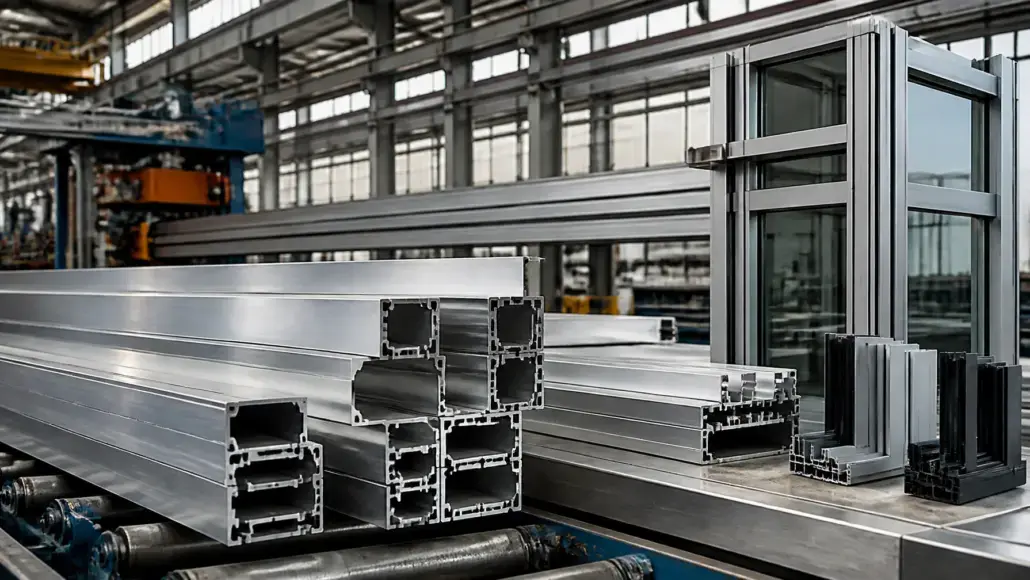
The building envelope is one area where these changing requirements are especially visible. Aluminium extrusions are used in thermally improved window and façade systems, as well as shading structures and louvers. Profile design can therefore affect both the structural role of a component and its contribution to a building’s thermal performance.
Customisation is another factor affecting the market. Extrusion can produce profiles tailored to specific architectural and engineering requirements, while processes such as machining, bending and joining can further adapt those profiles for installation. This increases the importance of tooling, fabrication and finishing capabilities alongside the extrusion process itself.
The result is a construction-driven market in which demand is increasingly influencing not only the quantity of extruded aluminium required, but also the specifications and production capabilities needed to supply it. As building systems become more performance-oriented and customised, the aluminium extrusion market is being shaped by a wider combination of profile complexity, processing requirements and manufacturing flexibility.
Product Requirements are Raising the Bar for Extrusion Capacity
Construction demand is increasingly affecting not only the volume of extruded aluminium required but also the capabilities expected from extrusion operations. Architectural systems can require profiles with more complex cross-sections, tighter dimensional control and specific surface finishes, while building-envelope applications place greater emphasis on thermal performance and integration with other components. These requirements can increase the importance of tooling, process control and downstream fabrication alongside basic press capacity.
For the aluminium extrusion market, this shift creates a more demanding relationship between construction customers and producers. A standard profile may require relatively straightforward production, whereas a customised façade, window or structural profile can involve specialised dies, controlled extrusion parameters and additional machining or finishing. The ability to handle different profile geometries and specifications can therefore become an important part of production strategy as construction requirements diversify.
Energy performance is another factor changing the product mix. Building regulations and efficiency requirements are supporting demand for aluminium profiles used in thermal-break window systems, curtain walls and other building-envelope applications. These systems can require designs that combine structural performance with reduced heat transfer, making profile engineering and assembly more important than simply increasing material volume.
Capacity Expansion is Increasingly Linked to Manufacturing Flexibility
The broader extrusion industry is also dealing with a more varied end-market mix. Construction remains the largest application, but transportation, electrical and energy, industrial machinery and other sectors are expanding their use of extruded aluminium. A wider customer base can create pressure for extrusion facilities to manage different alloys, profile sizes, tooling requirements and finishing processes without sacrificing productivity.
That makes capacity planning more complicated. Adding another extrusion press can increase output, but it does not necessarily address shortages in specialised tooling, finishing, fabrication or quality-control capabilities. The industry therefore has to consider the entire production chain when responding to construction-led demand. In some applications, the ability to provide machined, bent, joined or finished components can be as important as the nominal extrusion capacity itself.
Digitalisation is also beginning to influence this production equation. Current industry research points to greater use of real-time monitoring, advanced automation and digital modelling to improve dimensional consistency, reduce material waste and support more complex extrusion processes. These technologies can become particularly useful when producers need to accommodate a wider range of customised profiles while maintaining consistent output.
Sustainability requirements add another layer. Construction customers are increasingly considering the material footprint of building products, including recycled content and manufacturing emissions. For extrusion producers, this can increase the importance of scrap management, material efficiency and the ability to document product-level sustainability characteristics. The result is a market in which competitiveness increasingly depends on a combination of press capacity, engineering capability, downstream processing and operational control.
Construction demand is therefore reshaping the aluminium extrusion market at several levels. The opportunity is not simply to produce more profiles, but to develop the flexibility and technical capability needed to supply increasingly specialised building systems while maintaining cost, quality and production efficiency.