












Mining companies have traditionally looked for value by increasing production, improving grades or expanding resources. But another lever sits inside the ore that is already being mined: recovery. Recovering a greater share of the metal contained in processed ore can increase payable production without necessarily requiring more tonnes to be extracted.
That makes recovery increasingly important to mine economics. A one-percentage-point improvement can appear small on paper, but across a large operation processing millions of tonnes, the additional recovered metal can become commercially significant. The economics, however, depend on what it costs to achieve that improvement through additional energy, reagents, water, grinding, equipment or processing capacity.
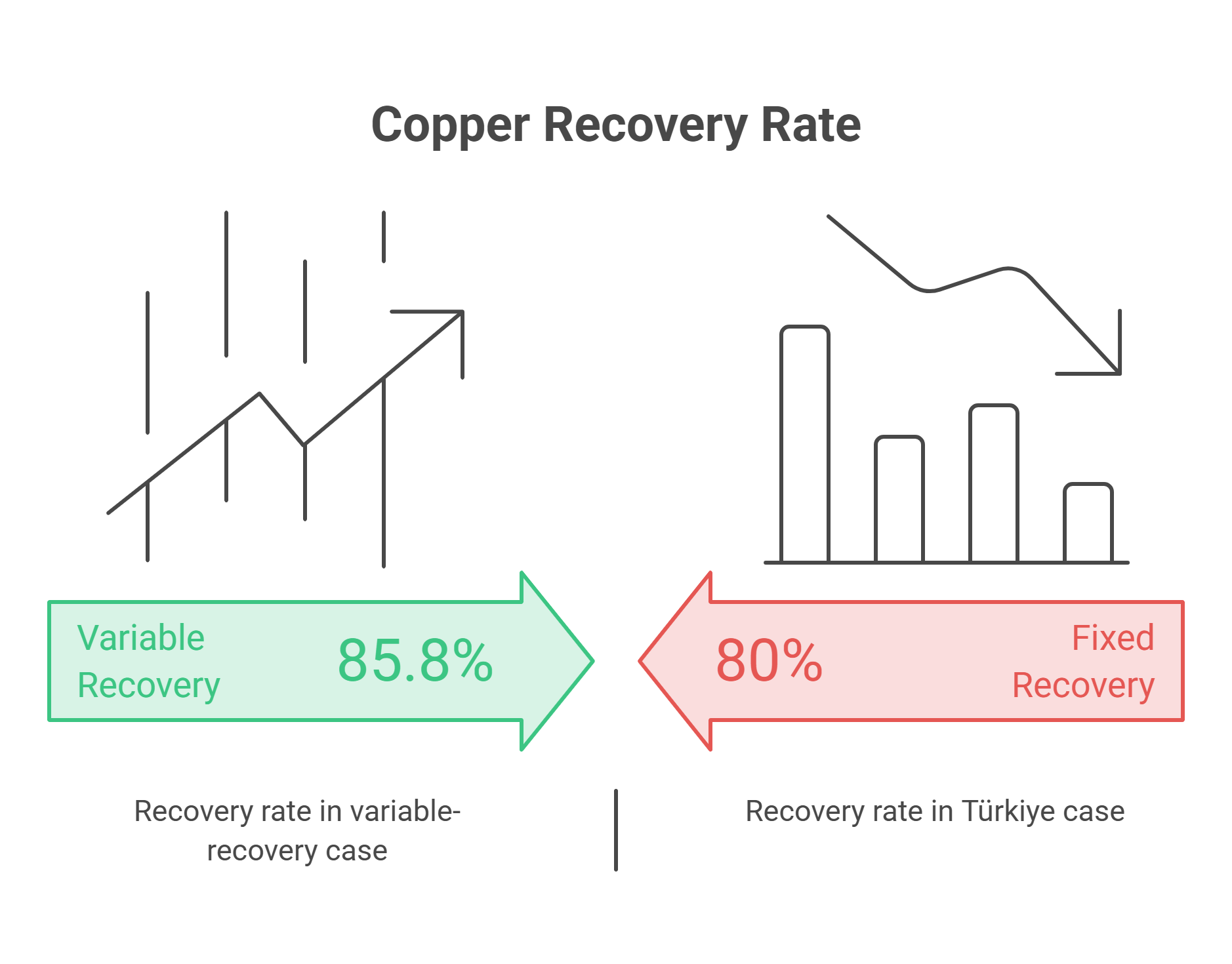
Recent research shows why recovery assumptions deserve closer attention during mine planning. A 2026 copper case study from eastern Türkiye compared a fixed recovery assumption of 80% with a model that incorporated recovery variation by ore type. Under the economic cut-off scenario, the variable-recovery approach produced an average recovery of 85.8% and around 2.8 thousand tonnes of additional recovered copper. The study also found that using a fixed recovery assumption understated project NPV by roughly 8%.
The finding is important because recovery is rarely uniform across a deposit. Mineralogy, liberation, hardness, oxidation and ore type can all influence how much metal a processing plant can recover. A mine-wide average can therefore hide differences between material that is highly responsive to processing and material that is much harder to treat.
Recovery Can Add Value Without Adding More Ore
The economic logic behind recovery is straightforward: if the same amount of ore contains the same amount of metal, recovering more of that contained metal increases the amount that can potentially be sold.
The challenge is finding where the additional value exceeds the additional processing cost.
That makes recovery different from simply pushing a plant for higher throughput. More tonnes through a plant do not automatically create more value if those tonnes have lower grades or poorer metallurgical characteristics. In some cases, improving recovery from material already being processed can provide a more attractive route to additional production.
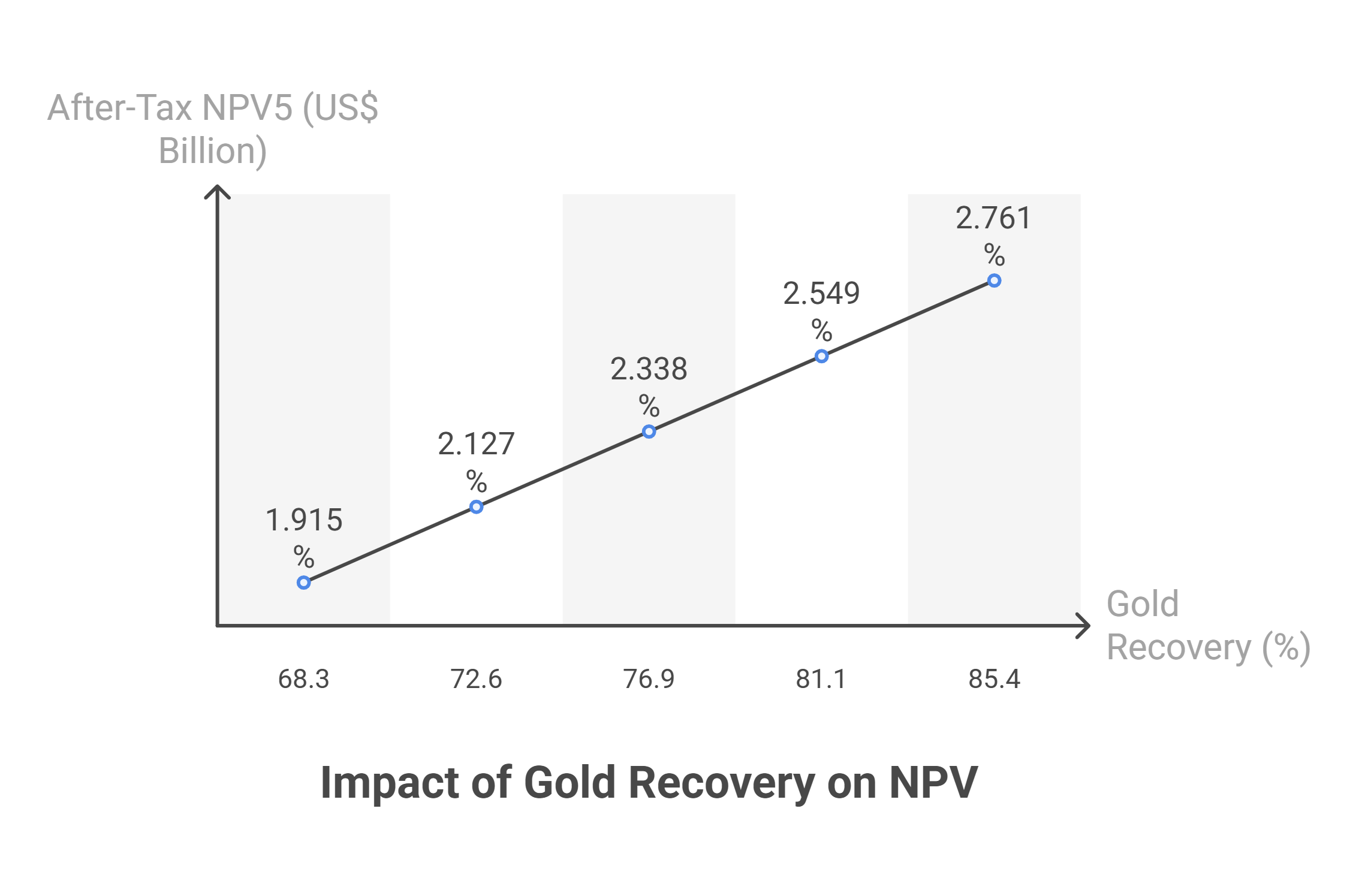
The effect can become significant at the project level. A 2025 gold-project sensitivity analysis modelled recovery between 68.3% and 85.4%. At a gold price of US$2,750 per ounce, after-tax NPV5 increased from US$1.915 billion at 68.3% recovery to US$2.761 billion at 85.4%. That is a project-specific economic sensitivity, not an industry benchmark, but it illustrates how strongly recovery assumptions can influence asset value.
For miners, the question is therefore moving beyond how much ore can be processed toward how much valuable metal can be recovered from the ore already entering the plant.
The Best Recovery Rate is Not Always the Highest
The economics of recovery become more complicated once the cost of achieving each additional percentage point is considered. More metal recovered can increase revenue, but higher recovery may also require finer grinding, additional reagents, more energy, longer processing times or new equipment. The most profitable point is therefore not necessarily the maximum technically achievable recovery.
This is where ore variability becomes important. Different parts of a deposit can respond very differently to the same processing conditions. Mineralogy, liberation, hardness and oxidation can all affect how much metal can be recovered. Recent research from a copper deposit in eastern Türkiye found that incorporating variable recovery by ore type changed the economic assessment materially. A fixed 80% recovery assumption understated project NPV by roughly 8% compared with a model using measured recovery variation. (preprints.org)
That suggests a broader change in mine planning. Instead of applying one recovery number across an entire deposit, operators can increasingly use geometallurgical information to understand which parts of the orebody are likely to deliver stronger or weaker processing results.
Recovery is Becoming a Mine-Planning Variable
Geometallurgy connects geological characteristics with metallurgical performance, allowing miners to consider recovery alongside grade, cost and production timing. A 2026 study of a copper-gold-silver deposit found that incorporating more detailed geometallurgical information produced differences of up to 6.92% in NPV between modelling scenarios. The research linked the value difference to changes in processing costs, recovery and the sequencing of material through the operation. (mdpi.com)
This means the question is no longer simply whether a processing plant can recover more metal. It is whether the additional metal can be recovered economically from the right material at the right time.
Technology is also expanding that opportunity. A 2025 flotation study on Central African copper ore reported an approximately 11% improvement in copper recovery using tailored co-collectors, while maintaining concentrate grade in the tested conditions. The result shows how better process chemistry can potentially increase recovered metal without simply increasing the volume of material fed into the plant. (sciencedirect.com)
These are study-specific results, not standard industry benchmarks. But together they illustrate why Recovery is becoming a bigger value lever. The opportunity is to understand where incremental recovery creates more value than it costs, rather than pursuing the highest possible percentage as an end in itself.