











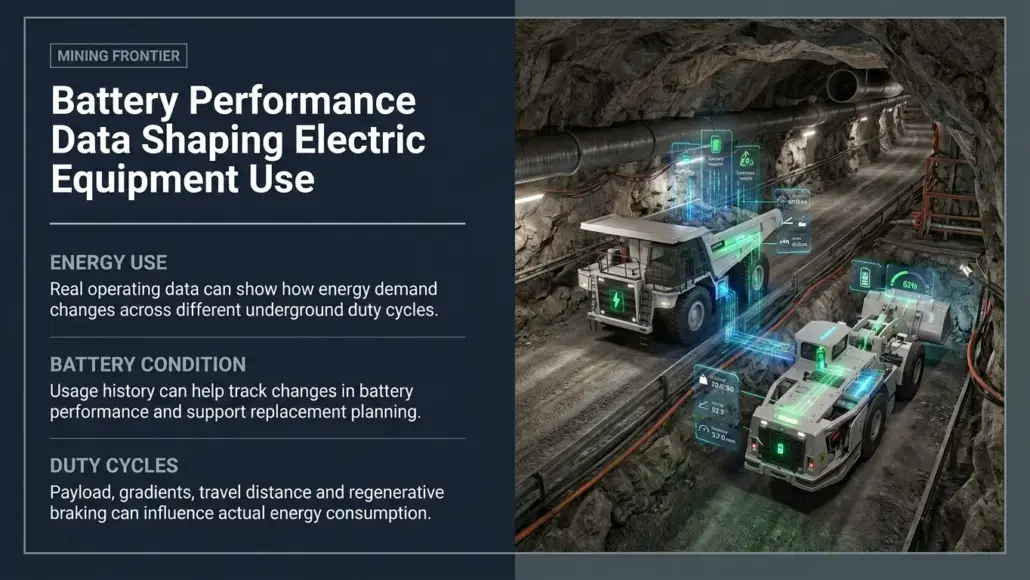

Battery performance data is becoming a more important input into underground electrification decisions as mines move from equipment trials toward longer-term fleet deployment. Manufacturer battery ratings provide a starting point, but actual energy consumption depends on operating conditions. Payload, terrain slope, travel distance, speed, drivetrain efficiency and regenerative braking can all change the energy consumed or recovered during a duty cycle.
A 2026 University of Adelaide study found that real-world performance data for underground electric haul trucks remains limited and modelled 50,000 operational scenarios using 11 variables. The research identified several factors as particularly influential:
- Terrain slope
- Vehicle mass including payload
- Travel distance
- Vehicle speed
- Drivetrain efficiency
These variables demonstrate why battery performance data needs to be assessed against the actual duty cycle of a mine rather than against battery capacity alone.
Duty Cycles Connecting Equipment Data to Mine Planning
Field testing provides further evidence of the difference between theoretical and observed performance. A 2026 study covering underground mines in the European Union and Canada compared Battery Electric Vehicles (BEVs) with diesel equipment and recorded different energy-consumption ratios across near-horizontal and inclined grades. The results highlight how haul conditions and regenerative braking can materially influence energy demand.
For mine planners, the most useful information comes from understanding how equipment performs across a complete operating cycle:
- Loading with different payloads
- Loaded travel across changing gradients
- Unloaded return travel
- Energy recovered through regenerative braking
- Energy consumed across repeated production cycles
The same type of measured information can help determine whether an electric machine can meet production requirements under a specific mine’s conditions. It can also reveal differences between expected and actual energy consumption once equipment enters regular operation.
As more machines are deployed, battery performance data can become an important bridge between equipment specifications and broader electrification decisions. Understanding how machines perform in different duty cycles can also help operators evaluate electrification across other underground equipment categories, creating a natural connection to electric drilling equipment.
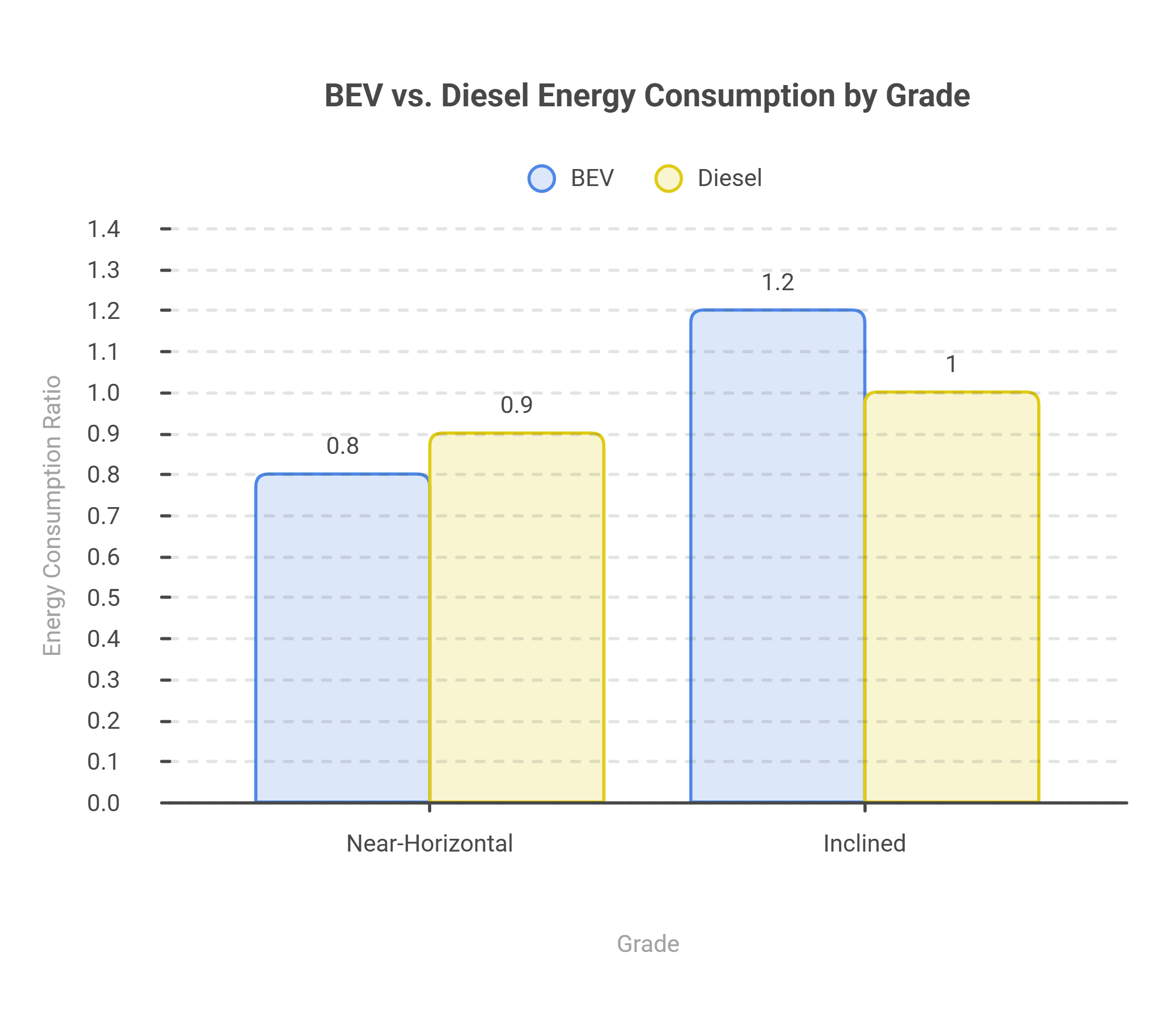
Actual duty-cycle conditions can materially change energy consumption, making measured operating performance an important input when assessing underground electric equipment.
Battery Ageing Expanding the Performance Data Requirement
The value of battery performance data extends beyond measuring energy consumed during a single production cycle. As battery-electric equipment remains in service, operators also need to understand how battery condition changes with repeated charging, discharge patterns, temperature and workload. This becomes important when estimating whether a machine can maintain its expected operating range and productivity later in its service life.
A 2026 study on underground mining electric trucks modelled battery degradation alongside battery capacity, charging rate, regenerative braking and operating conditions. The research found that battery life varied with operating strategy, with larger battery packs and lower charging power generally extending simulated battery life in the scenarios examined.
The study also reinforces the need to connect battery condition with how equipment is actually used:
- Battery size influences how deeply the pack is discharged during operations.
- Charging power affects the rate at which energy is replenished.
- Route distance changes the frequency of charging events.
- Regenerative braking can alter the energy returned to the battery.
- Repeated operating cycles contribute to battery degradation.
These relationships mean that battery performance data can help operators move from fixed assumptions about battery life toward assessments based on actual equipment usage.
Battery History Connecting Performance with Lifecycle Planning
Equipment manufacturers are also developing systems to capture battery history over time. Sandvik describes battery passports that record usage and performance information, allowing battery data to follow the asset through its operating life. The company says mining batteries typically have an operational lifespan of five to six years and that battery packs are generally considered at end of life at 80% capacity, although remaining capacity can potentially support less demanding applications or stationary storage. These are Sandvik’s stated practices rather than universal industry standards.
Data collected during operation can therefore become useful for several decisions:
- Identifying changes in usable battery capacity
- Comparing actual and expected energy consumption
- Planning battery replacement
- Assessing the effect of different duty cycles
- Evaluating potential second-life applications
Natural Resources Canada is also using Artificial Intelligence (AI) to model energy consumption, regeneration and battery performance in electric mining vehicles, citing limited real-world underground data as a reason for developing predictive tools.
As measurement systems improve, battery performance data can provide a more continuous view of how electric equipment behaves from deployment through battery replacement, rather than treating performance as a fixed specification at the time of purchase.
Battery Data Becoming Part of Electrification Planning
The growing availability of battery performance data is changing how underground operators assess electric equipment beyond its initial specifications. Measured energy consumption, duty cycles, regenerative braking, charging history and battery degradation can provide a more realistic view of how equipment performs under actual mine conditions.
This information can increasingly support:
- Equipment selection and deployment
- Operating-range assessment
- Battery replacement planning
- Production modelling
- Longer-term electrification decisions
The move toward better performance tracking also highlights a continuing industry challenge: reliable real-world datasets remain limited, particularly where manufacturers do not disclose detailed operational information. As more electric equipment enters regular service, consistent measurement can help reduce reliance on theoretical assumptions and improve mine-specific planning.
References
- An Optimization Algorithm for the Design of Battery Electric Fleets in Underground Mines
- Energy Consumption Ratio and Heat Output Comparison of Battery Electric Vehicles and Diesel-Powered Machines: Results of Field Trials in European Union and Canadian Underground Mines
- Coordinated Sizing of Battery and Charging Systems for Underground Mining Electric Trucks
- Simply Science Seconds: Artificial Intelligence Helping Scientists Understand Energy Use in Electric Mining Vehicles