












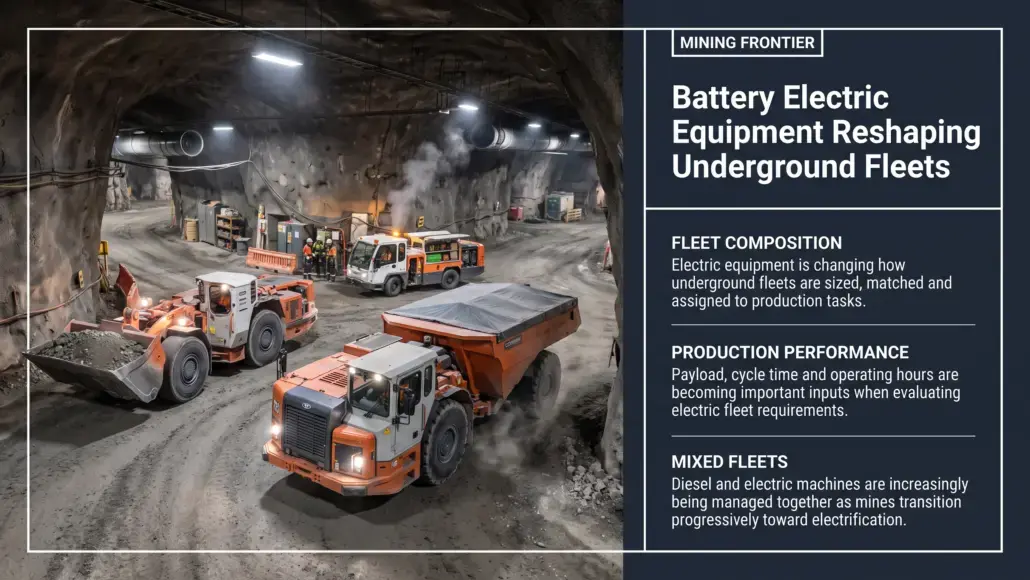

The move toward battery electric equipment is changing how underground mines approach fleet planning. Rather than replacing diesel machines with electric versions on a one for one basis, operators increasingly need to reassess equipment numbers, machine classes and production requirements around the characteristics of each site. Battery range, payload, cycle times, haul distances and productive operating hours can all influence the fleet required to maintain output.
The Global Mining Guidelines Group (GMG) identifies battery capacity, charging methods, equipment availability and utilisation as important considerations when designing battery-electric vehicle fleets. Mine-level studies are also showing that the resulting fleet can differ from its diesel equivalent.
The Cosmos Electrification Study evaluated the use of Battery Electric Vehicles (BEVs) at an underground mining operation and found that fleet configuration needed to account for:
- Equipment matching between loaders and trucks
- Battery size and operating range
- Mine depth, geometry and haul distances
- Equipment productivity and availability
- Charging or battery-swapping requirements
The study modelled an increase from three diesel loaders to four BEV loaders under its selected assumptions, illustrating that electrification can change fleet composition rather than simply change the power source.
Equipment Performance Changing Production Fleet Calculations
Productivity is another important variable because rated machine capacity does not necessarily translate directly into tonnes moved per shift. A field comparison of a battery electric equipment and diesel Load Haul Dump (LHD) machine at an underground nickel-copper mine in Ontario found that the electric machine recorded a faster gross cycle time while also carrying more material per cycle. Once charging time was included, average net cycle times were broadly comparable across the test, but the electric machine still moved more payload over the measured eight-hour period.
This means mine planners increasingly need to examine the complete operating cycle:
- Payload carried per trip
- Loading and travel time
- Haul distance and mine geometry
- Charging or battery-change downtime
- Productive hours available per shift
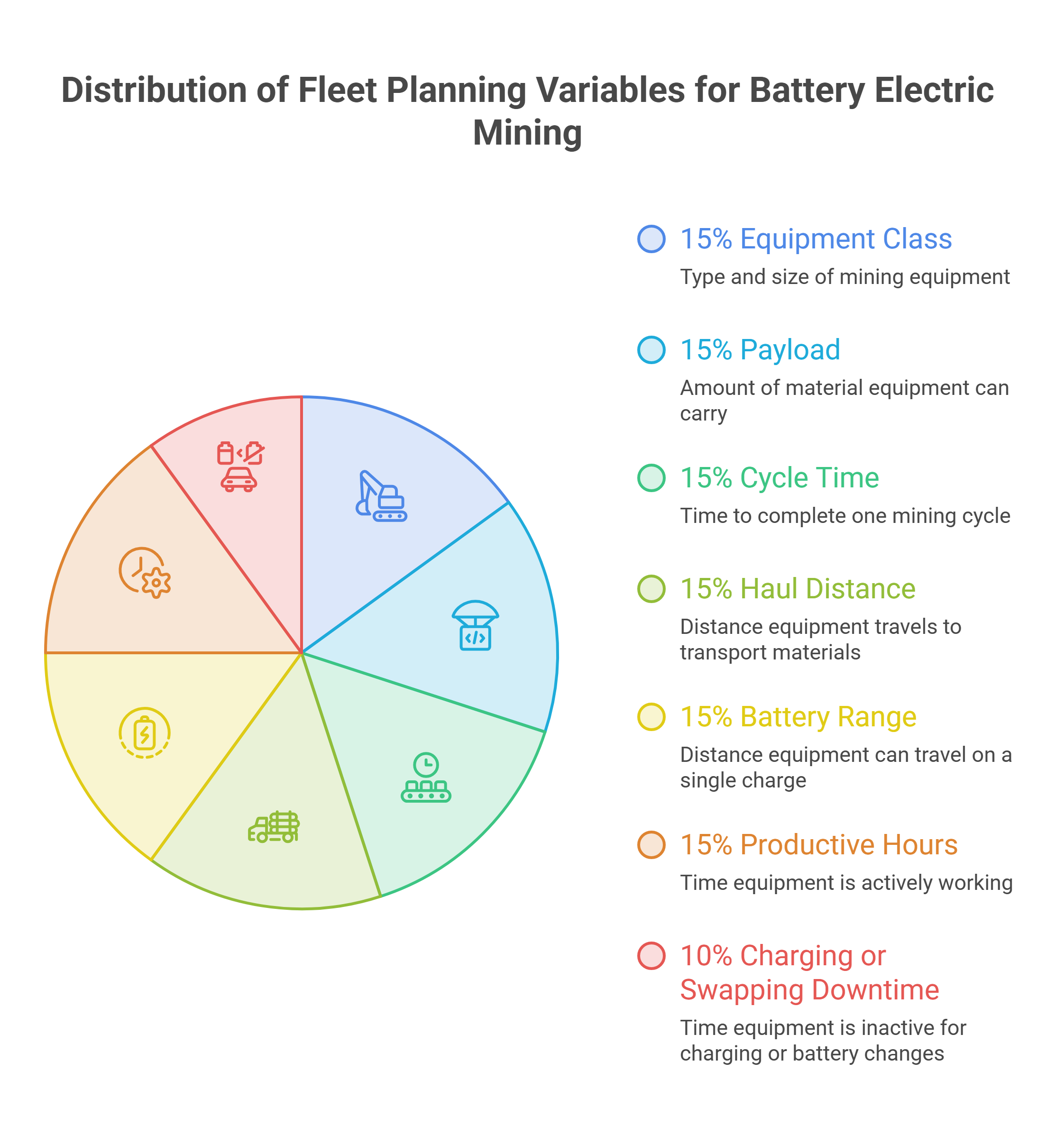
Battery-electric fleet planning requires mine-specific modelling because equipment performance, route characteristics and operating constraints can change the number and mix of machines required.
Mixed Fleets Shaping the Transition Underground
The shift toward battery-electric fleets is not happening uniformly across underground mines. Existing operations often need to introduce BEVs alongside diesel equipment, creating mixed fleets in which different machines perform different roles according to their range, payload, operating conditions and availability. This makes battery electric equipment a fleet-planning decision rather than a technology choice limited to individual machines.
Recent mine deployments show several approaches to this transition. At Hindustan Zinc’s Sindesar Khurd Mine in India, battery-electric vehicles have been introduced into an established underground operation rather than replacing the entire mobile fleet at once. At Eldorado Gold’s Lamaque Complex in Québec, the operator is expanding its BEV fleet to include both haul trucks and loaders. These examples show how battery electric equipment can be introduced progressively as operators assess performance and determine where electric machines fit most effectively within existing production systems.
The same approach can involve different levels of electrification across equipment categories:
- BEVs can be assigned first to haulage or loading activities where operating conditions are suitable.
- Diesel machines can continue serving routes or tasks where current electric capabilities are less suitable.
- Electric and diesel machines may operate within the same production cycle.
- Fleet planning may change as additional electric machines become available.
- Equipment deployment can therefore develop in stages rather than through a single fleet replacement programme.
Fleet Composition Expanding Across Equipment Classes
Newer projects are also demonstrating that battery electric equipment can extend beyond a small number of haul trucks or loaders. Glencore’s Onaping Depth project in Canada is being developed around an all-battery-electric fleet covering production and support activities, while South32’s Hermosa project includes battery-electric trucks, loaders, bolters and drilling equipment alongside conventional machines.
This broader deployment changes how fleet planners evaluate equipment compatibility and production matching. A mine may need to determine whether electric loaders can maintain loading rates required by the haulage fleet, whether different machine classes can be scheduled effectively across shifts, and how the introduction of electric units affects the availability of conventional equipment.
Supplier deployment data also indicates that the market is moving across multiple underground equipment categories. Epiroc reported more than 600 electric drill rigs, loaders and mining trucks in its fleet by the end of 2025, with equipment ordered by 40 mine sites. While this is company-reported data, it indicates that electrification is increasingly being evaluated across a wider range of underground fleet requirements rather than being limited to isolated trials.
Fleet Design Becoming Central to Underground Electrification
The transition to electric underground mining is increasingly influencing how operators plan entire fleets rather than individual machines. Battery electric equipment introduces different considerations around payload, cycle times, mine geometry, operating range and equipment availability, making fleet configuration increasingly dependent on site-specific production requirements.
The experience from operating mines and new projects also shows that electrification can follow different pathways. Some operations are introducing electric machines alongside diesel units, while newer developments are considering wider deployment across production and support activities. This allows mine planners to assess equipment performance and fleet requirements progressively as operating data becomes available.
As electrification expands, fleet planning will increasingly need to connect equipment selection with the wider infrastructure and operating systems required to keep machines productive throughout each shift. This makes charging requirements for underground fleets a natural next consideration as operators plan the infrastructure supporting electric fleets.
References
- Recommended Practices for Battery Electric Vehicles in Underground Mining – Version 3
- Lessons from the Cosmos Electrification Study
- Comparison of Heat, Noise and Ore Handling Capacity of Battery-Electric versus Diesel LHD
- Safe, Inclusive and Innovative Operations
- Glencore Canada’s Onaping Depth Project Meets Key Milestones on the Path to Production
- Sandvik Wins Record Order for Battery-Electric Mining Equipment
- Epiroc – Annual and Sustainability Report 2025