












The journey from a raw copper cathode to a high-precision industrial component is a series of complex physical transformations. Whether the end product is a seamless tube for a cooling system, a busbar for a power plant, or a micro-thin foil for a battery, the margin for error is shrinking every year. In this high-stakes environment, traditional manual inspection methods are no longer sufficient. The industry has turned to a new paradigm: digital quality control in modern copper fabrication. This Mining Frontier identifies this shift involves the integration of high-resolution sensors, automated optical inspection (AOI), and data-driven feedback loops that monitor the manufacturing process in real-time. By catching defects at the source and ensuring that every millimeter of material meets exact specifications, manufacturers can drastically reduce scrap rates, improve safety, and deliver products that are perfectly suited for their intended applications.
The Evolution from Manual to Digital Inspection
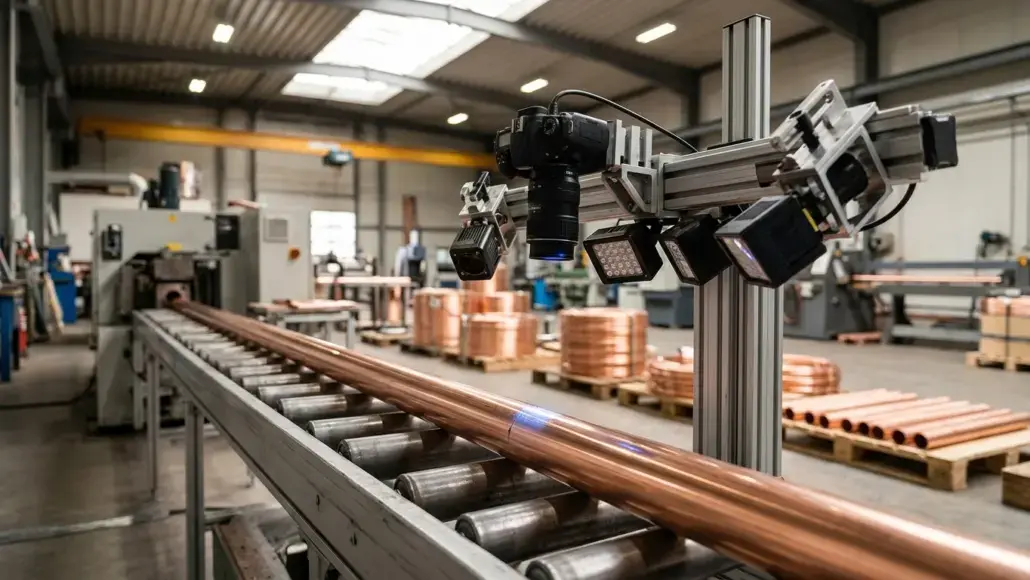
Historically, quality control in a copper mill or fabrication shop relied heavily on the eyes and hands of experienced craftsmen. An inspector might check the surface of a copper sheet for blemishes or use a micrometer to measure the thickness of a tube at several points along its length. While these methods served the industry well for decades, they are inherently limited by human subjectivity and the physical impossibility of 100% inspection at high production speeds. Digital quality control in modern copper fabrication has changed this by automating the data collection process. Instead of periodic checks, every inch of the product is now scanned by lasers or high-speed cameras as it moves through the production line. This continuous monitoring ensures that even the smallest deviation from the required standard is immediately detected and logged.
Automated Optical Inspection (AOI) and Surface Quality
One of the most critical aspects of copper fabrication is surface integrity. Even a tiny scratch or inclusion can become a point of failure in a high-pressure tube or a high-voltage electrical component. Modern fabrication lines now utilize AOI systems equipped with multi-angle lighting and high-definition cameras. These systems use artificial intelligence to distinguish between harmless surface variations and actual defects like pitting, slivers, or oxidation. The implementation of digital quality control in modern copper fabrication means that if a defect is found, the system can automatically mark the section of material for removal or, in some cases, adjust the upstream machinery to correct the issue that caused the defect in the first place.
Precision Metrology and Dimensional Accuracy
For components used in the aerospace and electronics industries, dimensional accuracy is measured in microns. Copper’s ductility makes it a challenging material to fabricate to such tight tolerances, as it can easily deform under pressure. Digital quality control in modern copper fabrication addresses this through the use of non-contact metrology tools. Laser micrometers and ultrasonic thickness gauges can measure the dimensions of a moving product without ever touching its surface. This data is fed directly into a statistical process control (SPC) software, which analyzes trends in real-time. If the software detects that a dimension is drifting toward the edge of the allowed tolerance, it can trigger an automated adjustment in the rolling or drawing equipment, ensuring that the process stays “centered” and reducing the volume of out-of-spec material.
Eddy Current Testing and Subsurface Integrity
Not all defects are visible on the surface. For copper tubing and wire used in critical heat exchange and power transmission roles, internal integrity is paramount. Eddy current testing (ECT) has become a staple of digital quality control in modern copper fabrication. This electromagnetic technique can detect internal cracks, voids, or changes in material composition that would be invisible to a camera. In a modern setup, the ECT probe is integrated into the production line, providing a digital “map” of the internal structure of the material. This data is archived alongside the production records, providing a complete “birth certificate” for every batch of material produced, which is increasingly required for compliance with international safety and quality standards.
The Power of Data Analytics and Machine Learning
The “digital” in digital quality control refers not just to the hardware but to the sophisticated software that interprets the sensor data. Machine learning algorithms are now being used to predict when a fabrication process might fail. By analyzing months of production data, these systems can identify the subtle combinations of temperature, speed, and material composition that lead to defects. This move from reactive inspection to proactive process management is the hallmark of digital quality control in modern copper fabrication. It allows plant managers to optimize their operations for the highest possible yield, knowing that the digital “eyes” of the system will prevent any sub-par material from reaching the customer.
Traceability and the Digital Thread
In today’s global supply chain, traceability is a non-negotiable requirement. Customers want to know exactly where their copper came from and how it was processed. Digital quality control systems provide the foundation for this “digital thread.” By tagging every coil or bundle with a unique digital ID, manufacturers can link every quality measurement, every process parameter, and even the chemical analysis of the original melt to the final product. This level of transparency builds trust with high-value customers in the automotive and medical device sectors. If a problem is ever discovered in the field, the manufacturer can quickly use their digital records to identify the specific production window and batch affected, limiting the scope of any potential recalls.
Improving Sustainability through Precision
One of the often-overlooked benefits of digital quality control in modern copper fabrication is its impact on sustainability. Copper is an energy-intensive material to produce and process. When a large section of material is rejected due to a quality issue, all the energy used to melt, cast, and fabricate that section is effectively wasted. By improving the “first-time-right” ratio, digital systems directly reduce the carbon footprint of the fabrication process. Furthermore, by ensuring that products are of the highest possible quality, manufacturers can design components that are more efficient and have longer service lives, further contributing to a more sustainable and circular economy for this essential metal.
Integration Challenges and the Future of Quality
The transition to a fully digital quality control environment is a significant undertaking. It requires not only a large investment in technology but also a shift in organizational culture. Workers who previously relied on their intuition must now learn to trust and interpret complex data visualizations. There is also the challenge of data management; the sheer volume of information generated by high-speed sensors can be overwhelming. However, as cloud computing and edge processing become more affordable, these hurdles are being cleared. The future of digital quality control in modern copper fabrication will likely involve even more integration, with systems that can autonomously “self-heal” by adjusting their own parameters based on real-time quality feedback, leading to a truly autonomous fabrication environment.
Conclusion: Setting a New Standard for Excellence
As the world’s reliance on copper continues to grow, particularly in the context of the global energy transition, the quality of that copper becomes a matter of strategic importance. Digital quality control in modern copper fabrication is no longer a luxury for top-tier manufacturers; it is a fundamental requirement for staying competitive in a global market. By embracing the precision, speed, and transparency of digital tools, the copper fabrication industry is setting a new standard for excellence. Mining Frontier highlights that these technologies ensure that the copper components powering our cars, our homes, and our digital lives are built to the highest possible standards of reliability and efficiency, paving the way for a more technologically advanced and sustainable future.