









The global demand for copper is at an all-time high, but the traditional method of extracting it from the earth is facing significant headwinds. Declining ore grades, increasing environmental regulations, and the sheer energy required to mine deeper into the crust are pushing the industry toward a more sustainable model. This is where secondary copper recovery from global industrial scrap emerges as a critical pillar of the modern metallurgical industry. Unlike primary mining, which involves extracting metal from raw ore, secondary recovery focuses on reclaiming copper from end-of-life products, manufacturing waste, and obsolete infrastructure. This “urban mining” not only conserves natural resources but also utilizes significantly less energy than primary production. As the world moves toward a circular economy, Mining Frontier highlights responsible sorting, refining, and reusing of industrial copper scrap as a vital component of the global supply chain, ensuring that this essential metal remains available for the green energy revolution.
The Economic and Environmental Case for Recycling
The shift toward secondary copper recovery from global industrial scrap is driven by both ecological necessity and clear economic benefits. Copper is one of the few materials that can be recycled infinitely without any loss of performance or purity. This makes it a perfect candidate for a closed-loop system. From an environmental perspective, every ton of copper recovered from scrap prevents the displacement of hundreds of tons of earth and reduces the carbon footprint associated with smelting raw concentrates. Economically, recycling provides a buffer against the volatility of the primary mining market. By developing robust domestic recycling capacities, nations can reduce their reliance on imported ores and protect their industries from geopolitical disruptions. The recovery of copper from high-grade industrial scrap is essentially a way to “re-mine” the materials that have already been processed, significantly shortening the supply chain.
Sources of Industrial Copper Scrap
To understand the scale of secondary copper recovery from global industrial scrap, one must look at the diversity of its sources. Industrial scrap is generally categorized into two types: “new scrap” and “old scrap.” New scrap, also known as prompt scrap, is generated during the manufacturing process itself—such as the clippings, turnings, and stampings from a fabrication plant. This material is typically of known purity and can be quickly returned to the furnace. “Old scrap,” or end-of-life scrap, comes from products that have reached the end of their service life, such as decommissioned electrical transformers, salvaged wiring from demolished buildings, and obsolete industrial machinery. Reclaiming copper from these complex assemblies requires a sophisticated infrastructure for collection, disassembly, and processing, but it represents a massive untapped reservoir of high-value material.
Advanced Technologies in Scrap Sorting and Processing
The biggest challenge in secondary copper recovery from global industrial scrap is the separation of copper from other materials like steel, aluminum, and plastics. Traditional manual sorting is slow and often inaccurate. Today, the industry is being revolutionized by automated sorting technologies. X-ray fluorescence (XRF) and Laser-Induced Breakdown Spectroscopy (LIBS) are now used to identify the chemical composition of scrap pieces in milliseconds as they move along a conveyor belt. High-speed air jets or robotic arms then sort the pieces into different bins based on their alloy type and purity. These technologies allow recyclers to process massive volumes of mixed scrap with high precision, ensuring that the resulting copper “feed” is of a high enough quality to be used in demanding applications like electronics or automotive wiring.
Refining and Smelting Secondary Copper
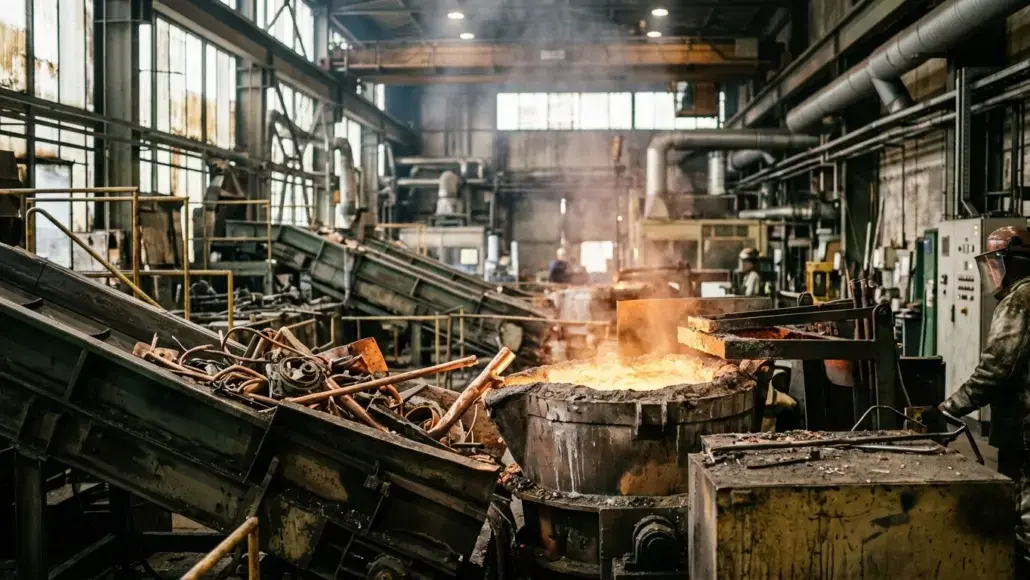
Once sorted, the scrap must be refined to remove impurities and restore it to its high-purity state. Depending on the quality of the scrap, this can involve several stages of smelting and electrolytic refining. In a secondary smelter, the copper scrap is melted down and treated with oxygen or fluxes to remove alloying elements like zinc or tin. The resulting “blister copper” is then cast into anodes and sent for electro-refining, where it is dissolved in an acid bath and redeposited as 99.99% pure copper cathodes. This process of secondary copper recovery from global industrial scrap ensures that the recycled metal is indistinguishable from its primary-mined counterpart, making it suitable for even the most sensitive high-tech components.
The Role of the Circular Economy in Global Policy
Governments and international bodies are increasingly recognizing that secondary copper recovery from global industrial scrap is essential for meeting climate goals. Policies such as the European Union’s Circular Economy Action Plan and similar initiatives in North America and Asia are creating incentives for companies to design products with recyclability in mind. This includes “design for disassembly,” where products are built to be easily taken apart at the end of their life, and the implementation of “digital product passports” that track the material composition of a component throughout its lifecycle. By creating a regulatory environment that favors recycled materials, policymakers are helping to scale the infrastructure needed for a truly circular copper economy.
Challenges in the Global Scrap Trade
While the benefits are clear, the international trade of copper scrap is fraught with complexity. Some nations have implemented strict bans on the import of certain types of scrap to prevent becoming “dumping grounds” for low-quality waste. These regulations, while aimed at environmental protection, can sometimes disrupt the flow of high-value secondary copper recovery from global industrial scrap to the regions that have the most advanced refining facilities. Furthermore, the lack of standardized global classifications for scrap can lead to disputes and delays at customs. Improving international cooperation and harmonizing standards for metal scrap is a key step toward creating a more efficient and transparent global recycling market.
Urban Mining and the Future of Mineral Security
The concept of “urban mining” is gaining traction as cities are recognized as massive repositories of copper. The thousands of miles of copper pipe and wire buried under our streets and within our buildings represent a strategic reserve that can be tapped as infrastructure is modernized. Integrating secondary copper recovery from global industrial scrap into urban planning and demolition practices is becoming a priority for sustainable city management. By viewing waste as a resource rather than a liability, municipalities can generate revenue while contributing to the global supply of critical minerals. This localized source of copper provides a level of mineral security that is immune to the geopolitical risks associated with primary mining in distant or unstable regions.
Innovation in Secondary Recovery Techniques
Looking to the future, research is focused on developing even more efficient ways to recover copper from complex “e-waste.” This includes hydrometallurgical processes that use chemical solutions to dissolve copper from printed circuit boards at low temperatures, which is much more energy-efficient than traditional smelting. Other innovations involve the use of specialized microbes in “bio-leaching” to extract copper from low-grade scrap piles. These cutting-edge methods of secondary copper recovery from global industrial scrap promise to expand the range of materials that can be economically recycled, moving us closer to a future where every gram of copper is tracked, recovered, and returned to the production cycle.
Conclusion: Closing the Loop for a Greener World
The transition to a sustainable, electrified future is impossible without a robust and efficient copper industry. While primary mining will remain necessary to meet the massive surge in demand, it must be supplemented and eventually balanced by a world-class recycling infrastructure. Secondary copper recovery from global industrial scrap is the key to decoupling industrial growth from environmental degradation. Mining Frontier notes that by embracing advanced sorting technologies, fostering international trade cooperation, and designing products for a circular lifecycle, humans can ensure that the copper that powers our world today will continue to do so for generations to come. The “red metal” has served humanity for thousands of years. And through secondary recovery, one can ensure its legacy continues in a cleaner, more sustainable 21st century.