

























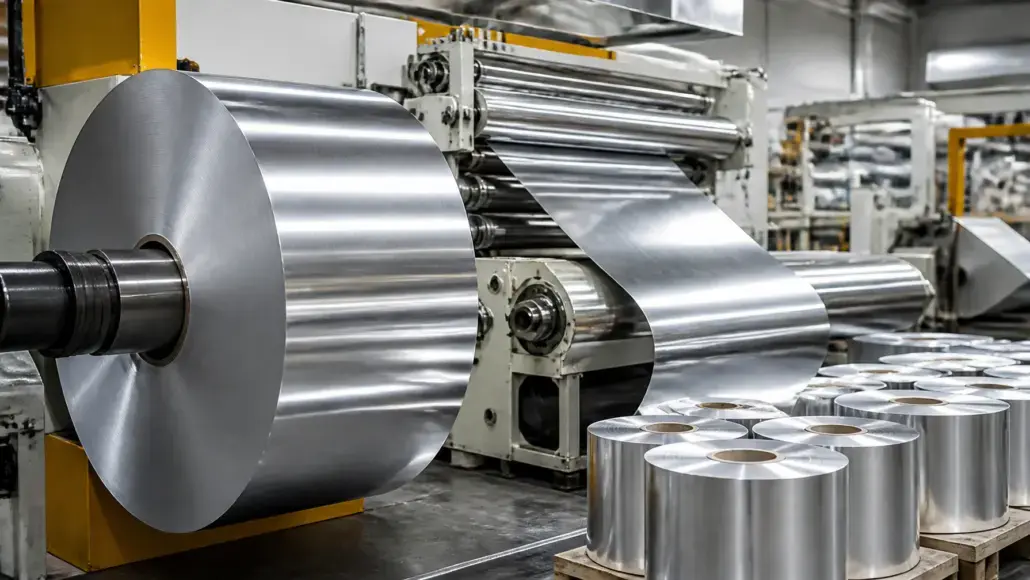

Packaging remains one of the most important end-use markets for aluminium foil, supported by demand for food, beverages, pharmaceuticals and other products that require protection from moisture, oxygen, light and contamination. The material’s combination of barrier performance, low weight, thermal resistance and formability has allowed foil to retain an important role even as packaging manufacturers pursue lower material use and alternative formats. This is strengthening the case for aluminium foil production as packaging requirements continue to evolve.
The scale of the market is significant. Packaging accounted for an estimated 66.6% of global aluminium foil market revenue in 2025, according to Grand View Research. The estimate is based on the wider aluminium foil market rather than physical production volumes, but it underlines the importance of packaging as the industry’s dominant demand segment.
Recent industry data also points to a recovery in foil deliveries, although the improvement has not been uniform. European Aluminium Foil Association data shows that total foil deliveries reached approximately 920,400 tonnes in 2025, an increase of 3.1% from 2024. Growth was strongest at the beginning of the year, with first-quarter deliveries increasing by 10.0% year on year, before slowing to 4.1% in the second quarter and 2.2% in the third quarter. Fourth-quarter deliveries subsequently declined.
Food and Pharmaceutical Packaging are Supporting Demand
Food and beverage applications are central to this demand because packaging must often protect products throughout transport, storage and preparation. Aluminium foil can provide an effective barrier against light, oxygen and moisture, while also supporting applications involving heat sealing, cooking, sterilisation and retort processing. These characteristics make it relevant to products ranging from prepared foods and confectionery to dairy products and beverages.
Pharmaceutical packaging provides another important application. Foil is widely used in blister packs, strip packs and laminate structures because its barrier properties can help protect medicines from moisture, light and oxygen. Market forecasts suggest pharmaceutical foil packaging could record faster growth than the broader foil packaging market, although such projections should be viewed as directional rather than definitive.
The combination of these applications means aluminium foil production is being supported by several packaging requirements rather than a single consumption trend. Changes in food consumption, convenience formats, medicine distribution and product shelf-life requirements can each influence demand for different grades and forms of foil.
Lightweighting is Changing Foil Requirements
The packaging opportunity is also increasingly linked to material efficiency. Aluminium foil can be manufactured at very low thicknesses, with some applications using foil as thin as approximately 6 microns. Reducing gauge can lower material consumption and packaging weight, but it places greater demands on rolling accuracy, alloy performance and manufacturing consistency.
This creates an important distinction between growth in packaging volumes and growth in aluminium consumption. Packaging demand can expand while manufacturers simultaneously seek to use less aluminium per package. For foil producers, maintaining performance at lower gauges therefore becomes an important competitive requirement.
Recent European data illustrates how varied the market can be. In the second quarter of 2026, total foil deliveries by EAFA members reached around 238,000 tonnes, only 0.6% higher year on year, while first-half deliveries remained 3.0% below the corresponding period of 2025. At the same time, foil between 61 and 200 microns increased by more than 8% during the quarter, indicating stronger demand in some thicker-gauge applications.
The market is therefore not simply expanding in volume. aluminium foil production is increasingly being shaped by differences in packaging formats, gauge requirements and product performance. As packaging manufacturers look for lighter materials without sacrificing protection, aluminium foil production will increasingly depend on the ability to deliver consistent performance with greater material efficiency.
Foil Production is Evolving Around Efficiency and Circularity
The packaging market is creating a more demanding environment for aluminium foil producers. Growth is increasingly being shaped not only by the amount of packaging entering the market, but also by requirements for thinner gauges, consistent barrier performance, efficient material use and improved recyclability. This is making aluminium foil production increasingly dependent on manufacturing precision and the ability to adapt output to different packaging applications.
Recent industry data shows why product mix matters. Aluminium foil deliveries by European Aluminium Foil Association members reached around 238,000 tonnes in the second quarter of 2026, up 0.6% year on year. However, the performance varied significantly by foil thickness. Deliveries of foil below 60 microns, used primarily in flexible packaging and household applications, remained slightly lower, while foil between 61 and 200 microns increased by more than 8%. Packaging volumes overall remained broadly stable.
This divergence points to a more segmented market for aluminium foil production. Producers cannot rely solely on overall packaging growth to determine future demand. Changes in food formats, pharmaceutical packaging, flexible laminates and semi-rigid containers can affect requirements for different gauges, alloys and surface characteristics.
Down-Gauging is Raising Manufacturing Requirements
Packaging manufacturers continue to look for ways to reduce material use without losing the barrier and mechanical properties required by individual applications. Aluminium foil can be manufactured at very low thicknesses, making down-gauging an important route toward lighter packaging.
However, thinner material also increases the importance of production control. Maintaining consistent thickness, surface quality and mechanical properties becomes more demanding as the gauge decreases. For foil producers, this places greater emphasis on rolling precision, process stability and quality control throughout the production cycle.
The opportunity is therefore not simply to sell more tonnes. A producer able to manufacture thinner foil reliably can potentially support packaging designs that use less material while still meeting performance requirements. This makes manufacturing capability an increasingly important part of the commercial case for aluminium foil production.
Circularity is Becoming Part of the Production Equation
Recycling is adding another layer to the market outlook. Aluminium can be recycled repeatedly, and producing recycled aluminium requires substantially less energy than producing primary metal. European Aluminium estimates that recycling aluminium requires about 5% of the energy needed for primary production.
Packaging regulations are also increasing pressure on the wider system. The Packaging and Packaging Waste Regulation began applying from 12 August 2026 and establishes requirements covering packaging design, composition, recyclability and waste management. The European Commission says the framework is intended to increase the use of secondary raw materials and make all packaging recyclable in an economically viable way by 2030.
For foil producers, this changes the relationship between production and recycling. Greater recovery of aluminium packaging can create a larger pool of secondary material, while improved sorting and processing can support more circular supply chains. The challenge is that not every foil-containing package is equally easy to recover. Multilayer structures that combine aluminium with plastic or paper can complicate collection and separation, particularly when small quantities of foil are dispersed across consumer waste streams.
This means recyclability increasingly depends on packaging design as well as the material itself. Producers may need to work with converters and packaging manufacturers to support structures that maintain foil’s barrier performance while improving end-of-life recovery.