

























The aerospace industry is entering a period of sustained aircraft demand, creating long-term requirements for lightweight and high-performance structural materials. Commercial aircraft fleets are expected to expand significantly over the next two decades as passenger traffic grows and older aircraft are replaced with more efficient models. This creates an important market opportunity for aerospace aluminium products, particularly where manufacturers require materials that combine low weight, strength, durability and predictable performance.
The scale of expected aircraft demand is substantial. The latest Airbus global market forecast projects demand for 43,420 new passenger and freighter aircraft between 2025 and 2044. Of this total, around 34,250 aircraft are expected to be single-aisle models and 9,170 widebody aircraft. The forecast also includes approximately 18,930 aircraft required to replace older aircraft, showing that replacement activity will represent a significant share of future deliveries.
This replacement cycle is important for aluminium producers because the aerospace sector places greater emphasis on weight reduction as aircraft are redesigned. Lower structural weight can contribute to fuel efficiency and operating performance, increasing the importance of materials that provide high strength without adding unnecessary mass.
Aluminium Remains Important Despite Greater Composite Use
The growing use of composite materials has changed aircraft material mixes, but aluminium remains an important structural material. Research on aerospace aluminium alloys indicates that aluminium can account for around 60% to 80% of the mass of a typical commercial aircraft, although the proportion varies significantly according to aircraft design and generation.
Several aluminium alloy families continue to serve demanding aerospace applications. 2xxx-series alloys are widely associated with structural applications requiring fatigue performance, while 7xxx-series alloys offer higher strength for highly loaded components. Aluminium-lithium alloys provide another route to reducing weight because lithium can lower density while increasing stiffness.
This means aircraft production is not simply creating more demand for standard aluminium. It is supporting demand for materials developed around specific combinations of strength, weight, fatigue resistance and corrosion performance.
The distinction is becoming increasingly important as aircraft designers seek to improve efficiency without compromising structural integrity. A material that offers higher tensile strength but performs poorly against fatigue or corrosion may not provide a practical aerospace advantage. Consequently, alloy development is increasingly focused on achieving several properties simultaneously.
Lightweighting is Increasing the Value of Material Performance
Research into advanced aerospace aluminium shows how closely lightweighting is connected to material development. NASA research on aluminium-lithium alloys indicates that adding lithium can reduce alloy density by approximately 3% for every 1 wt% increase in lithium, while increasing elastic modulus by around 6%. These characteristics can make aluminium-lithium systems attractive where reducing structural weight and increasing stiffness are important design objectives.
At the same time, the aerospace sector requires materials to perform consistently throughout long service lives. Components can experience repeated loading, temperature changes, corrosion exposure and other demanding conditions. This raises the importance of microstructure, heat treatment and manufacturing consistency alongside nominal alloy strength.
For aluminium producers and downstream processors, aerospace demand can therefore influence both volume and product complexity. The opportunity lies in supplying materials that meet increasingly specific performance requirements rather than simply increasing tonnes of conventional products.
The continuing expansion of aircraft fleets is likely to reinforce this trend. As the aerospace industry balances new aircraft production, replacement demand and ongoing lightweighting, the importance of specialised aerospace aluminium products is likely to increase alongside overall aluminium consumption.
Higher Specifications are Changing Aluminium Product Requirements
Growing aircraft demand is increasing the importance of aluminium products that can meet more demanding structural and performance requirements. The aerospace sector continues to use aluminium because of its combination of low density, strength, workability and corrosion resistance, but material selection is becoming more application-specific. Rather than treating aluminium as a uniform commodity, aerospace manufacturers increasingly require different alloy systems and product forms for components exposed to different loads and operating conditions. This is strengthening demand for aerospace aluminium products with tightly controlled mechanical and metallurgical properties.
The 2xxx and 7xxx alloy families remain particularly important. Research on aircraft structures identifies 2xxx alloys as suitable for fatigue-critical applications because of their damage tolerance, while 7xxx alloys are generally selected where high strength is a priority. Aluminium-lithium alloys occupy another important position where low density and high stiffness are required. High-performance 2xxx and 7xxx alloys have been reported to account for more than 70% of structural aluminium use in aircraft.
Alloy Development is Moving Beyond Strength Alone
The development of newer aerospace aluminium alloys reflects a broader change in performance requirements. A 2026 review of ultra-high-strength aluminium alloys reports that tensile strength in advanced aerospace systems has progressed from roughly 500 MPa to above 700 MPa. However, the research also highlights a shift away from strength maximisation alone toward balancing strength with ductility and damage tolerance.
This is significant because aerospace components operate under repeated mechanical loads and demanding environmental conditions. A material must withstand fatigue, crack growth and corrosion while retaining its structural performance over a long service life. Research into 7xxx alloys identifies stress-corrosion resistance, fracture toughness and fatigue performance as important alongside static strength. Heat treatment, alloy composition and microstructure therefore become central to final product performance.
The result is a more technically demanding market for aerospace aluminium products. Producers must control not only the chemistry of the alloy, but also the processing route used to achieve the required properties. Rolling, extrusion, forging, solution treatment, quenching and ageing can all influence the resulting microstructure and mechanical behaviour.
Aluminium-Lithium is Supporting Further Lightweighting
Aluminium-lithium alloys illustrate how the industry is pursuing additional weight reduction without abandoning aluminium altogether. Research has established that lithium additions can reduce density while increasing stiffness, making these alloys attractive for aerospace structures where weight and rigidity are critical design considerations.
The appeal is particularly strong as aircraft manufacturers seek incremental efficiency improvements. Even relatively small reductions in structural mass can become significant when applied across large aircraft structures and fleet production volumes. However, the benefits of Al-Li alloys must be balanced against challenges involving processing, mechanical performance and commercial availability.
The development of these materials also illustrates why higher-specification aluminium can command greater technical requirements. Producing an alloy with a targeted combination of strength, stiffness and density is only part of the challenge. The final product must also maintain consistent properties across large batches and different product forms.
Manufacturing Control is Becoming More Important
Aerospace requirements extend throughout the production process. The relationship between alloy composition, processing conditions, microstructure and final properties means that product quality depends on controlling multiple manufacturing stages rather than relying solely on final inspection. Research into advanced 7xxx alloys identifies optimisation of composition and heat-treatment processes as important pathways toward improving the balance between strength, toughness and corrosion resistance.
This places greater emphasis on process capability, traceability and quality assurance. For producers, supplying aerospace-grade aluminium is therefore increasingly about demonstrating repeatable performance rather than simply meeting a nominal alloy specification.
Certification also creates a significant barrier to rapid material substitution. Aerospace materials must demonstrate predictable behaviour across manufacturing and service conditions, while suppliers need processes capable of consistently reproducing qualified properties. Research into aerospace Al-Li applications identifies certification and commercial availability among the factors that can limit broader adoption.
The same issue applies to recycling. Aluminium can be recycled, but aerospace scrap contains multiple alloy compositions and material specifications. Research into closed-loop aerospace aluminium recycling highlights alloy composition as a major reason why existing scrap streams can be difficult to return directly to high-value aerospace applications.
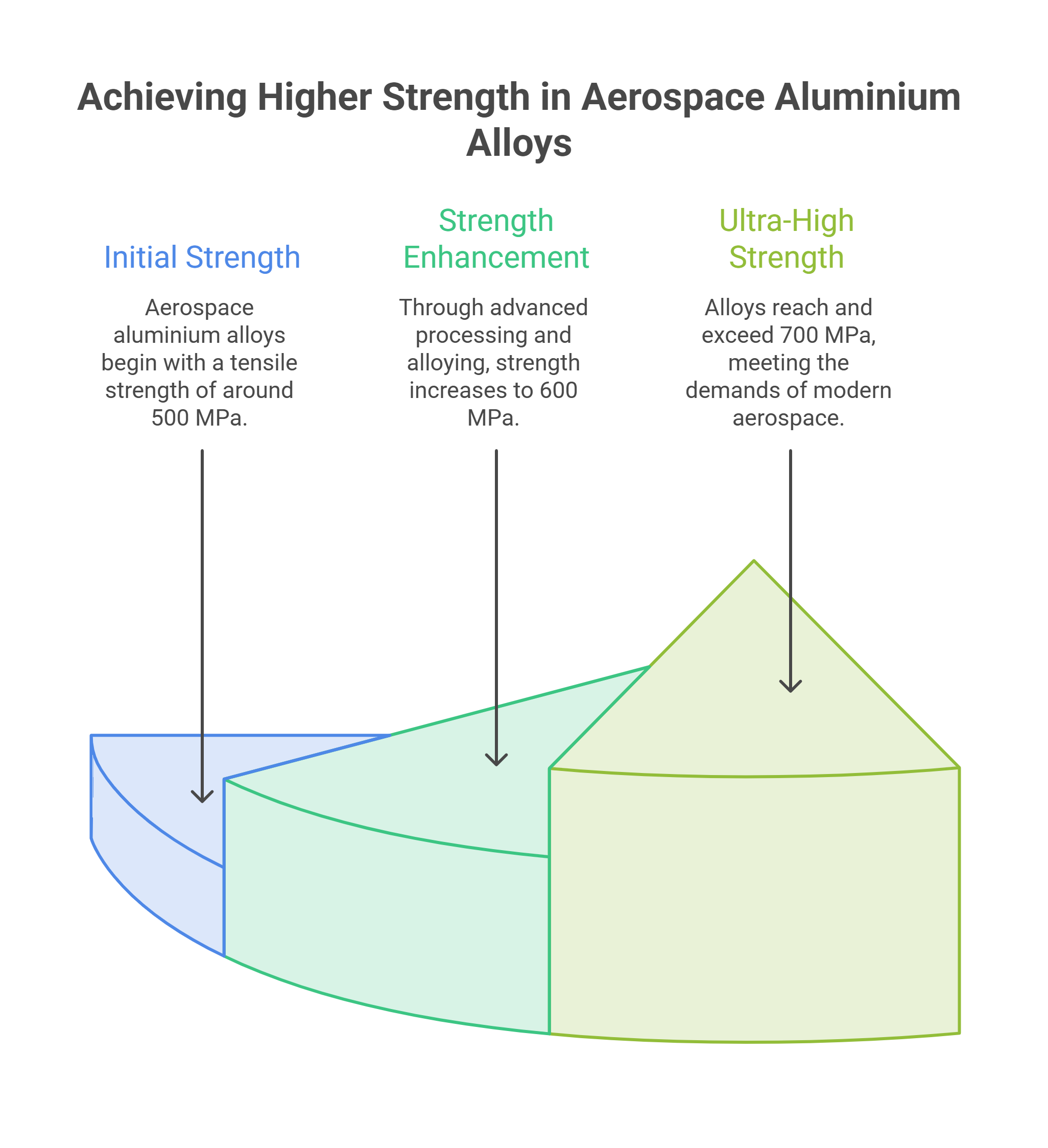
Key Takeaway: Aerospace aluminium development is moving toward higher strength while maintaining ductility and damage tolerance, increasing the technical requirements placed on aluminium products.
As aerospace applications become more demanding, aerospace aluminium products are increasingly defined by the combination of properties they can deliver rather than by alloy grade alone. This is raising the importance of advanced alloy development, precise processing, heat treatment, quality control and certification across the aluminium value chain.
Aerospace Demand is Raising the Value of Material Performance
Aerospace demand is creating a market opportunity for aluminium that is increasingly defined by performance rather than volume alone. Aircraft lightweighting, structural durability and efficiency requirements are raising the need for alloys and product forms that can deliver specific combinations of strength, low density, fatigue resistance and corrosion performance.
For aluminium producers and processors, this places greater importance on alloy development, process control, certification and consistent quality. The ability to manufacture specialised material at scale while maintaining tightly controlled properties could become increasingly important as aircraft production and fleet replacement continue.
The aerospace market is therefore strengthening demand for higher-value aluminium applications alongside overall material consumption. Aerospace aluminium products are likely to become increasingly differentiated by their technical performance, manufacturing precision and ability to meet demanding aerospace specifications.