














Close
2026 Taiwan Int'l Tools & Hardware Expo x Int'l Hardware Expo Taiwan (TiTE x IHT)

Renewable Energy Expansion Driving New Aluminium Demand

Note* - All images used are for editorial and illustrative purposes only and may not originate from the original news provider or associated company.

Related stories

A Tightening Global Aluminium Market Reshaping Producer Strategies

The global aluminium market is entering a period in...

Construction Demand Reshaping the Aluminium Extrusion Market

Construction remains the largest application for aluminium extrusion, giving...

Recovery is Becoming a Bigger Mining Value Lever

Mining companies have traditionally looked for value by increasing...

The rapid expansion of renewable energy is creating a growing source of demand for aluminium across power generation, electricity networks and supporting infrastructure. Solar photovoltaic systems, wind installations, transmission equipment and energy-storage applications use aluminium in different forms, linking the growth of clean-energy infrastructure directly with the aluminium value chain. As investment in renewable capacity continues to rise, Renewable energy aluminium demand is becoming an increasingly important factor in the industry’s long-term consumption outlook.

The scale of renewable deployment provides a clear indication of the potential opportunity. Global renewable power capacity increased by 585 GW in 2024, taking total installed renewable capacity to 4,448 GW. Renewables accounted for 92.5% of total power-capacity additions during the year. Solar capacity increased by 451.9 GW, while wind capacity increased by 113.2 GW. Together, solar and wind accounted for 96.6% of net renewable additions in 2024, reinforcing their position as the main sources of new renewable generation capacity. According to the International Renewable Energy Agency, the world added more renewable capacity in 2024 than in any previous year.

Solar Expansion is Increasing Aluminium Requirements

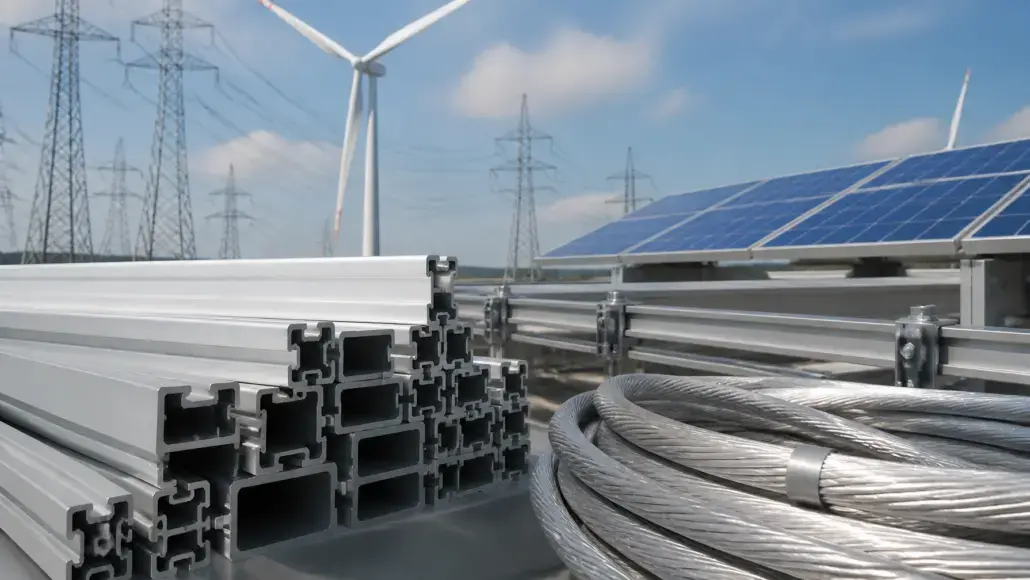
Solar power is particularly important to aluminium demand because the metal is widely used in photovoltaic module frames and mounting structures. Its combination of relatively low weight, corrosion resistance, durability and ease of fabrication makes it suitable for equipment exposed to outdoor operating conditions over long periods.

The aluminium requirement from solar is already substantial. The International Aluminium Institute estimates that the photovoltaic sector consumed around 8 million tonnes of aluminium in 2024. Its analysis estimates aluminium requirements of approximately 21 tonnes per MW for utility-scale photovoltaic systems and around 37 tonnes per MW for distributed photovoltaic systems, although actual requirements vary according to system design, mounting technology and material choices.

These figures show how continued solar deployment can strengthen renewable energy aluminium demand across the downstream aluminium market. Higher installation volumes create requirements for extrusions, rolled products and fabricated components rather than only additional primary aluminium. At the same time, manufacturers are under pressure to improve material efficiency while maintaining the dimensional accuracy and mechanical performance required for large-scale deployment.

This also creates scope for changes in product design. As solar systems become more widespread, aluminium suppliers may need to deliver products that use less material without compromising structural performance. Greater attention to recycled content can also become important as developers and manufacturers seek to reduce the embodied emissions associated with renewable-energy infrastructure.

Grid Expansion is Adding Further Demand

Renewable generation cannot expand without supporting electricity infrastructure. New transmission and distribution capacity is required to connect generation assets, move electricity across longer distances and accommodate changing patterns of power generation and consumption. Aluminium is widely used in electrical applications, particularly conductors, where its lower density can provide significant weight advantages.

A CRU study commissioned by the International Aluminium Institute projects aluminium consumption in the electrical sector to increase from 10.4 million tonnes in 2020 to 15.6 million tonnes by 2030. This represents an additional 5.2 million tonnes of consumption, with approximately 70% of the projected growth expected to come from renewable-energy deployment and the resulting expansion of electricity transmission and distribution infrastructure.

This means renewable energy aluminium demand is not limited to solar panels or wind equipment. It can also emerge through the networks required to transport renewable electricity. The combination of generation growth and grid investment therefore gives aluminium multiple routes into the energy-transition market.

For the industry, this creates a broader and more sustained demand opportunity. Renewable deployment is increasing the need for aluminium across generation equipment, electrical infrastructure and fabricated components, while growing expectations around recycling, efficiency and production emissions are likely to shape which products and suppliers capture that demand.

Renewable Energy Growth is Broadening Aluminium Applications

The aluminium opportunity created by renewable energy extends well beyond solar module frames and power-transmission equipment. As renewable systems become larger and more integrated into electricity networks, demand is emerging across wind components, energy storage, electrical equipment and supporting infrastructure. This is creating a broader base for renewable energy aluminium demand, with growth increasingly linked to the build-out of the wider power system rather than individual renewable technologies.

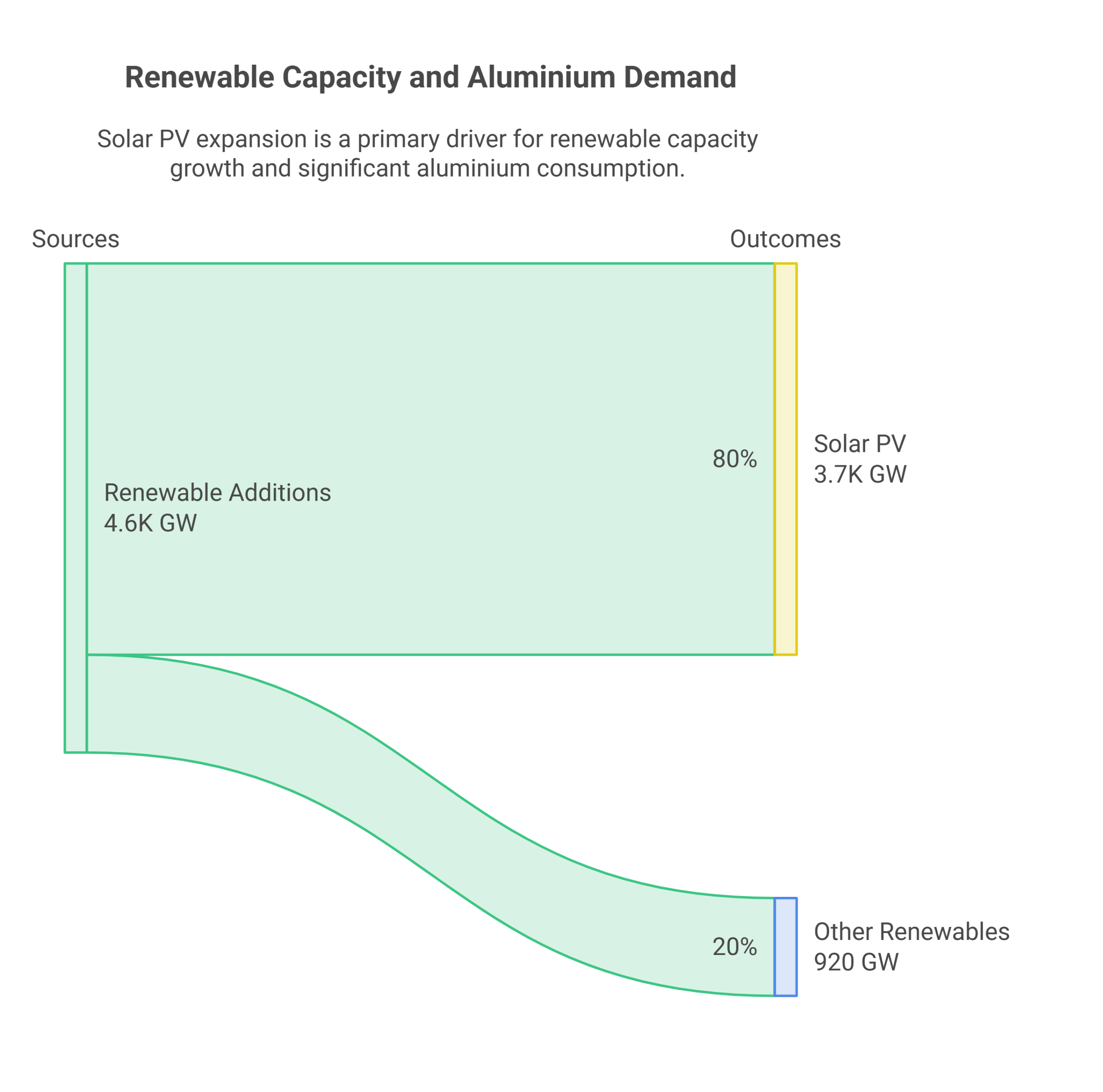
The pace of deployment is expected to remain strong. The International Energy Agency forecasts that global renewable power capacity will increase by almost 4,600 GW between 2025 and 2030, roughly doubling the capacity added during the previous five-year period. Solar PV is expected to account for almost 80% of total renewable capacity expansion, while cumulative onshore wind additions are forecast to reach 732 GW during the same period.

Wind and Storage are Expanding the Demand Base

Wind power creates aluminium requirements across electrical and structural applications, while continued improvements in system design can influence the quantities and specifications required. The IEA expects annual global wind capacity additions to reach around 160 GW in 2025, following an increase of almost 40% from the previous year. This continued growth provides another route for aluminium producers and downstream manufacturers to participate in renewable infrastructure expansion.

Energy storage is adding another dimension. Battery storage capacity additions increased by around 40% in 2025, reaching almost 110 GW, making storage the fastest-growing power technology during the year. Aluminium is used in battery components including current collectors and casings, while broader storage infrastructure also creates requirements for electrical and structural materials. As renewable generation becomes more dependent on flexible power systems, storage growth can therefore provide an additional source of aluminium consumption.

The development of these applications also changes the product mix required from aluminium suppliers. Renewable infrastructure can require specific alloys, dimensional tolerances, surface treatments and fabricated forms rather than undifferentiated primary metal. The International Aluminium Institute’s analysis of the solar sector, for example, identifies the use of 6-series aluminium alloys across applications including module frames and racking, demonstrating how renewable deployment can translate into more specialised downstream requirements.

Circularity is Becoming Part of the Demand Equation

The growth of renewable infrastructure is also creating a future requirement for recovering aluminium from equipment reaching the end of its operating life. The International Aluminium Institute estimates that cumulative end-of-life photovoltaic material could reach 1.7 million tonnes by the early 2030s, increasing rapidly to 60โ€“78 million tonnes by the 2050s. Aluminium recovery from these systems could therefore become increasingly important as the installed renewable base matures.

This creates a second opportunity for the aluminium industry. Greater use of recycled material in new renewable equipment could help reduce the material footprint of future installations while creating additional demand for collection, sorting, remelting and downstream processing.
Mining Frontier brings together the global mining industry โ€” from exploration and extraction specialists to processing operators and mineral supply chain leaders โ€” through trusted editorial, market intelligence, and digital engagement.

Our 2026 Media Pack offers integrated solutions to reach your audience:

  • Magazine & Digital Editions Showcase your brand within premium mining industry coverage read by executives and decision - makers worldwide.
  • Industry Insights & Reports Align with data - driven analysis, trend reports, and regional roundups across the global mining and resources value chain.
  • Brand Authority & Credibility Position your company as a thought leader through expert commentary, interviews, and special features.

Subscribe

- Never miss a story with notifications

- Gain full access to our premium content

- Browse free from any location or device.

Media Packs

Expand Your Reach With Our Customized Solutions Empowering Your Campaigns To Maximize Your Reach & Drive Real Results!

โ€“ Access the Media Pack Now

โ€“ Book a Conference Call

โ€“ Leave Message for Us to Get Back

Latest stories

Related stories

A Tightening Global Aluminium Market Reshaping Producer Strategies

The global aluminium market is entering a period in...

Construction Demand Reshaping the Aluminium Extrusion Market

Construction remains the largest application for aluminium extrusion, giving...

Recovery is Becoming a Bigger Mining Value Lever

Mining companies have traditionally looked for value by increasing...

Mine to Mill Optimisation is Gaining Economic Weight

Mining companies have long looked at drilling, blasting, crushing...

Subscribe

- Never miss a story with notifications

- Gain full access to our premium content

- Browse free from any location or device.

Media Packs

Expand Your Reach With Our Customized Solutions Empowering Your Campaigns To Maximize Your Reach & Drive Real Results!

โ€“ Access the Media Pack Now

โ€“ Book a Conference Call

โ€“ Leave Message for Us to Get Back

Translate ยป