














Close
2026 Taiwan Int'l Tools & Hardware Expo x Int'l Hardware Expo Taiwan (TiTE x IHT)

Electric Equipment Economics Shaping Underground Fleet Costs

Note* - All images used are for editorial and illustrative purposes only and may not originate from the original news provider or associated company.

Related stories

Battery Swapping and Fast Charging Shaping Fleet Models

The growing use of electric equipment underground is giving...

Electrification Projects Shaping Mine Power Infrastructure

The expansion of electric fleets is changing how underground...

Battery Management Shaping Underground Equipment Utilisation

Battery management is becoming a more direct part of...

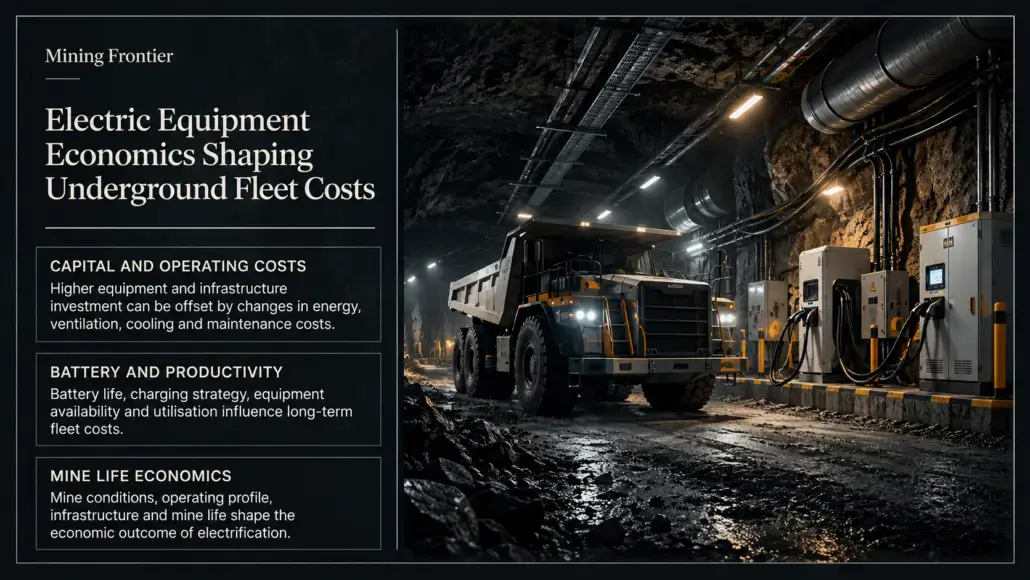
The economic case for underground electrification begins with a cost structure that differs from conventional Internal Combustion Engine (ICE) fleets. Battery Electric Vehicle (BEV) operations can require higher upfront spending on equipment, batteries, charging systems and supporting electrical infrastructure, while offering potential reductions in energy, ventilation, cooling and maintenance costs over the operating life of the mine. This makes electric equipment economics a mine-level calculation rather than a comparison of vehicle purchase prices alone. Sandvik’s Total Cost of Ownership (TCO) analysis similarly identifies equipment capital costs, energy, maintenance, ventilation and cooling as interconnected variables that can materially change the economics of a BEV fleet.

Capital Cost Drivers

For an underground operation, the initial investment can extend across several parts of the system:

  • Electric equipment: BEV trucks, loaders and other mobile machines can carry higher acquisition costs than comparable diesel equipment.
  • Battery systems: Battery packs add a separate capital component and introduce future replacement considerations.
  • Charging infrastructure: Chargers, charging bays and associated electrical equipment become part of the mine’s infrastructure requirement.
  • Electrical infrastructure: Brownfield operations may also require modifications to power distribution and mine facilities.

The Cosmos Electrification Study illustrates how these costs interact. Its model found that the direct cost of purchasing, operating and maintaining the BEV fleet represented the largest cost difference against its diesel base case. Additional spending on mine development for workshops and charging bays, as well as charging equipment for ancillary and lift vehicles, also contributed to the difference.

Operating Cost Savings

The potential operating savings come from several parts of the mine rather than from electricity prices alone. Sandvik’s research notes that diesel mobile equipment can account for a substantial share of underground heat generation, while ventilation and cooling can represent a major portion of mine electricity demand. Replacing diesel equipment can therefore reduce both heat and exhaust-related ventilation requirements, creating an operating-cost offset alongside the electricity consumed by the electric fleet.

  • Energy: electricity replaces diesel consumption for mobile equipment.
  • Ventilation: lower diesel emissions can reduce ventilation requirements.
  • Cooling: lower fleet heat output can reduce cooling demand.
  • Maintenance: electric powertrains change the maintenance profile by removing some diesel-specific components, although batteries and electrical systems create new requirements.

These interacting cost lines are central to electric equipment economics, particularly where mine design, energy prices and operating conditions allow savings outside the mobile fleet to offset higher initial investment.

Battery Life and Productivity Changing the Economic Equation

The upfront cost of an electric fleet does not determine its economic performance over the life of a mine. Battery replacement, equipment availability, energy prices and machine productivity can materially change the cost profile after the initial investment. This makes electric equipment economics dependent on how equipment performs in actual operating conditions, rather than on acquisition cost alone.

Battery longevity is particularly important because battery capacity declines with use and can eventually require replacement. A 2025 Journal of Power Sources study using an underground mining setting examined battery ageing under different temperatures, battery chemistries, sizes and charging strategies. It found that both Nickel Manganese Cobalt (NMC) and Lithium Iron Phosphate (LFP) batteries could produce lower seven-year TCO than diesel in the tested fast-charging scenarios at moderate temperatures. At 40ยฐC, however, shortened battery life and the resulting replacement requirements made the tested battery-electric cases economically unfavourable relative to diesel.

Battery Cost Variables

The cost of battery ownership can therefore be influenced by several operational factors:

  • Battery life: Longer usable life can spread replacement costs over a greater operating period.
  • Replacement timing: Earlier replacement can increase life-of-mine capital expenditure.
  • Temperature: Higher operating temperatures can accelerate battery degradation.
  • Charging strategy: Charging patterns can influence both battery ageing and equipment availability.

These variables make electric equipment economics closely connected to battery-management practices. A fleet operating under different temperatures, duty cycles or charging conditions can therefore produce a different long-term cost profile even when the equipment itself is identical.

Production Variables

Productivity is equally important because the economic value of an electric machine depends on how effectively it contributes to production. Equipment availability, charging downtime, haul cycles and utilisation determine how much productive work each asset delivers during its operating life.

  • Productivity: Tonnage moved and cycle performance affect the value generated by each machine.
  • Availability: Equipment downtime can reduce production and increase the effective cost of the fleet.
  • Utilisation: Higher asset utilisation can spread capital costs across greater production.
  • Cost per tonne: Energy, maintenance and capital costs need to be assessed against the material produced.

A 2025 Journal of Cleaner Production study modelled fleet electrification in heat-constrained underground mines and reported a 1% to 26% improvement in Net Present Value (NPV) across its tested scenarios. However, the analysis assumed procurement and maintenance costs were sunk, so the result does not represent a universal return for electric fleets.

This distinction is important when comparing technologies. Lower energy costs do not automatically translate into a lower cost per tonne if equipment spends more time unavailable, requires additional charging capacity or performs below the productivity assumptions used in a mine plan. Conversely, higher utilisation can increase the production generated from the same capital investment. The resulting electric equipment economics therefore depend on the interaction between battery life, charging strategy, operating conditions, productivity and asset utilisation.

Underground Fleet Economics Becoming More Mine Specific

The economic assessment of underground electrification is increasingly moving toward mine-specific models that combine equipment costs with operating conditions, infrastructure and production requirements. Battery replacement, energy prices, charging arrangements, equipment utilisation, ventilation and mine life can all change the outcome of a fleet comparison. The Cosmos study illustrates this site-specific approach, while projects such as Evolve are testing productivity, charging, cost and asset-utilisation assumptions in operating underground mines.

Key Economic Variables

  • Capital and operating costs: Equipment, batteries and infrastructure need to be assessed alongside energy and maintenance expenses.
  • Battery replacement: Battery life and replacement timing can materially affect long-term fleet costs.
  • Productivity and utilisation: Downtime, charging requirements and production output influence cost per tonne.
  • Mine life and conditions: Temperature, haul profiles, electricity prices and mine design can change the economic result.

As these variables interact, electric equipment economics becomes closely linked to battery electric fleet planning, particularly when operators assess equipment selection, charging requirements and fleet deployment over the full mine life.

References

  1. Lessons from the Cosmos Electrification Study
  2. Power at the End of the Tunnel: Electrifying Underground Mining
  3. Economic Implications of Battery Longevity in Heavy-Duty Vehicles
  4. The Impact of Fleet Electrification on Productivity in Heat-Constrained Underground Mines
  5. Evolve Project – Proving Profitability in Battery Electric Fleets Underground

Mining Frontier brings together the global mining industry โ€” from exploration and extraction specialists to processing operators and mineral supply chain leaders โ€” through trusted editorial, market intelligence, and digital engagement.

Our 2026 Media Pack offers integrated solutions to reach your audience:

  • Magazine & Digital Editions Showcase your brand within premium mining industry coverage read by executives and decision - makers worldwide.
  • Industry Insights & Reports Align with data - driven analysis, trend reports, and regional roundups across the global mining and resources value chain.
  • Brand Authority & Credibility Position your company as a thought leader through expert commentary, interviews, and special features.

Subscribe

- Never miss a story with notifications

- Gain full access to our premium content

- Browse free from any location or device.

Media Packs

Expand Your Reach With Our Customized Solutions Empowering Your Campaigns To Maximize Your Reach & Drive Real Results!

โ€“ Access the Media Pack Now

โ€“ Book a Conference Call

โ€“ Leave Message for Us to Get Back

Latest stories

Related stories

Battery Swapping and Fast Charging Shaping Fleet Models

The growing use of electric equipment underground is giving...

Electrification Projects Shaping Mine Power Infrastructure

The expansion of electric fleets is changing how underground...

Battery Management Shaping Underground Equipment Utilisation

Battery management is becoming a more direct part of...

Equipment Interoperability Shaping Underground Fleet Design

The expansion of underground electrification is creating a stronger...

Subscribe

- Never miss a story with notifications

- Gain full access to our premium content

- Browse free from any location or device.

Media Packs

Expand Your Reach With Our Customized Solutions Empowering Your Campaigns To Maximize Your Reach & Drive Real Results!

โ€“ Access the Media Pack Now

โ€“ Book a Conference Call

โ€“ Leave Message for Us to Get Back

Translate ยป