









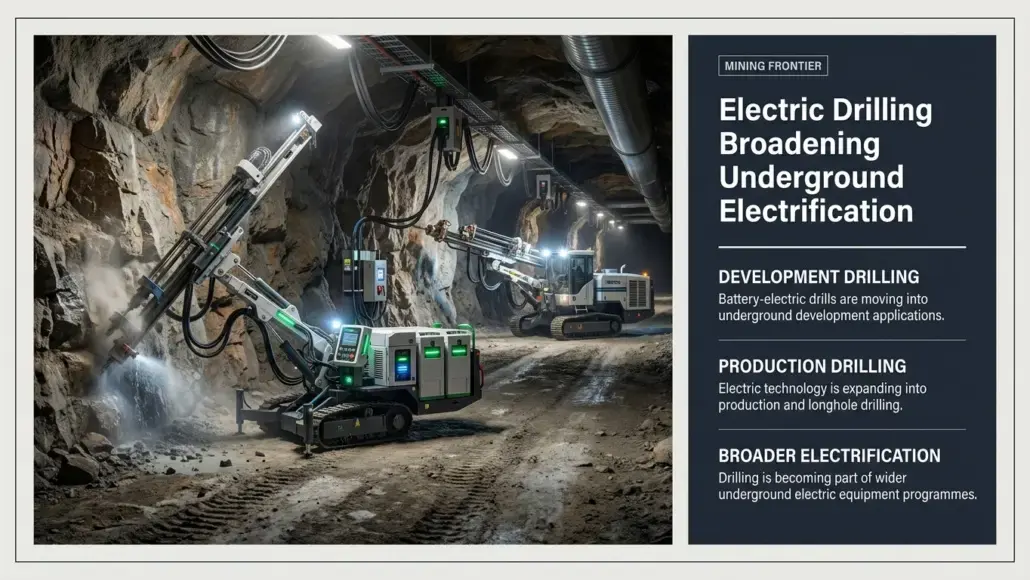

Electric drilling is expanding the scope of underground mine electrification beyond loading and haulage. Development drills and production drills are increasingly being introduced into operating mines, giving operators another opportunity to reduce diesel use while examining how electrically powered equipment fits within established production cycles. The transition is particularly relevant because drilling has different energy and mobility requirements from haulage. A drill must tram between working areas, position accurately, complete drilling cycles and remain available for the next production activity.
Early underground trials provided a foundation for this shift. At Agnico Eagle Finland’s Kittilä mine, the European Union (EU) Sustainable Intelligent Mining Systems (SIMS) project tested a Boomer E2 Battery development drill alongside other battery-electric equipment. The trial examined operational performance as well as working conditions in an active underground environment.
The experience highlighted several factors that influence how drilling equipment can be integrated into mine operations:
- Tramming between development headings
- Positioning and drilling requirements at the work face
- Energy use across different operating phases
- Equipment availability between drilling cycles
- Interaction with other production equipment
These considerations mean electric drilling cannot be assessed solely through battery capacity or machine specifications. The relevant question is whether the equipment can complete its required duty cycle while maintaining the productivity and availability expected from the mine.
Production Drilling Expanding the Scope of Electrification
The technology is now moving beyond development trials into production applications. In 2025, MMG introduced an Epiroc Simba E70SG battery-electric production drill at its Rosebery underground mine in Tasmania. The machine is designed for production blast-hole drilling, placing battery power directly within a core stage of underground ore extraction.
The development is significant because production drilling operates within a different planning environment from a technology demonstration. Drilling performance has to align with blast schedules, production targets, equipment movements and downstream loading and haulage activities. Electric drilling therefore becomes part of a broader production system rather than an isolated equipment upgrade.
The expansion is also visible in newer procurement programmes. Battery-electric drilling equipment is being ordered alongside loaders, trucks and ground-support machines at projects such as South32’s Hermosa development in the United States. This suggests that underground electrification is increasingly being evaluated across multiple equipment functions, with drilling becoming part of the wider transition from diesel-powered production fleets.
Development and Production Drilling Expanding Electric Applications
The move toward electric drilling is increasingly covering different underground drilling applications rather than remaining focused on development headings. Current equipment programmes include face drilling, production drilling and longhole drilling, allowing mine operators to examine where battery power can fit within different stages of the production cycle.
Recent deployments illustrate the widening range of applications:
- Epiroc’s Boomer battery-electric drills have been used for underground development work.
- MMG introduced a battery-electric Simba E70SG production drill at its Rosebery mine in Tasmania.
- South32’s Hermosa project includes battery-electric development and longhole drills alongside trucks, loaders and bolters.
- Sandvik is testing newer battery-electric development drills with higher battery capacity and faster charging capabilities.
These applications have different operating patterns. Development drills may spend more time tramming between headings, while production and longhole drills can remain positioned at a work area for longer periods. That changes the balance between drilling time, tramming energy, charging requirements and equipment availability. As a result, electric drilling has to be assessed against the specific production cycle in which the machine will operate.
Charging While Drilling Changing Equipment Utilisation
One development directly addressing this challenge is the integration of charging with drilling activity. Sandvik has developed a patented Charging while Drilling approach that allows a battery-electric drill to replenish energy during parts of the drilling process, reducing the need to treat charging as an entirely separate activity.
This approach connects several operating stages that would otherwise be planned independently:
- Equipment tramming to the work area
- Drill positioning and setup
- Active drilling
- Battery energy consumption
- Energy replenishment during suitable operating periods
The significance is broader than the charging technology itself. If energy replenishment can be incorporated into productive or naturally stationary periods, the relationship between battery size, drilling duration and equipment availability can change. This becomes particularly relevant as electric drilling moves into production applications where machine utilisation has to align closely with blast schedules and downstream mining activities.
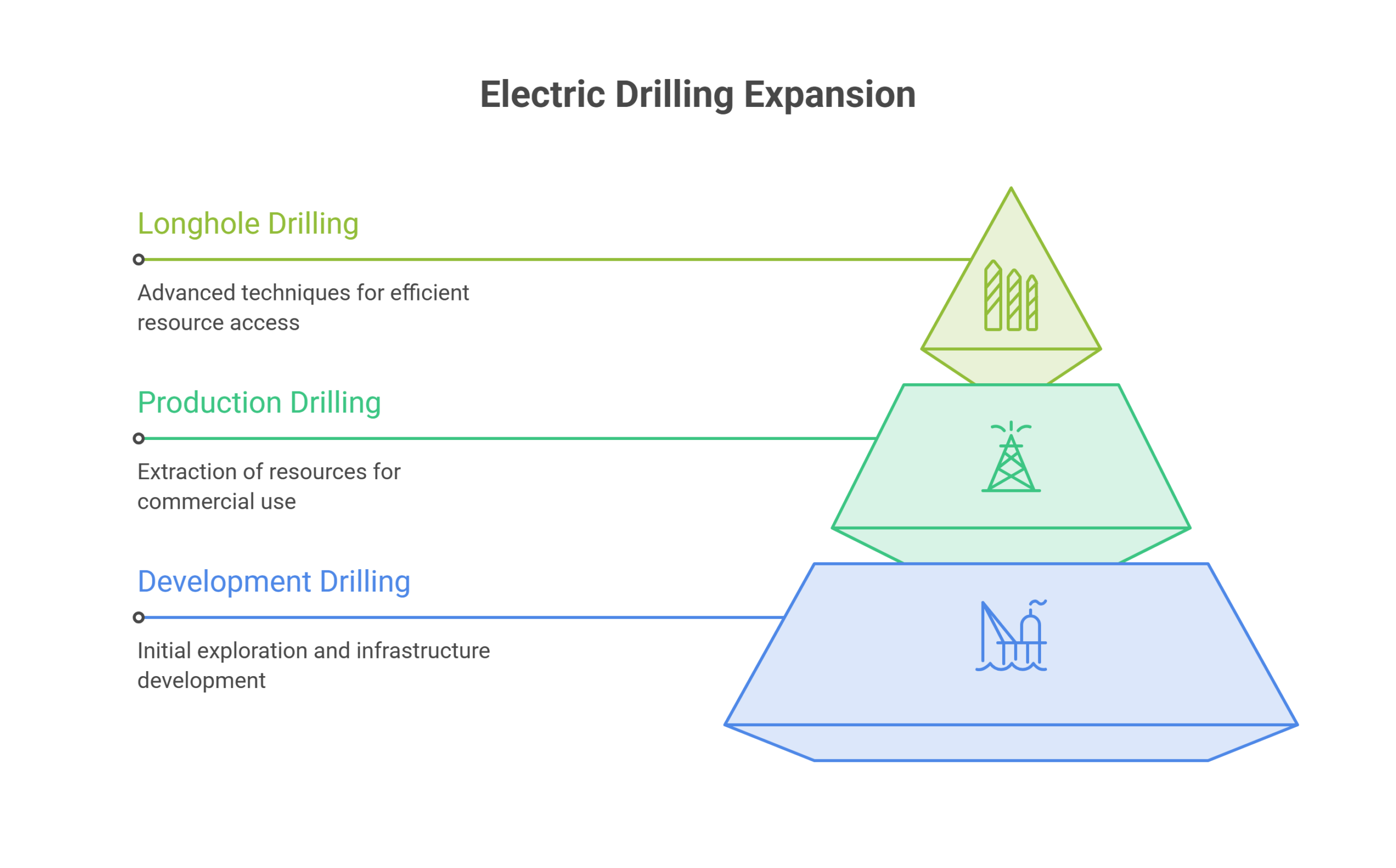
Battery-electric drilling is expanding from development applications into production and longhole drilling, broadening electrification across the underground mining cycle.
As drilling becomes part of a wider electric equipment ecosystem, equipment interoperability across electric fleets becomes an important next consideration because drills, loaders, trucks, charging systems and fleet platforms need to operate within the same mine environment.