















The growing use of electric equipment underground is giving mines two different ways to manage energy replenishment: battery swapping and fast charging. The choice affects more than how a machine receives energy. It can influence vehicle downtime, battery requirements, equipment scheduling and the number of supporting assets needed to keep production moving.
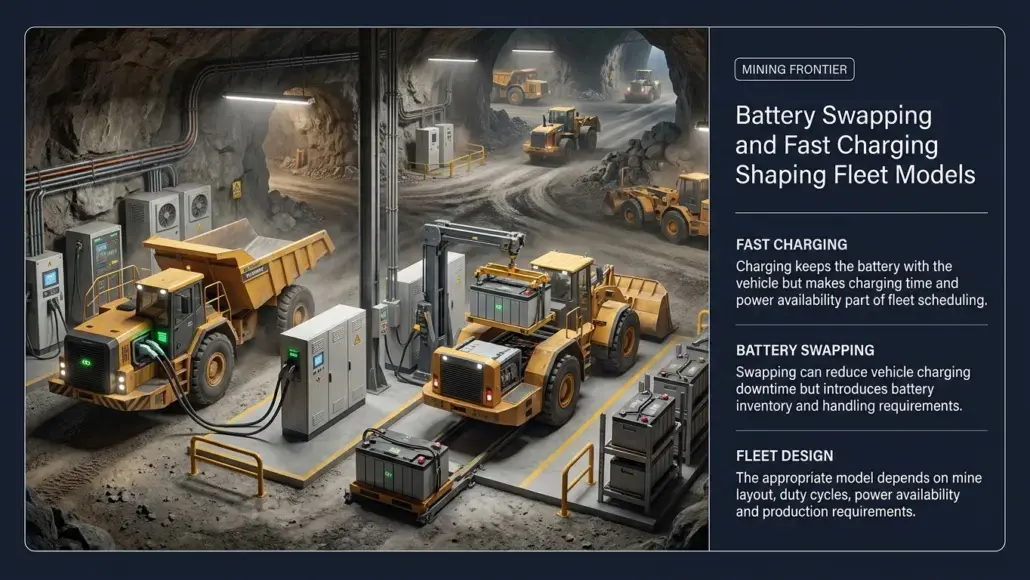
With fast charging, the battery stays on the machine and is replenished through a dedicated charging system. Battery swapping follows a different model, where a depleted battery is removed and replaced with a charged unit. This separates vehicle operating time from the time required to recharge the battery, but also creates a requirement for additional battery inventory and handling infrastructure.
The two approaches therefore create different operating characteristics:
- Fast charging keeps the battery permanently associated with the vehicle.
- Battery swapping separates the vehicle from the battery during replenishment.
- Fast charging can require greater electrical power during charging periods.
- Swapping requires sufficient charged batteries to keep vehicles available.
- Both models depend on the mine’s duty cycle and production schedule.
Fast Charging Model
Fast charging can be suited to operations where equipment can return to a charging location during planned or naturally occurring breaks. The Global Mining Guidelines Group (GMG) notes that off-board charging can allow chargers to be shared between Battery Electric Vehicles (BEVs), although vehicle movement to charging locations has to be considered. The effectiveness of the approach therefore depends on whether charging can be incorporated without creating excessive downtime.
The 2026 study comparing charging strategies for underground haul trucks found that battery size, charging power, route length and battery degradation can all influence the performance of a fast-charging fleet. The study modelled an eight-truck underground fleet and found that changing these variables produced different outcomes for productivity, energy consumption and battery life.
Battery Swapping Model
Battery swapping changes the downtime calculation because the vehicle can return to work with a charged battery while the removed battery is recharged separately. Epiroc reports typical swapping times of five to 10 minutes for its underground electric trucks, while Sandvik reports battery changes of approximately three minutes for its AutoSwap and AutoConnect systems. These are manufacturer-reported figures for specific equipment and systems.
The model also introduces a separate battery resource that has to be managed alongside the vehicle fleet. Battery swapping and fast charging can therefore lead to different requirements for battery inventory, charging capacity and production scheduling.
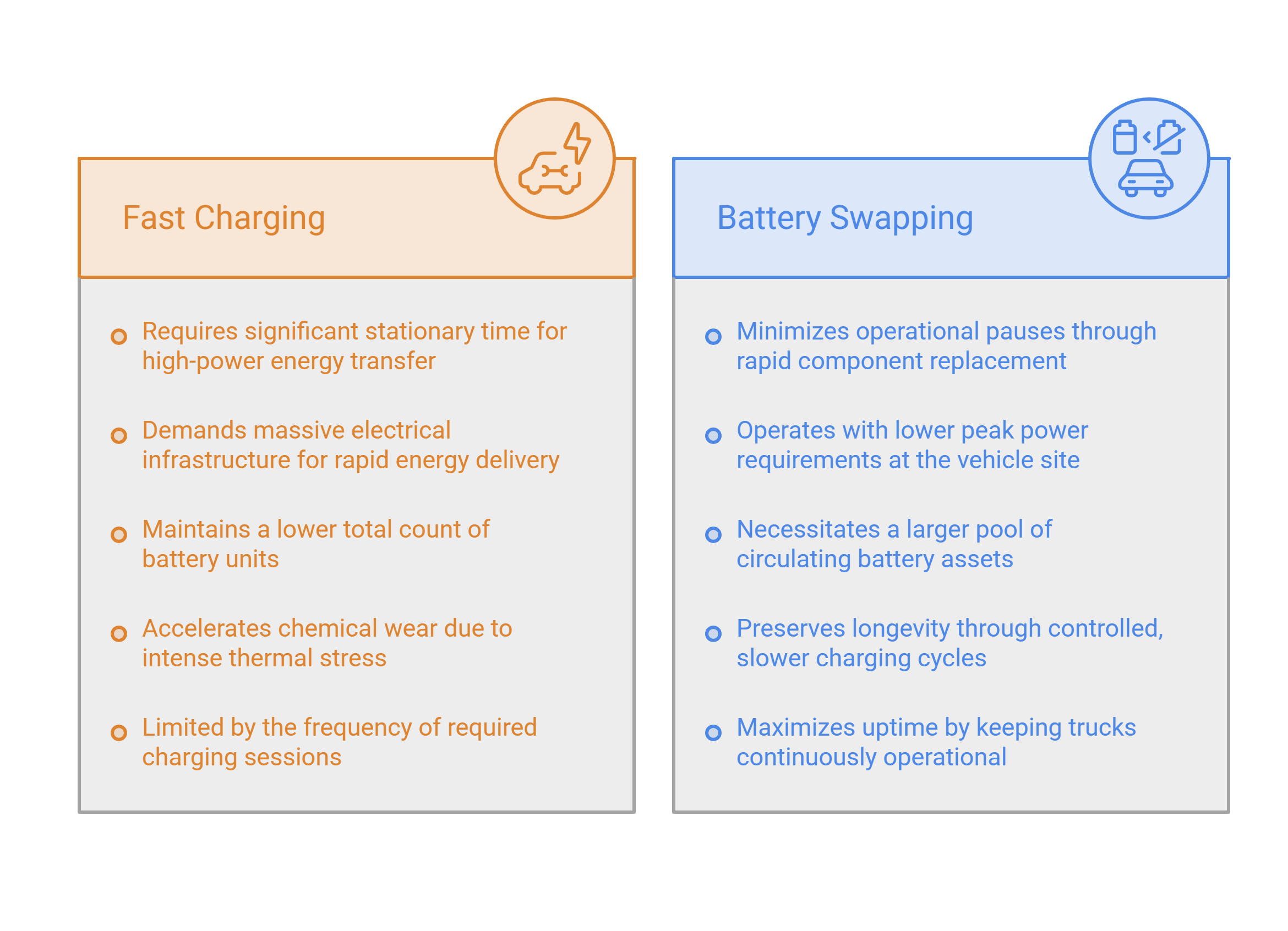
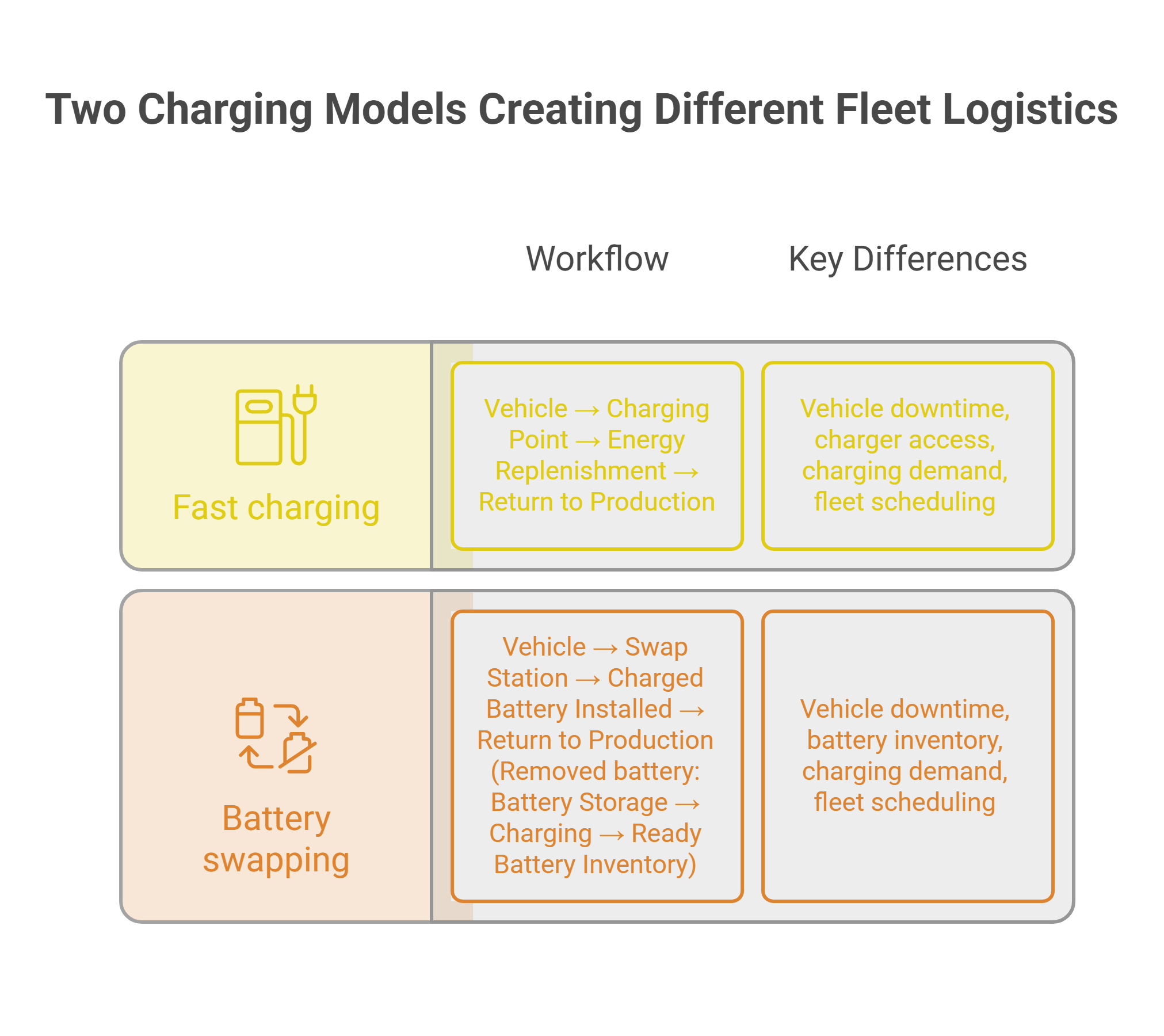 Battery swapping and fast charging therefore create different logistics around energy replenishment. One concentrates more of the scheduling challenge around charger access and electrical demand, while the other adds battery inventory and handling to the fleet-management equation.
Charging Strategy Becoming a Fleet Design Decision
The choice between battery swapping and fast charging is increasingly becoming a fleet-design decision rather than a standalone charging decision. The suitable approach can depend on the mine’s haul profile, equipment availability, charging access, electrical capacity and production schedule. The 2026 underground haul-truck study also shows that different combinations of battery size, charging power and battery inventory can produce different operational outcomes.
The main planning considerations include:
- Vehicle downtime during energy replenishment
- Required battery inventory
- Available charging capacity
- Mine layout and haul distances
- Equipment availability and production targets
Neither approach removes the need for careful scheduling. Fast charging places greater emphasis on charging access and power availability, while swapping adds battery inventory and handling requirements. The choice can therefore shape how the entire electric fleet is organised and operated. This makes electric equipment economics a natural next step, as the operational differences between the two models also influence capital, energy, maintenance and asset-utilisation costs.
References
- Darcovich, K., Ribberink, H., Acuña-Duhart, E., Le, J., Levesque, M. and Loizeaud, L. – Simulation Study Comparing Battery Swapping to Fast Charging for Electric Underground Mine Haul Trucks – CIM Journal, 2026.
- Global Mining Guidelines Group – Recommended Practices for Battery Electric Vehicles in Underground Mining – Version 3 – 2022.
- Epiroc – Electric Mining Trucks.
- Sandvik – Creating Smart Battery Solutions – 2025.
- Komatsu – Komatsu Launches Battery-Powered LHD Alongside Innovative Charging Solution – 2024.