












Close
2026 Taiwan Int'l Tools & Hardware Expo x Int'l Hardware Expo Taiwan (TiTE x IHT)

Battery Management Shaping Underground Equipment Utilisation

Note* - All images used are for editorial and illustrative purposes only and may not originate from the original news provider or associated company.

Related stories

Electrification Projects Shaping Mine Power Infrastructure

The expansion of electric fleets is changing how underground...

Equipment Interoperability Shaping Underground Fleet Design

The expansion of underground electrification is creating a stronger...

Battery Electric Equipment Reshaping Underground Fleets

The move toward battery electric equipment is changing how...

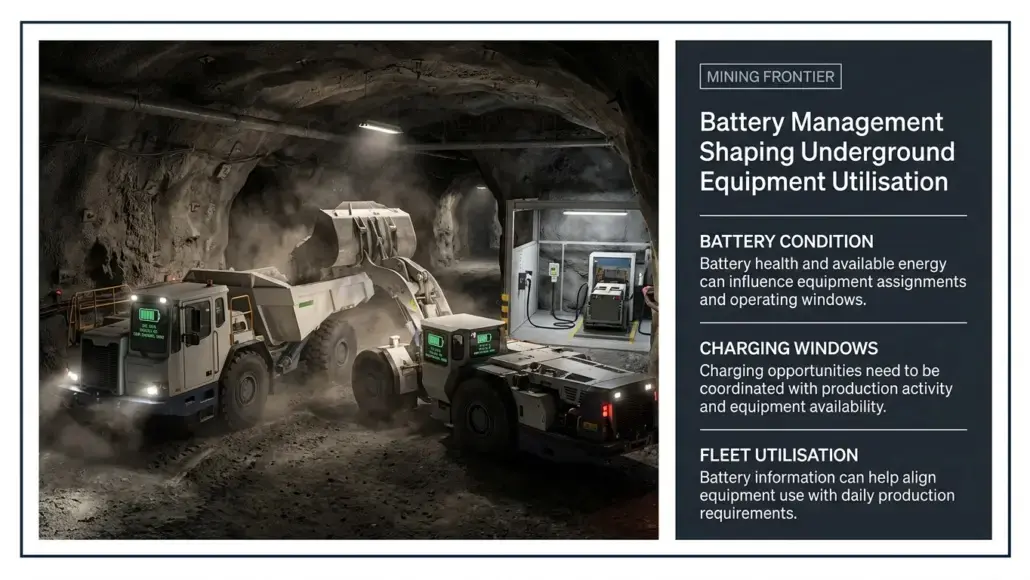
Battery management is becoming a more direct part of underground production planning as electric equipment moves into regular operation. Instead of treating the battery as a fixed component of a machine, operators increasingly need to account for how much usable energy is available, how the battery is performing and when the equipment can be recharged without interrupting production.

The Global Mining Guidelines Group (GMG) notes that charging and battery swapping can affect equipment availability and utilisation, making battery-related information relevant to the way electric fleets are operated. A Battery Management System (BMS) can monitor parameters such as State of Charge (SoC), State of Health (SoH), temperature and charging conditions, providing information that can help determine whether a machine is ready for its next task.

Several factors can influence a machine’s available operating window:

  • State of Charge
  • Battery health and degradation
  • Route distance and gradient
  • Payload and duty cycle
  • Charging availability and duration

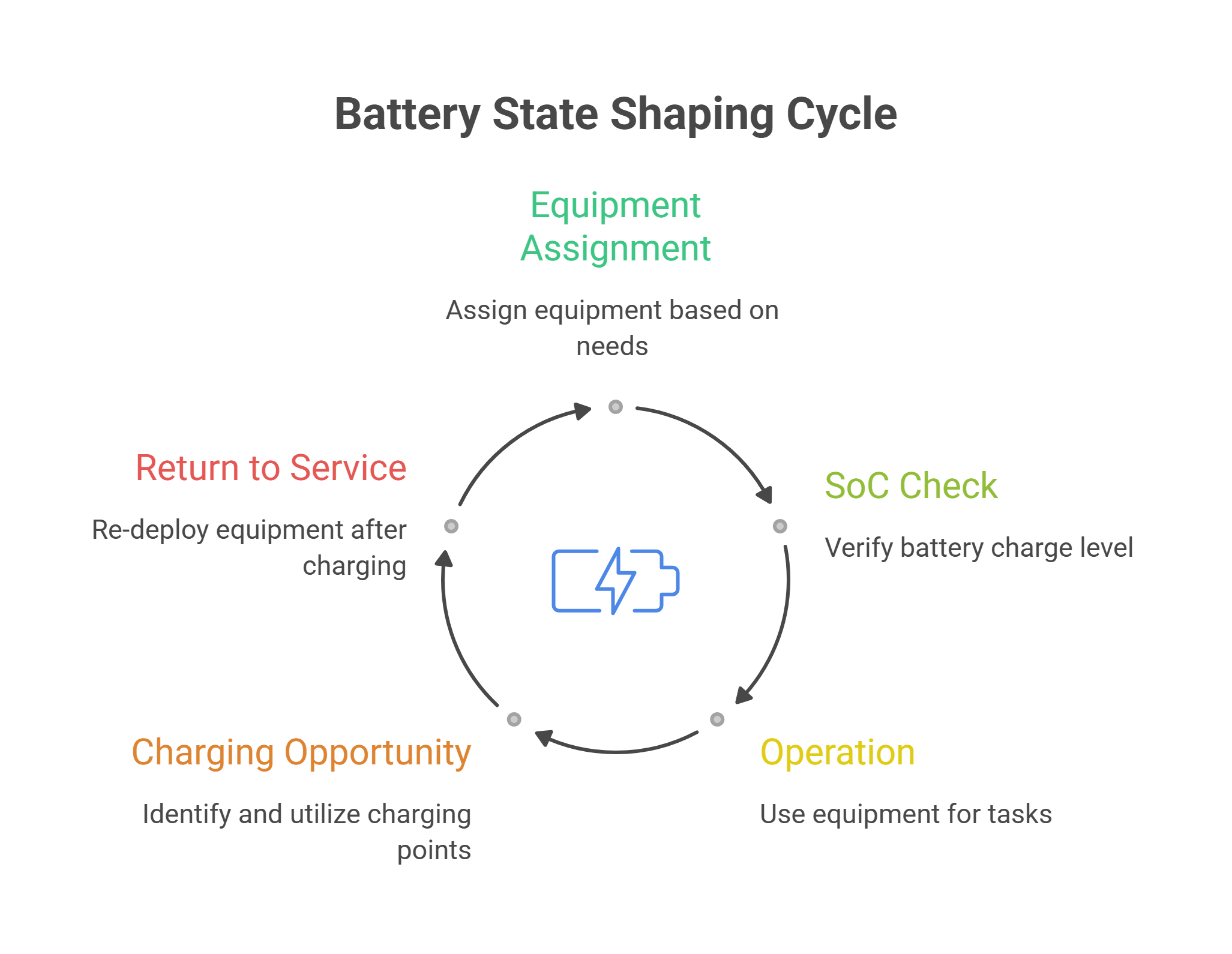
This makes battery management more closely connected to shift planning. A machine with sufficient charge for one route may not have enough usable energy for a longer or steeper assignment, while a machine approaching a charging window may need to be scheduled differently from one that can continue operating.
Battery condition and available energy are becoming operational inputs that can influence when underground electric equipment can work, charge and return to production.

Battery Availability Influencing Equipment Selection

The importance of battery management becomes clearer when several machines depend on the same operational energy resources. Underground fleets can experience different energy demands because equipment operates across different routes, payloads and gradients. This means battery availability cannot be assessed independently from the work assigned to each machine.

Research on underground battery-electric Load-Haul-Dump (LHD) operations has shown that battery availability and swapping resources can affect queueing and production when multiple machines require energy at similar times. The findings reinforce the need to consider battery resources alongside equipment requirements rather than treating energy replenishment as a separate activity.

As operators build more detailed information about battery condition and machine duty cycles, that data can also influence wider decisions around mine power infrastructure. The next consideration is how individual equipment requirements connect with the electrical systems needed to supply an expanding electric fleet.

Charging Windows Becoming Part of Equipment Scheduling

As underground electric fleets expand, battery management is increasingly connected to when machines can charge and return to production. A machine may have enough energy for its current assignment but still need a charging opportunity before the next task. This makes charging windows an operational variable that needs to be coordinated with production schedules rather than treated as downtime outside the planning process.

Opportunity charging can help address this by using periods when equipment is naturally stationary. Depending on the mine and duty cycle, useful charging windows can include:

  • Shift changes
  • Planned operating pauses
  • Loading or unloading delays
  • Scheduled maintenance periods
  • Other short stationary intervals

The effectiveness of these windows depends on how closely charging opportunities align with equipment demand. A machine operating continuously at a production face may have fewer opportunities than equipment moving between multiple working areas. Battery management therefore needs to consider both the amount of energy available and when that energy can be replenished without disrupting production.

Battery Availability Affecting Fleet Utilisation

Managing several electric machines creates another challenge when multiple units require energy at similar times. Research on underground Load Haul Dump (LHD) operations has shown that limited battery resources can create queueing and reduce production when equipment reaches its energy threshold simultaneously. In one simulated eight-LHD operation, the study found that maintaining more than one available battery per machine helped reduce queueing under the tested operating conditions.

This highlights how battery resources can become part of fleet coordination:

  • Tracking which machines are approaching their energy limits
  • Scheduling charging or battery replacement before production is interrupted
  • Maintaining sufficient charged batteries or charging capacity
  • Preventing several machines from requiring energy at the same time
  • Matching energy availability with production priorities

Real-time monitoring can make this coordination more responsive. Epiroc has demonstrated the use of machine telemetry covering State of Charge (SoC), regeneration, payload and cycle distance to examine battery performance and identify potential degradation trends. Its fleet-management systems also provide information on equipment status, productivity and operating events.

As this information becomes more integrated into daily operations, battery management can move from a technical battery function toward a production-planning tool. The aim is not simply to keep batteries charged, but to ensure that available equipment, energy and charging opportunities remain aligned with the mine’s operating schedule.

Battery Management Becoming Part of Production Control

As electric equipment becomes more integrated into underground operations, battery management is moving closer to the centre of production planning. State of Charge (SoC), battery condition, charging availability and equipment duty cycles can influence when a machine is assigned to a task, when it needs energy and how long it can remain productive.

The main operational considerations include:

  • Matching battery availability with production requirements
  • Scheduling charging around equipment activity
  • Tracking changes in battery condition
  • Reducing unnecessary waiting for energy replenishment
  • Maintaining equipment availability across the shift

This makes battery information increasingly relevant to the wider mine operating system. Rather than treating battery monitoring as a function limited to the equipment itself, operators can use it alongside fleet and production information to make more informed utilisation decisions.

References

  1. Recommended Practices for Battery Electric Vehicles in Underground Mining โ€“ Version 3
  2. Developing a Model for Production in Underground Mines with BEVs
  3. Analysing Battery Swapping of Battery Electric LHD Machines in Block Cave Mining Using Discrete Event Simulation
  4. Epiroc CIM 2026 Presentation: Developing a Model for Production in Underground Mines with BEVs

Mining Frontier brings together the global mining industry โ€” from exploration and extraction specialists to processing operators and mineral supply chain leaders โ€” through trusted editorial, market intelligence, and digital engagement.

Our 2026 Media Pack offers integrated solutions to reach your audience:

  • Magazine & Digital Editions Showcase your brand within premium mining industry coverage read by executives and decision - makers worldwide.
  • Industry Insights & Reports Align with data - driven analysis, trend reports, and regional roundups across the global mining and resources value chain.
  • Brand Authority & Credibility Position your company as a thought leader through expert commentary, interviews, and special features.

Subscribe

- Never miss a story with notifications

- Gain full access to our premium content

- Browse free from any location or device.

Media Packs

Expand Your Reach With Our Customized Solutions Empowering Your Campaigns To Maximize Your Reach & Drive Real Results!

โ€“ Access the Media Pack Now

โ€“ Book a Conference Call

โ€“ Leave Message for Us to Get Back

Latest stories

Related stories

Electrification Projects Shaping Mine Power Infrastructure

The expansion of electric fleets is changing how underground...

Equipment Interoperability Shaping Underground Fleet Design

The expansion of underground electrification is creating a stronger...

Battery Electric Equipment Reshaping Underground Fleets

The move toward battery electric equipment is changing how...

Battery Performance Data Shaping Electric Equipment Use

Battery performance data is becoming a more important input...

Subscribe

- Never miss a story with notifications

- Gain full access to our premium content

- Browse free from any location or device.

Media Packs

Expand Your Reach With Our Customized Solutions Empowering Your Campaigns To Maximize Your Reach & Drive Real Results!

โ€“ Access the Media Pack Now

โ€“ Book a Conference Call

โ€“ Leave Message for Us to Get Back

Translate ยป