Mine planning increasingly depends on the ability to combine geological information with operational and production data. Orebody models, grade estimates, equipment performance, processing constraints and changing site conditions all influence decisions about extraction sequences and production schedules. As these datasets become larger and more frequently updated, artificial intelligence is being used to identify patterns, generate predictions and support planning decisions.
This is giving AI mine planning a broader role across the mining value chain. Rather than relying solely on predefined assumptions and conventional optimisation techniques, planners can increasingly use machine learning models to process complex datasets and provide additional information about possible outcomes.
AI is Bringing More Data into Mine Planning
Geological information is one of the most important inputs. Resource estimation requires mining teams to interpret drilling, geological, geochemical and geophysical information before determining how an orebody may be extracted. Machine learning can process relationships within these datasets and assist with resource estimation or classification.
The same principle applies to operational information. Equipment utilisation, production rates, maintenance records and changing operating conditions can provide additional inputs for planning models. Bringing these datasets together can allow planners to assess proposed schedules against a wider range of real-world conditions rather than relying entirely on historical averages.
Recent research demonstrates the growing scale of interest. A 2025 bibliometric review analysed more than 1,200 publications examining artificial intelligence applications across minerals engineering, including mineral exploration, mining and mineral processing. The research identified applications spanning resource estimation, operational optimisation, safety and autonomous systems.
The growth in research does not mean that these applications have reached uniform commercial adoption. It does, however, show that AI is becoming an increasingly established area of research across the mining value chain. AI mine planning is part of this wider movement toward using more data-intensive methods to support technical and operational decisions.
From Geological Models to Data-Driven Decisions
The potential value becomes greater when AI is combined with established planning and optimisation techniques. Machine learning can provide predictions or identify relationships within complex datasets, while optimisation models can use those outputs alongside production and operational constraints.
This creates a more connected planning process. Geological uncertainty, equipment availability and production requirements can be considered together instead of being treated as completely separate analytical problems.
AI mine planning can therefore help planners work with more detailed and continuously updated information, while maintaining human oversight over final decisions. The technology is not necessarily replacing established mine-planning expertise. Its role is increasingly to expand the quantity and range of information available when evaluating alternative plans.
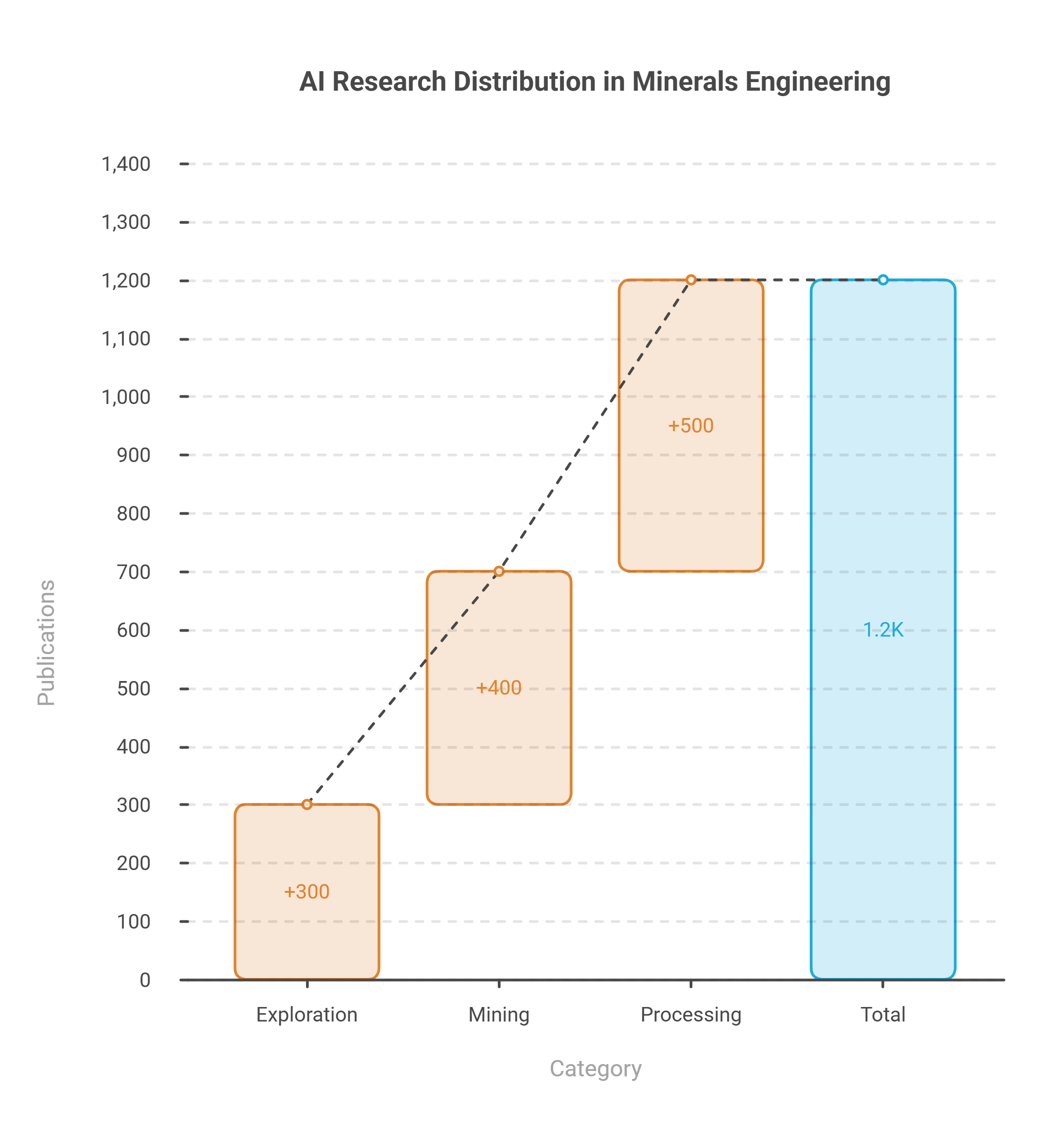
Key Takeaway: AI research is expanding across minerals engineering, with mining applications increasingly covering resource estimation, operational optimisation and other data-intensive decision areas.
The growing integration of geological, operational and production information is changing the information environment surrounding mine planning. AI mine planning is consequently becoming less about applying a single algorithm and more about bringing diverse datasets into a common decision-making process.
AI is Connecting Prediction with Mine Scheduling
The growing use of artificial intelligence in mine planning is shifting attention from analysing historical information toward predicting how different conditions could affect future production. Geological uncertainty, equipment availability, dilution, production requirements and other constraints can all influence the feasibility of a mine plan. AI can help process these variables and generate predictions that can then be incorporated into established planning and optimisation methods.
This is making AI mine planning increasingly relevant to scheduling decisions where the number of possible combinations can become difficult to evaluate using conventional approaches alone. Machine learning can be used to identify patterns within large datasets, estimate likely outcomes and provide inputs that allow optimisation models to evaluate alternative production strategies.
AI is Improving the Inputs Behind Mine Schedules
Geological uncertainty is a particularly important area. Mine plans are often based on estimates of ore grades, reserves and material distribution, but these estimates can change as additional information becomes available. AI models can process geological datasets and help quantify relationships that may be difficult to capture through simpler assumptions.
A recent study using deep reinforcement learning for underground production-layout optimisation incorporated geological and mineral-grade uncertainty into the planning process. In the tested scenario, the approach produced an 8.3% improvement in expected profit and a 3.4% increase in gold reserves compared with the benchmark across multiple resource realisations.
These results are specific to the study and should not be treated as universal performance gains. They do, however, demonstrate how AI can be used to evaluate mine-planning decisions under uncertain geological conditions rather than optimising against a single fixed representation of the orebody.
Dilution prediction provides another example. Research combining machine learning with production scheduling has shown that more granular predictions of dilution at individual stopes can improve the robustness of optimisation models compared with using one average dilution assumption across an entire operation.
Prediction is Becoming Part of the Planning Loop
This combination of prediction and optimisation is important because AI does not need to replace existing mine-planning methods to create value. Machine-learning models can act as a predictive layer, while established optimisation techniques continue to handle production constraints, sequencing and economic objectives.
This can create a more responsive planning process. New geological information, equipment performance or operational data can potentially be incorporated into predictive models, allowing planners to test whether an existing schedule remains appropriate.
AI mine planning can also support scenario analysis by evaluating multiple potential outcomes rather than relying on a single forecast. This becomes particularly useful when planners need to balance production targets against uncertainty in grades, equipment availability or operating conditions.
The approach is also relevant to shorter planning horizons. As operational data becomes more accessible, information from equipment and production systems can provide feedback that helps planners compare planned performance with actual conditions. That creates a closer connection between strategic mine plans and day-to-day operations.
From Static Plans to Adaptive Decision-Making
The broader direction is toward planning systems that can incorporate new information more frequently. Rather than treating the mine plan as a fixed document that changes only at defined intervals, AI-assisted approaches can support a more iterative process in which predictions, optimisation and operational feedback inform subsequent decisions.
This does not eliminate the role of technical expertise. Geological interpretation, engineering judgement and operational experience remain important when determining whether a model output is practical or appropriate. Instead, AI mine planning can provide planners with additional scenarios, predictions and evidence when assessing complex decisions.
As data integration improves, the connection between machine learning and optimisation could allow mine planning to become more responsive to actual operating conditions. AI mine planning is therefore evolving from a modelling exercise toward a decision-support process that can continuously incorporate new information and test its implications for production.
AI-Assisted Planning is Becoming More Data-Driven
Mine planning is increasingly moving toward decision-making that can incorporate larger and more varied datasets. Geological information, production records, equipment performance and operational conditions can all provide inputs that improve predictions and allow planners to test different scenarios.
This makes AI mine planning increasingly relevant to how mining operations respond to uncertainty. Machine learning can support resource estimation, predict operational variables and provide inputs to optimisation models, while planners retain responsibility for evaluating whether the resulting scenarios are technically and economically practical.
The direction is toward a more continuous planning process in which new information can be incorporated into models and schedules as operating conditions change. AI mine planning can therefore strengthen the connection between data, prediction and planning, helping mining teams make more informed decisions while keeping technical expertise and operational judgement at the centre.