














The industrial landscape is currently witnessing a profound shift as traditional heavy industries embrace the digital age. In the realm of metallurgy, copper production and fabrication are undergoing a radical transformation driven by the principles of Industry 4.0. The adoption of smart manufacturing trends in modern copper processing is not merely an incremental improvement but a complete overhaul of how the metal is refined, cast, and shaped. Mining Frontier notes that this digital revolution is fueled by the need for greater efficiency, reduced waste, and the ability to meet the increasingly stringent quality requirements of high-tech industries. By integrating the Internet of Things (IoT), artificial intelligence (AI), and advanced robotics into the production floor, copper processors are moving toward a future of autonomous, self-optimizing factories that can respond in real-time to changes in raw material quality or market demand.
The Integration of Industrial IoT and Big Data
At the heart of the smart manufacturing movement is the ability to gather and analyze vast amounts of data from every stage of the production process. In a modern copper processing plant, sensors are embedded in everything from smelting furnaces to rolling mills. These devices monitor temperature, pressure, chemical composition, and mechanical vibration with unprecedented precision. The data collected by these sensors is transmitted to centralized platforms where it is analyzed using machine learning algorithms. This allows operators to identify patterns and anomalies that would be invisible to the human eye. The application of these smart manufacturing trends in modern copper processing enables predictive maintenance, where potential equipment failures are identified before they occur, drastically reducing downtime and preventing costly production interruptions.
Real-Time Optimization of Smelting and Refining
Smelting is one of the most energy-intensive and complex parts of copper processing. Traditionally, it required highly experienced operators to manually adjust parameters based on visual cues and periodic lab samples. Today, digital twins—virtual replicas of the physical furnace—allow for real-time simulation and optimization of the smelting process. By feeding real-time sensor data into the digital twin, the system can automatically adjust oxygen levels, fuel flow, and flux additions to maximize yield and minimize energy consumption. This level of control ensures that the resulting copper matte is of consistent quality, which simplifies subsequent refining steps and reduces the overall environmental footprint of the operation.
Automation and Robotics in Casting and Fabrication
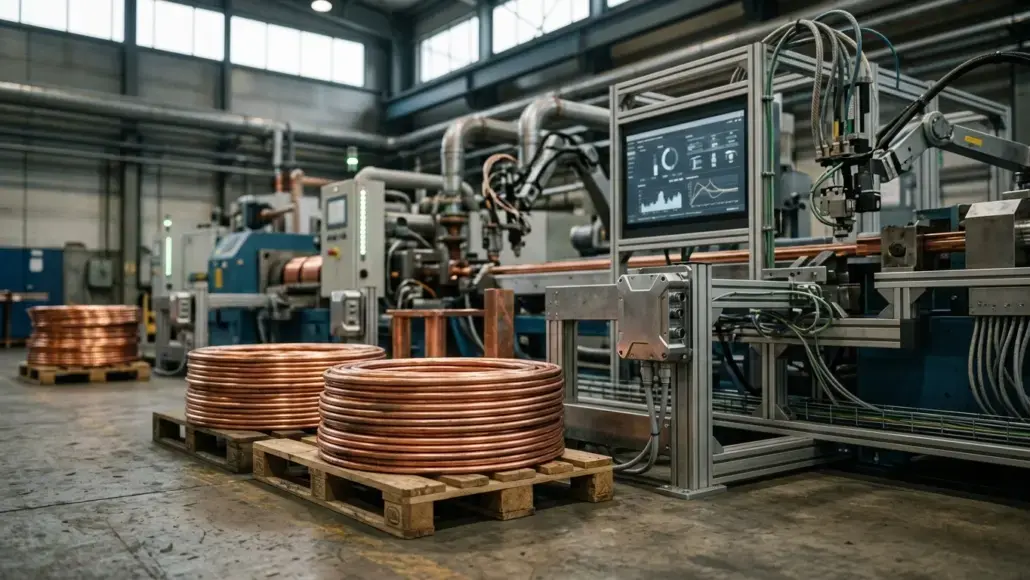
The physical handling of molten copper and the precision required in casting are areas where automation is making a significant impact. Modern casting plants now utilize robotic systems for tasks that were once dangerous or prone to human error. Automated pouring systems, guided by high-precision sensors, ensure that the molten metal is delivered to the molds at the exact rate and temperature required for optimal solidification. This reduces the occurrence of internal defects such as porosity or inclusions. Furthermore, in the fabrication stage, where copper is converted into tubes, wires, or sheets, smart manufacturing trends in modern copper processing are visible in the use of automated quality control systems. High-speed cameras and laser sensors inspect the product at every step, identifying surface blemishes or dimensional inaccuracies instantly and allowing for immediate corrective action.
Enhancing Safety and Ergonomics
While efficiency and quality are primary drivers, the human element remains central to the smart manufacturing vision. Automation is being used to remove workers from hazardous environments, such as those near high-heat furnaces or heavy moving machinery. Collaborative robots, or “cobots,” are designed to work alongside humans, taking over repetitive or physically demanding tasks while allowing the worker to focus on high-level process management and problem-solving. This shift not only improves workplace safety but also enhances the overall job quality for the workforce. The modernization of the copper processing environment is attracting a new generation of tech-savvy professionals who are adept at managing complex digital systems rather than just performing manual labor.
The Role of AI in Material Science and Alloy Development
Beyond the production line, artificial intelligence is accelerating the development of new copper alloys. The demand for materials with specific combinations of conductivity, strength, and corrosion resistance is growing, particularly in the electronics and aerospace sectors. AI-driven materials informatics can scan through thousands of potential alloy compositions and processing routes to predict the properties of the resulting material. This drastically shortens the development cycle for new products. These smart manufacturing trends in modern copper processing extend to the design phase, where simulation software can predict how a specific copper component will perform under stress or in extreme temperatures. This integration of digital tools from the laboratory to the factory floor ensures that the copper industry remains at the cutting edge of material science.
Circular Economy and Waste Reduction
Sustainability is no longer an optional add-on but a core requirement for modern industry. Smart manufacturing provides the tools needed to implement truly circular production models. By tracking the chemical signature of scrap material and utilizing automated sorting technologies, copper processors can integrate a higher percentage of recycled content without compromising the quality of the final product. Advanced analytics also help in optimizing the use of water and chemicals throughout the refining process, ensuring that waste is minimized and valuable byproducts are recovered. The transparency provided by digital tracking systems allows manufacturers to provide detailed environmental, social, and governance (ESG) reports, which are increasingly demanded by global customers and regulators.
Challenges in Digital Adoption
Despite the clear benefits, the transition to smart manufacturing is not without its hurdles. The initial capital investment required for state-of-the-art sensors, robotics, and software platforms can be significant. Furthermore, there is the challenge of cybersecurity. As factories become more connected, they also become more vulnerable to digital threats. Protecting the integrity of production data and ensuring the security of automated systems is a top priority for IT departments in the metallurgical industry. Additionally, there is a “skills gap” that must be addressed. The current workforce needs extensive training to operate and maintain these new technologies, and the industry must compete with the tech sector to attract the necessary talent in data science and robotics engineering.
Future Outlook: The Autonomous Foundry
Looking ahead, the evolution of smart manufacturing trends in modern copper processing points toward increasing levels of autonomy. We are moving toward a “lights-out” manufacturing model for certain stages of production, where the systems can run for extended periods without human intervention. These systems will not only execute tasks but will also learn from their own performance, continuously refining their algorithms to achieve higher levels of efficiency. As connectivity improves through technologies like 5G, the integration between different sites across the globe will become seamless, allowing a company to optimize its entire supply chain from a single control center. The copper industry, once seen as a traditional “old-world” sector, is now leading the way in industrial innovation.
Conclusion: A Digital Foundation for an Essential Metal
The copper industry is the backbone of the modern electrified world, and its survival and growth depend on its ability to evolve. The implementation of smart manufacturing trends in modern copper processing is ensuring that the industry can meet the challenges of the 21st century. By embracing the power of data, the precision of robotics, and the intelligence of AI, copper processors are creating a more efficient, safer, and more sustainable future. As the demand for high-quality copper continues to rise, driven by the global energy transition and the expansion of digital infrastructure, the smart foundry will be the engine that powers our technological progress. Mining Frontier believes the integration of physical metallurgy with digital intelligence is not just a trend; it is the new standard for industrial excellence.