







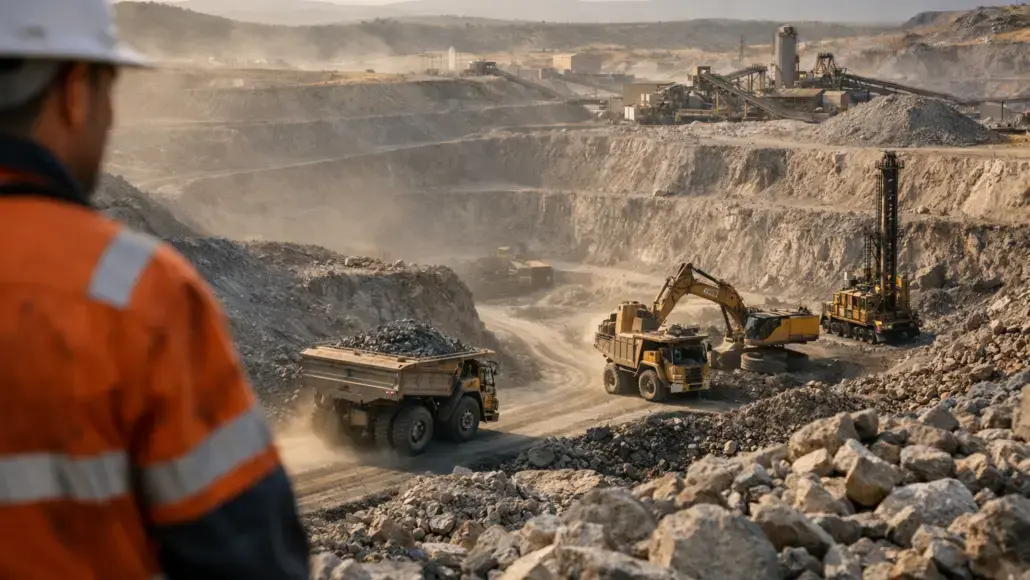

The lifespan of a mine is one of its most valuable assets. Beyond determining how long mineral resources can be extracted, it directly influences investment returns, workforce stability, infrastructure utilization, and the long-term economic contribution of mining operations. As the industry faces rising demand for critical minerals alongside declining discovery rates of high-quality deposits, Mine Life Extension has become an increasingly important strategy for maintaining production while maximizing the value of existing assets.
Developing a new mining project is a complex and capital-intensive process that often requires years of exploration, permitting, environmental assessments, infrastructure development, and regulatory approvals before production can begin. In contrast, extending the life of an existing operation allows mining companies to build on established infrastructure, operational expertise, and geological knowledge. This approach can improve resource utilization while reducing many of the financial and operational uncertainties associated with greenfield developments.
The growing focus on Mine Life Extension also reflects broader changes in the mining industry. Volatile commodity markets, increasing operational costs, and greater expectations around environmental and social performance are encouraging companies to extract greater value from existing resources rather than relying solely on new discoveries. By expanding mineral reserves, improving recovery rates, and optimizing mine planning, operators are extending productive mine life while strengthening long-term business resilience.
Rather than being viewed as a final stage in a mine’s lifecycle, Mine Life Extension is increasingly integrated into long-term strategic planning from the earliest phases of project development. It combines geological evaluation, operational efficiency, resource optimization, and disciplined capital allocation to ensure that mining assets continue generating economic value throughout their productive life.
Why Mine Life Extension Has Become a Strategic Priority?
Across the global mining industry, extending the productive life of existing operations is becoming a strategic business objective rather than simply an operational opportunity. Growing demand for minerals essential to infrastructure, manufacturing, renewable energy, and advanced technologies continues to increase pressure on the industry to maintain reliable supply. At the same time, discovering and developing new mineral deposits has become more challenging, making Mine Life Extension an increasingly attractive alternative to replacing depleted assets.
The economic advantages of extending existing mines are significant. Established operations already possess critical infrastructure such as processing plants, transportation networks, power supply, water management systems, and skilled workforces. Leveraging these existing assets often requires considerably lower capital investment than developing entirely new mining projects, while reducing many of the risks associated with exploration, permitting, and construction.
Mine Life Extension also supports greater operational continuity. Longer mine life enables companies to maximize returns on existing infrastructure investments, maintain consistent production, and provide greater certainty for employees, suppliers, and surrounding communities. From a strategic perspective, extending the life of productive assets allows mining companies to strengthen long-term planning while improving overall business resilience in changing market conditions.
Resource Expansion and Reserve Optimization Support Longer Mine Life
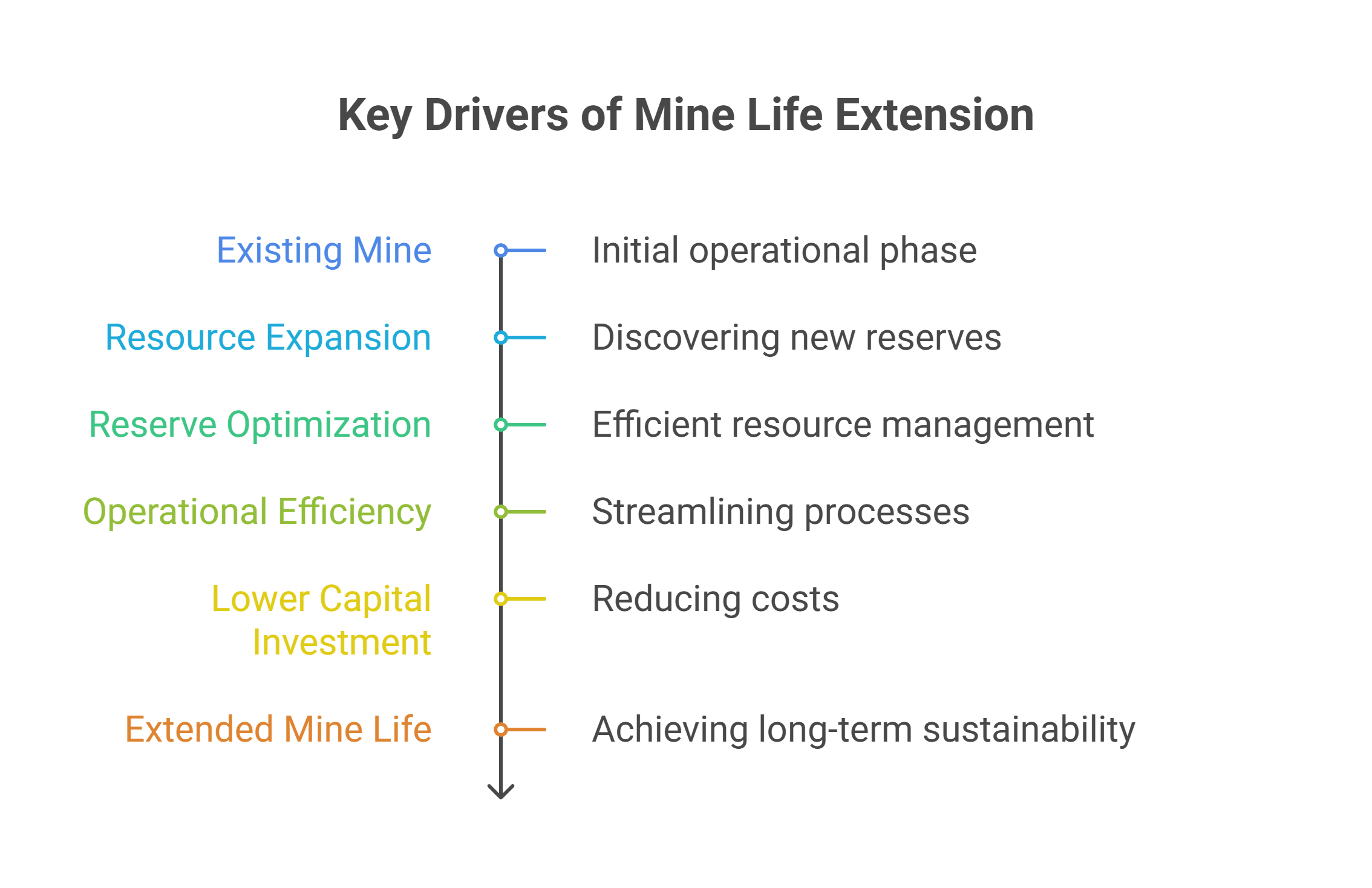
One of the most effective approaches to achieving Mine Life Extension is expanding the available mineral resource surrounding existing operations. Many producing mines continue exploring nearby areas to identify additional mineralization that can be economically integrated into current mining plans. These exploration activities often build upon existing geological knowledge, making them more efficient and less risky than exploring entirely new regions.
Resource expansion alone, however, does not automatically extend mine life. Mineral resources must undergo detailed technical and economic evaluation before they can be converted into economically recoverable reserves. Through geological modelling, drilling programmes, metallurgical testing, and feasibility assessments, mining companies continuously refine their understanding of ore bodies while identifying opportunities to increase recoverable reserves. Successful reserve optimization enables operations to sustain production over longer periods without requiring major new developments.
Mine planning also plays an important role in supporting Mine Life Extension. Sequencing ore extraction, optimizing production schedules, and managing ore blending strategies allow operators to maximize resource recovery while maintaining consistent operational performance. By integrating geological information with economic analysis, mining companies can make informed decisions that improve both short-term productivity and long-term asset value.
Operational Efficiency Creates Additional Value Throughout Mine Life
While resource expansion and reserve growth are fundamental to Mine Life Extension, improving operational efficiency can also significantly extend the productive life of a mining operation. Mines that optimise extraction methods, reduce operating costs, and improve resource recovery are often able to continue operating economically even as ore grades decline or market conditions fluctuate. Rather than relying solely on discovering additional reserves, many operators are creating long-term value by improving how existing resources are mined and processed.
Efficient mine planning plays a central role in this process. Optimising production schedules, reducing ore dilution, improving equipment utilisation, and managing operating costs enable mining companies to maximise the economic value of available reserves. Better coordination between mining and processing operations also helps maintain consistent throughput while minimising operational disruptions that could shorten the productive life of a mine.
Improving recovery rates further strengthens Mine Life Extension by increasing the proportion of valuable minerals extracted from each tonne of ore. More efficient mineral processing allows mining companies to generate greater value from existing deposits without increasing mining volumes, supporting both economic performance and responsible resource utilisation. Together, operational efficiency and recovery optimisation help ensure that mining assets remain competitive throughout changing market conditions.
Sustainability and Community Benefits of Longer Mine Life
The benefits of Mine Life Extension extend beyond operational performance and financial returns. Extending the productive life of an existing mine can also contribute to more sustainable resource development by making better use of established infrastructure and reducing the need for entirely new mining projects. Existing processing plants, transport networks, power supply, and water management systems can continue supporting production, improving the return on previous investments while minimising additional land disturbance associated with new developments.
Longer mine life also provides greater stability for employees, local businesses, and surrounding communities that depend on mining activity. Continued operations help preserve employment opportunities, maintain regional economic activity, and support local supply chains over extended periods. This continuity enables mining companies to strengthen long-term relationships with host communities while providing greater certainty for workforce planning and regional development initiatives.
From an environmental perspective, Mine Life Extension encourages more efficient utilisation of available mineral resources. By maximising the value of existing deposits through improved planning and resource management, mining companies can reduce unnecessary waste while supporting responsible extraction practices. Although environmental performance depends on many operational factors, extending productive assets can contribute to more efficient use of both infrastructure and natural resources over the life of a mine.
 Challenges Continue to Influence Mine Life Extension Strategies
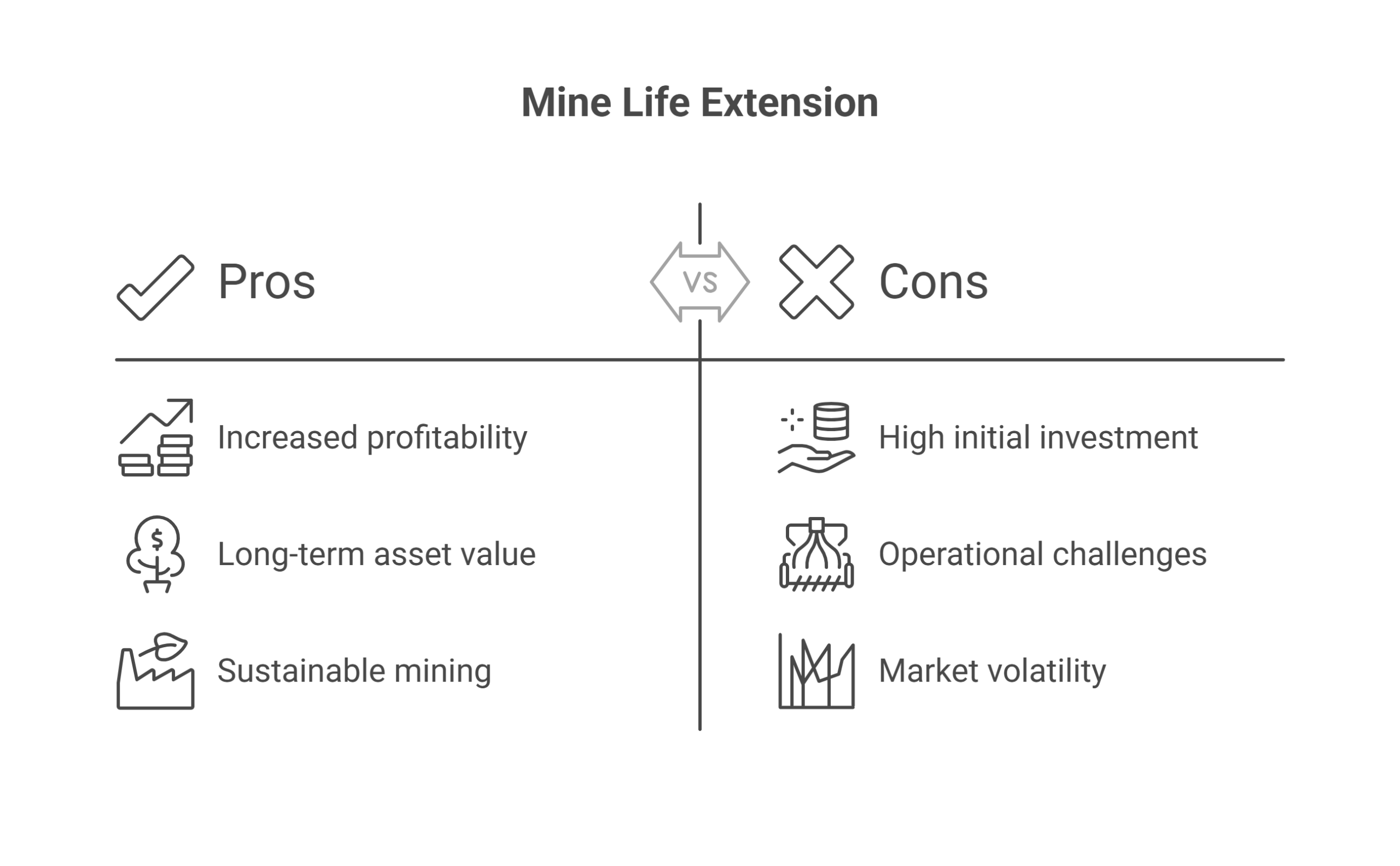
Despite its advantages, achieving Mine Life Extension is not without challenges. Geological uncertainty remains one of the most significant factors affecting long-term planning, as the quantity, quality, and continuity of mineral resources must be confirmed through ongoing exploration and technical evaluation. Even where additional mineralisation is identified, converting resources into economically recoverable reserves requires detailed geological, engineering, environmental, and economic assessments.
Economic conditions also play an important role in determining whether extending mine life remains commercially viable. Changes in commodity prices, operating costs, labour availability, energy expenses, and processing costs can all influence the financial performance of existing operations. Mining companies must continuously reassess production plans and reserve estimates to ensure that extension strategies remain aligned with prevailing market conditions.
Regulatory requirements and environmental obligations further shape Mine Life Extension decisions. Extending operations may require updated permits, environmental approvals, and ongoing engagement with stakeholders throughout the mine lifecycle. Successfully balancing technical feasibility, commercial performance, regulatory compliance, and responsible resource management has therefore become essential to achieving sustainable long-term mine development.
Conclusion
Mine Life Extension has evolved from an operational objective into a strategic business priority that influences long-term resource development, investment planning, and operational resilience across the mining industry. As new mineral discoveries become more challenging and development timelines continue to lengthen, extending the productive life of existing operations allows mining companies to maximise the value of established assets while improving resource utilisation and maintaining production continuity.
Achieving successful Mine Life Extension requires more than expanding mineral reserves. It depends on integrating resource evaluation, efficient mine planning, operational performance, recovery optimisation, and disciplined capital allocation into a unified long-term strategy. By balancing these factors, mining companies can strengthen project economics, support sustainable resource development, and ensure that existing mining operations continue delivering value throughout their productive life.