


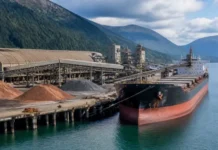






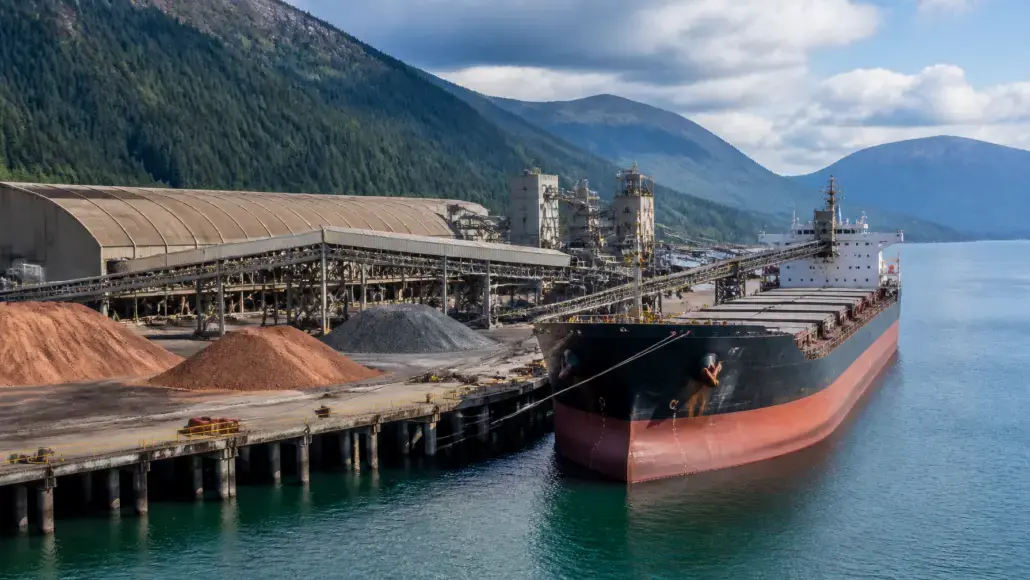

The Portland Canal Marine Terminal has officially opened in British Columbia, establishing a new corridor for critical minerals transportation from one of Canada’s most productive mining regions to international markets. The terminal stands as the province’s first majority Indigenous-owned port, marking a notable development in how mining infrastructure is built and operated in the region.
Ownership, Location and Operational Profile
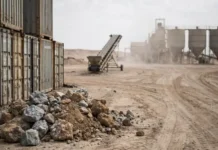
The Portland Canal Marine Terminal is co-owned by the Nisga’a Nation, Tahltan Nation Development Corporation (TNDC), and Arrow Transportation Systems. Located in Stewart, near the Golden Triangle, the facility is a fully permitted deep-sea terminal capable of handling approximately 300,000 tonnes of copper concentrate and gold concentrate annually.
The terminal offers all-weather marine operations and direct highway access across Northwest British Columbia and the Yukon, positioning it as a strategic node for critical minerals transportation across the broader region. Its deep-sea capabilities allow direct shipment of mineral products to global buyers, removing logistical barriers that have historically constrained export routes from the area.
Acquisition and Provincial Funding
The partnership acquired the Portland Canal Marine Terminal in 2025. The Province of British Columbia supported the project with a C$5 million grant through its Northwest Strategy. This funding is directed toward port modernisation, wharf expansion, terminal development, expanded services, long-term storage, and workforce-enabling infrastructure.
President of the Nisga’a Nation Eva Clayton described the official opening as a significant milestone, demonstrating the strength of Indigenous leadership, partnership, and economic self-determination. “Our partnership with the Tahltan Nation and Arrow Transportation demonstrates what can be achieved when Indigenous Nations and industry work together to build meaningful economic opportunities,” Clayton said. “This terminal provides an important gateway to global markets and strengthens the infrastructure needed to support the growing critical minerals sector in Northwest British Columbia.”
Tahltan Nation Development Corporation CEO Todd den Engelsen said the partnership underscores a shared commitment to regional development. “The acquisition of the Port of Stewart Bulk terminal and the creation of a transportation business is more than infrastructure. It is a gateway to global markets, improved logistics, and economic growth for the Tahltan and Nisga’a Nations, our partners, and Canada as a whole,” den Engelsen said.
Critical Minerals Transportation and Supply Chain Connectivity
The terminal’s capacity and connectivity give it a central role in the critical minerals supply chain for Northwest British Columbia. With the Golden Triangle hosting significant copper and gold deposits, the Portland Canal Marine Terminal provides producers in the region with a reliable, permitted export route. Its highway links to the Yukon further extend the catchment area for critical minerals transportation, connecting remote operations to a functional deep-sea port.
The Indigenous-owned port model adopted here reflects a growing trend in British Columbia mining where First Nations take direct ownership stakes in infrastructure that supports resource development on or near their traditional territories. This approach ties economic participation directly to the facilities that enable critical minerals transportation rather than limiting involvement to benefit agreements alone.
Reinforcing Mining Infrastructure in British Columbia
The opening of the Portland Canal Marine Terminal adds a significant piece of mining infrastructure to British Columbia’s northwest corridor. By combining Indigenous ownership with deep-sea shipping capability and substantial provincial investment, the terminal is positioned to serve as a long-term gateway for copper concentrate and gold concentrate exports. As demand for critical minerals transportation capacity grows alongside exploration and development activity in the Golden Triangle and surrounding regions, the facility addresses a tangible infrastructure need for the province’s mining sector.