









Comprehending Carbonatite-Hosted Critical Minerals of Southern Africa
Carbonatite intrusions are among the most intriguing geological events in global critical mineral exploration, focusing on a variety of strategic elements via complex magmatic processes in order to produce large-tonnage deposits with surprisingly uniform grade distribution.
These unusual igneous systems, which are derived from carbon-bearing magmas rising from the Earth’s mantle, happen to be natural concentrators of rare earth elements, strontium, niobium and related minerals which are of growing importance in uses in terms of modern technology.
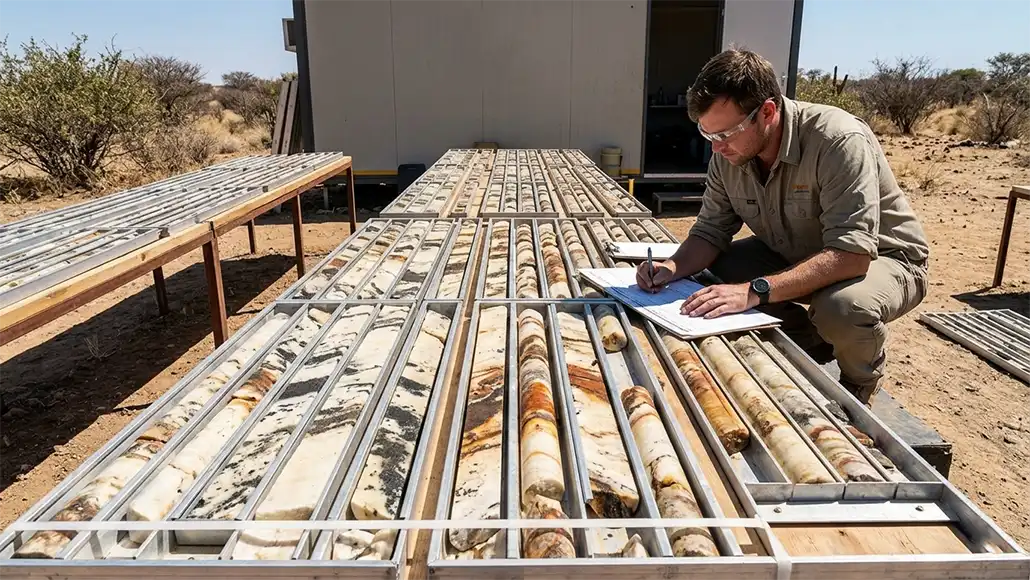
It is well to be noted that Southern Africa is home to some of the most important carbonatite-hosted critical minerals systems in the world, and Kameelburg’s rare-earth exploration drilling has confirmed the outstanding potential of such geological formations. Recent drilling returned 354.2 metres of ongoing mineralisation from a single drill hole, demonstrating the impressive scale as well as consistency of well-developed carbonatite systems.
Geological Formation Mechanisms pertaining to REE-Niobium Deposits
Very specialised processes in the formation of carbonatite intrusions create perfect conditions for the concentration of critical minerals. These magmatic systems are formed by a rise of carbon-rich melts from the mantle and their interaction with crustal rocks, producing characteristic mineralogical assemblages consisting of high concentrations of rare earth elements, strontium, niobium and associated commodities.
Formation of carbonatite-hosted deposits includes multiple phases of magmatic evolution and mineralisation. Initial emplacement happens when carbonatitic melts intrude crustal rocks and form large-scale intrusive structures that may extend over several kilometres. These melts concentrate incompatible elements, such as rare earth elements, strontium and niobium, into different mineral phases during crystallisation.
Kameelburg’s geological study has shown that ancylite is the most common rare earth mineral – an attribute of carbonatite-hosted systems around the world. The mineral assemblage is typical of normal carbonatite genesis, with rare earth elements entering carbonate-rich phases during the magmatic crystallisation.
Magnetite-rich zones within the mineralised system reflect the complex interaction between carbonatitic melts and iron-bearing phases. The zones are prospective for multi-commodity extraction, as indicated by a 74-metre intersection of iron ore averaging 30% Fe within the broader mineralised system.
Carbonatite intrusion and mineralisation characteristics
Carbonatite systems exhibit unique mineralisation characteristics that vary from those of other deposit forms. The continuous 354.2-metre mineralised interval at Kameelburg is indicative of the large scale and consistent grade distribution characteristic of well-developed carbonatite deposits. This continuity is due to the even distribution of mineralising fluids during the emplacement of the carbonatite.
Crustal contamination is a key factor in the control of final grade distribution patterns in carbonatite systems. Carbonatitic melts may absorb surrounding rocks as they react to them, which may either improve or dilute the concentration of a specific commodity. This process produces the intricate zonation patterns typical of many carbonatite-hosted deposits.
The Strategic Mineral Endowment of the Damara Orogenic Belt
The Kameelburg project is located within the Damara Orogenic Belt, an important metallogenic province of the geological framework of southern Africa. This belt was formed during Neoproterozoic to early Paleozoic orogenic events which provided favourable conditions for the emplacement of carbonatites and associated mineralisation.
Regional geological work has identified multiple carbonatite intrusions in the Damara Belt, indicating a belt-wide mineralising system with scope for further discovery. The recent critical minerals strategy of the Government of Australia highlights the significance of securing diverse sources of supply for these critical materials. The structural controls as well as magmatic processes which led to the formation of the Kameelburg deposit probably extended over larger regions inside this geological sphere.