
























Escalating water recycling rates in mineral beneficiation plants have introduced severe chemical instability into milling and froth flotation circuits. When modern concentrators operate with water recycling rates exceeding 80 to 90 percent, reclaimed water from thickeners, tailings ponds, and mine dewatering systems carries variable loads of dissolved ions, residual organic reagents, thiosalts, and colloidal particles. To maintain steady metallurgical recoveries and prevent reagent overdosing, industrial concentrators are replacing periodic manual grab sampling with continuous water quality monitoring across their processing streams.
Historically, plant operators relied on daily or shift-based laboratory assays to determine process water composition. This operational latency of several hours or days rendered water management purely reactive. By the time laboratory titrations revealed a spike in calcium hardness, a drop in pulp oxidation-reduction potential, or an accumulation of residual frother, thousands of metric tons of valuable mineral had already passed unrecovered into the tailings stream.
Continuous water quality monitoring provides process metallurgists with instantaneous, stream-specific chemical data. Automated sensor arrays installed directly within grinding discharge lines, conditioner tanks, and flotation feedwells enable proactive chemical adjustments, safeguarding mineral recovery rates and delivering substantial operational savings across reagent supply chains.
Flotation Sensitivity to Recycled Water Chemistry
Froth flotation represents one of the most chemically sensitive unit operations in industrial mineral processing. The separation of valuable sulfide minerals, such as chalcopyrite, pentlandite, or galena, from barren silicate and carbonate gangue depends upon precise surface chemistry manipulations.
When process water is continuously recycled without rigorous quality tracking, accumulated chemical species disrupt this delicate balance through several distinct mechanisms:
- Residual organic collectors, including xanthates and dithiophosphates, return in recycle water and inadvertently float gangue minerals, degrading final concentrate purity
- Polythionates and thiosalts consume dissolved oxygen rapidly in the pulp phase, depressing valuable sulfide flotation kinetics and reducing overall metal recovery by 2 to 5 percent
- Fluctuation in multivalent cations, particularly calcium and magnesium, precipitates inorganic hydroxides that coat mineral surfaces, preventing collector adsorption
- Variable frother residuals alter bubble size distribution and froth stability unpredictably, resulting in excessive water recovery and fine slime entrainment into the final concentrate
- Seasonal ambient temperature variations and reservoir stratification alter reagent dissociation constants, producing unanticipated surges in dissolved ionic strength across the circuit
Without continuous analytical visibility, operators frequently overcompensate by over-dosing expensive activators, depressants, and frothers, driving up production costs and accelerating water quality degradation downstream.
Advanced Sensor Architectures for Industrial Slurries
Deploying analytical instruments into abrasive mineral slurries presents significant engineering hurdles. High solids content, coarse mineral particles, scaling precipitates, and turbulent flow rapidly foul conventional laboratory-grade electrodes.
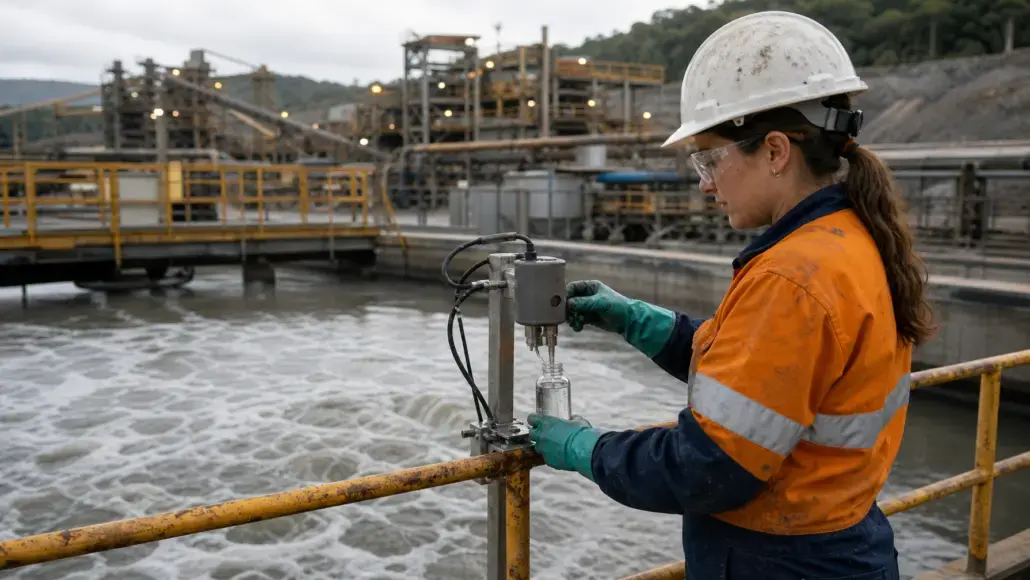
Modern mineral processing facilities overcome these harsh conditions by deploying ruggedized, industrial-grade analytical sensor skids designed for continuous duty. Multi-parameter monitoring platforms combine optical, electrochemical, and physical measurements within self-cleaning analytical enclosures. Specialized sample conditioning modules utilize miniature polyurethane hydrocyclones and continuous static strainers to remove coarse sands from the sample stream, presenting a de-gritted slurry to the measurement cells without distorting chemical equilibrium.
Ultraviolet-visible spectrophotometers equipped with fiber-optic flow-through probes measure residual collector and frother concentrations directly in clarified process streams. By analyzing spectral absorption peaks, optical sensors distinguish between active collector molecules and oxidized degradation byproducts in real time.
Electrochemical analysis relies on solid-state ion-selective electrode arrays and glass-free enamel-coated pH sensors:
- Solid-state ion-selective sensors continuously track free calcium, chloride, sodium, and copper ions, alerting operators to scale risks and accidental chemical activation
- Differential oxidation-reduction potential electrodes measure pulp redox states without drift, providing critical inputs for managing sulfidization and collector adsorption
- High-frequency toroidal conductivity sensors monitor total dissolved solids loadings, impervious to fouling from suspended mineral fines and scale buildup
- Luminescent dissolved oxygen probes track oxygen consumption rates across conditioner cells, allowing precise control of slurry aeration blowers
To prevent sensor blinding from gypsum scaling and biofouling, modern sensor assemblies feature automated cleaning mechanisms, including high-frequency ultrasonic transducers, compressed air-purge blasts, and periodic automated acid flushing cycles.
Telemetry, Digital Twins, and Automated Reagent Control
The true operational value of real-time water data emerges when sensor signals are integrated into the plant distributed control system and digital twin architectures. Industrial Internet of Things edge gateways collect data from distributed monitoring stations across the processing plant, transmitting high-frequency measurements via industrial protocols such as OPC-UA and Modbus.
Advanced process control algorithms process incoming water chemistry metrics alongside feed ore tonnage, mineralogy, and particle size distributions. Instead of maintaining static reagent dosing ratios based solely on ore mass, the control system dynamically modulates chemical additions based on instantaneous water quality:
- Dynamic lime dosing adjusts milk-of-lime injection into grinding mills to achieve precise target pH levels, compensating automatically for fluctuating water alkalinity
- Predictive frother control regulates surfactant addition based on measured residual frother concentrations in recycled thickener overflow streams
- Depressant optimization modulates sodium hydrosulfide or cyanide addition during complex polymetallic separations, matching reagent delivery to exact pulp redox targets
- Automated blowdown routing diverts highly contaminated water streams before they can destabilize main flotation banks
Plant deployments across copper and gold concentrators in 2025 demonstrated that transitioning to sensor-guided reagent dosing achieved a 12 to 18 percent reduction in total flotation reagent consumption, while simultaneously stabilizing concentrate grades and lifting overall copper recovery by 1.2 percent.
Linking Water Quality to Effluent Upgrading Circuits
Real-time water analytics also serve a vital defensive function by protecting downstream water treatment and dewatering assets. When process upsets occur, such as a thickener bed slip or a reagent pump malfunction, sensor skids placed at thickener overflow launders immediately detect elevated turbidity, unconsumed polymer flocculant, or abnormal pH excursions.
When monitoring systems detect that process water has accumulated refractory salts, heavy metals, or scaling ions beyond allowable operating limits, the plant control system automatically isolates a portion of the stream. Rather than recirculating compromised water through the mill, the facility routes the contaminated volume directly to Advanced Membrane Filtration for Mining Wastewater Treatment. This targeted treatment extracts dissolved contaminants and returns pristine permeate to the concentrator, maintaining closed-loop balance without risking process upsets.
Economic Returns and Sustainable Plant Resilience
The capital cost of installing a comprehensive, plant-wide water quality monitoring network typically ranges between 250,000 and 750,000 dollars, depending on the number of flotation circuits and analytical parameters required. Given that reagent expenditures at a large-scale concentrator frequently exceed tens of millions of dollars annually, the investment routinely achieves payback within six to nine months through reagent savings alone.
Industry benchmarks presented at mineral processing operational forums in 2025 confirmed that unexpected ionic shifts account for up to 4 percent of avoidable metallurgical losses in high-recovery sulfide plants. A single day of suppressed recovery in a world-class copper or gold plant can represent hundreds of thousands of dollars in lost mineral revenue, dwarfing the initial instrumentation expense.
Deploying water quality monitoring transforms water management from a blind operational vulnerability into an active tool for process optimization. By providing continuous chemical intelligence, these automated platforms empower metallurgists to maximize water recycling rates, minimize chemical footprints, and maintain peak metallurgical performance across variable mining conditions.