













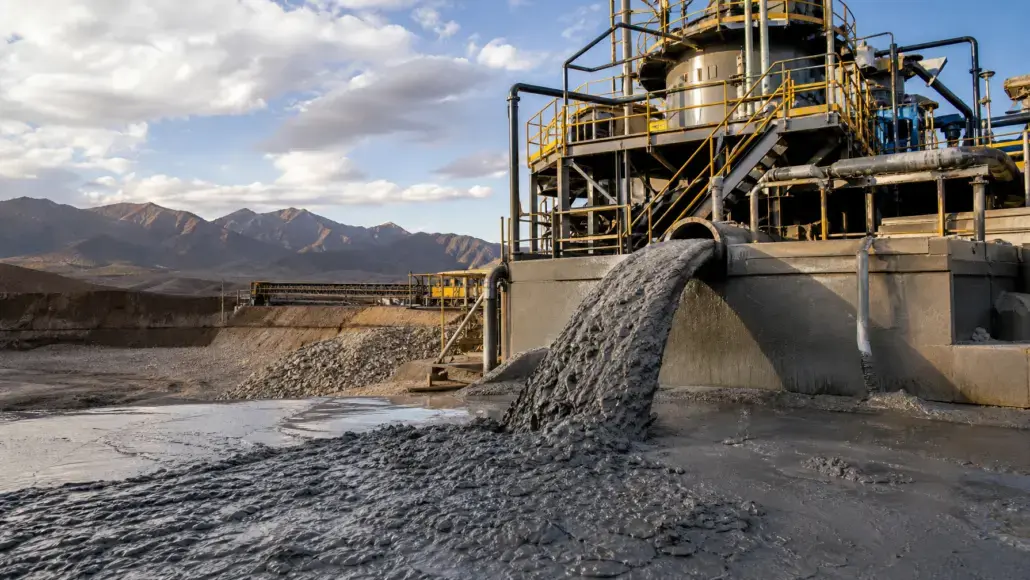

Stringent compliance deadlines established by the Global Industry Standard on Tailings Management have compelled mining companies worldwide to eliminate high-risk, conventional wet tailings storage facilities. Catastrophic historical dam breaches have forced insurers, international financiers, and mining ministries to mandate fundamental changes in slurry disposal. Implementing high-density paste thickening technologies for improved tailings management has emerged as an essential operational strategy to secure geotechnical stability, recover massive water volumes, and minimize environmental liabilities.
Traditional mineral processing plants historically discharged dilute slurries containing 25 to 40 percent solids by weight directly into expansive valley or paddock impoundments. In these conventional systems, billions of liters of process water remain trapped behind massive earthen containment embankments. This creates immense hydrostatic pressures, elevates the risk of seismic liquefaction, and causes continuous water losses through surface evaporation and sub-surface seepage.
Paste thickening fundamentally transforms this waste stream by mechanically dewatering tailings at the processing plant until the material achieves a non-segregating, paste-like consistency. By adopting paste thickening technologies, mine operators recycle up to 88 percent of process water immediately at the mill discharge, while producing an engineered material that forms structurally stable, self-supporting deposits without requiring conventional liquid storage impoundments.
Rheological Foundations of High-Density Tailings
The transition from a dilute slurry to an engineered paste represents a critical shift in fluid mechanics. Dilute mineral slurries behave as Newtonian fluids, where shear stress correlates linearly with shear rate, and solid particles settle freely by gravity once agitation ceases.
As solid concentrations increase beyond critical thresholds, particle-particle interactions begin to dominate fluid behavior. High-density paste exhibits non-Newtonian, Bingham plastic or yield-pseudoplastic rheology. The material possesses an internal yield stress, typically ranging between 100 and 300 Pascals, which must be overcome before flow can initiate. Once sheared, the paste flows smoothly, but when brought to rest, the suspension locks into place without particle segregation or significant surface water bleeding.
Key rheological parameters dictating paste behavior across transport and deposition circuits include:
- Yield stress threshold determining whether the material can be deposited in sloped layers without lateral containment walls
- Plastic viscosity governing pressure drops and friction losses across long-distance overland discharge pipelines
- Critical solids concentration defining the sharp transition zone where minute increases in solids cause exponential spikes in slurry yield stress
- Particle size distribution, particularly the presence of at least 15 percent fine particles below 20 microns, which retains moisture within the mineral skeleton and prevents pipeline settling
Engineers carefully balance these properties to ensure the paste remains pumpable through overland pipelines while retaining sufficient structural cohesion upon discharge to facilitate rapid surface drying and progressive rehabilitation.
Deep Cone and High-Compression Thickener Engineering
Producing mineral paste at industrial throughputs exceeding thousands of metric tons per day requires specialized dewatering vessels. Deep cone thickeners and high-compression thickeners differ fundamentally from conventional, shallow settling basins through their steep floor angles and elevated aspect ratios.
A deep cone thickener features a cylindrical tank with a sidewall height often exceeding 15 meters and a conical bottom with a steep slope of 30 to 45 degrees. Slurry enters through an engineered central feedwell where automated dilution systems mix the incoming pulp with recycled clarified water, optimizing feed solids for maximum chemical flocculation.
Within the deep settling column, the weight of the consolidating mud bed exerts massive compressive stress on the underlying mineral matrix. This hydrostatic bed pressure squeezes trapped pore water out from between consolidated particles. Heavy-duty rake mechanisms equipped with vertical structural pickets slowly rotate through the compressing mud bed, creating vertical pathways that allow liberated water to escape upward toward the surface overflow launder.
Mechanical drive systems in modern deep cone thickeners incorporate automated torque-sensing hydraulic lifts. When mud bed density or yield stress exceeds design limits, the rake automatically raises to reduce mechanical strain, preventing rake stall and ensuring continuous, stable underflow pumping.
Polymer Flocculation and Dewatering Chemistry
Effective paste thickening relies heavily on the tailored application of synthetic flocculants. Without chemical aggregation, fine sub-micron clay particles and mineral slimes remain suspended indefinitely due to repulsive electrostatic surface charges.
Mining operations utilize high-molecular-weight anionic polyacrylamides characterized by specific charge densities and molecular weights reaching 15 to 20 million Daltons. These long-chain polymer molecules bridge multiple mineral particles simultaneously, collapsing diffuse electrical double layers and aggregating fine particles into large, robust flocs that settle at velocities exceeding 30 meters per hour.
Operational parameters governing flocculant effectiveness include:
- Automated multi-point dosing that introduces dilute polymer solutions across successive feedwell stages to prevent floc shearing
- Dynamic feedwell dilution maintaining pulp solids between 8 and 12 percent, maximizing polymer-particle collision frequencies
- Rapid optical flocculation sensors monitoring floc growth in real time, adjusting polymer dosages dynamically in response to changes in ore mineralogy
- Coagulant pre-treatment utilizing inorganic multivalent salts to neutralize high negative zeta potentials before introducing long-chain polymer flocculants
By optimizing flocculation chemistry, operators minimize polymer consumption while producing crystal-clear overflow water with suspended solids concentrations below 50 milligrams per liter, making the reclaimed water immediately suitable for plant reuse.
Pumping Dynamics and Surface Deposition Strategies
Transporting high-density paste from the thickener underflow to the deposition site presents complex fluid dynamics challenges. Centrifugal slurry pumps, which operate effectively on dilute slurries, suffer severe efficiency losses and cavitate when handling high-yield-stress paste.
Operations rely on heavy-duty positive displacement pumps, predominantly hydraulically driven twin-cylinder piston or piston-diaphragm pumps. These units generate operating pressures up to 100 to 160 bar, propelling dense paste through high-pressure steel pipelines over distances exceeding 10 kilometers. Pipeline instrumentation includes continuous loop rheometers and acoustic pulse monitoring to detect internal wall friction and prevent catastrophic line blockages.
At the surface storage facility, paste is discharged from elevated central towers or along perimeter ring manifolds. The material spreads out in shallow, uniform layers at natural slopes ranging from 2 to 6 degrees. Once deposited, thin paste layers desiccate under ambient solar and wind conditions, consolidating into a dense, geotechnically competent mass with low hydraulic conductivity.
This deposition methodology eliminates the perched water ponds inherent in conventional dams, removing the primary catalyst for dam breaches and drastically cutting closure costs.
Closed-Loop Water Recycling and Process Integration
The primary economic and environmental benefit of paste thickening is the immediate recovery of process water. Recovering 85 percent or more of water at the processing plant drastically reduces raw water withdrawal permits and pumping energy costs.
However, recirculating massive volumes of thickener overflow water directly back to milling and flotation circuits alters overall circuit chemistry. Reclaimed water carries accumulated residual polyacrylamides, fine colloidal particulates, and concentrated dissolved salts that can destabilize froth structures or alter chemical reagent adsorption.
To ensure that recycled water streams do not compromise downstream mineral recovery, mineral processing facilities pair dewatering systems with Real-Time Water Quality Monitoring in Mineral Processing Plants. Continuous analytical monitoring enables metallurgists to detect chemical fluctuations in thickener overflow before the water is reintroduced into sensitive flotation circuits.
Deploying paste thickening technologies for improved tailings management bridges the gap between mineral processing efficiency and long-term environmental safety. By replacing hazardous liquid storage dams with stable, high-density paste stacks, mining companies reduce catastrophic failure risks, conserve critical regional water resources, and establish a foundation for responsible mine closure.