








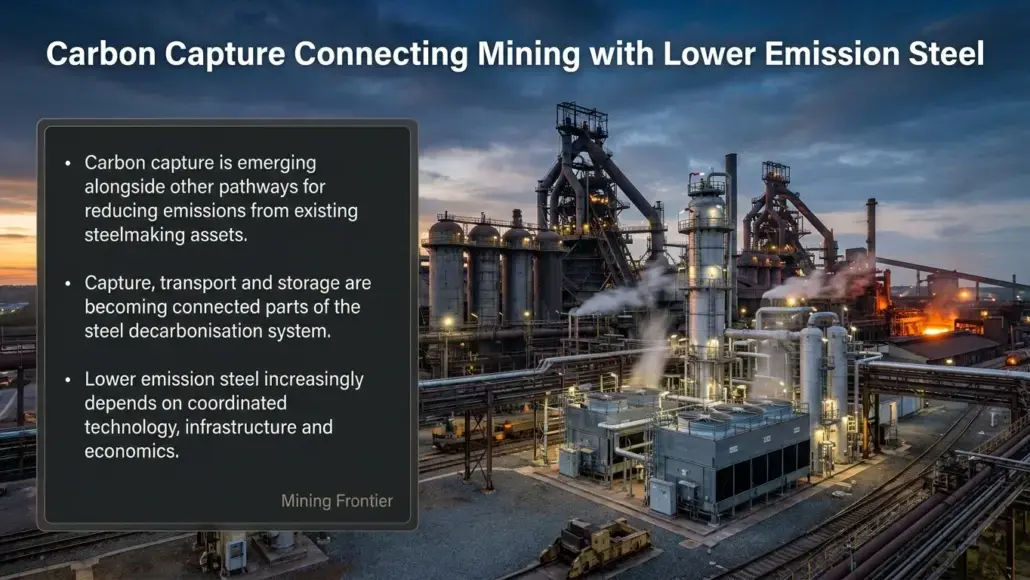

Steelmaking is adding more decarbonisation pathways as producers consider how to reduce emissions from existing production systems while developing new ironmaking technologies. The blast furnace and basic oxygen furnace route still accounts for around 70% of global steel production, keeping conventional assets central to the industry’s transition. This creates a role for carbon capture alongside hydrogen based direct reduction, electric steelmaking and other measures that address emissions at different stages of production.
The importance of carbon capture comes from the nature of conventional ironmaking. Coal and coke are not used only as sources of heat. They also participate in the chemical reduction of iron ore, meaning that changing the electricity source alone cannot remove all process emissions. Capturing carbon dioxide from suitable gas streams can therefore provide a pathway for reducing emissions while existing assets remain in operation.
Existing Steel Assets Creating a Retrofit Question
The scale of the existing production base makes retrofit options strategically relevant. Rather than assuming that all conventional furnaces can be rapidly replaced, the industry is examining whether selected plants can integrate capture systems into existing process infrastructure.
Steel Decarbonisation Pathways
- Process capture: Target carbon dioxide from concentrated gas streams generated by ironmaking and steelmaking processes.
- Energy integration: Manage the additional heat and electricity requirements created by capture equipment.
- Alternative production: Combine capture with other measures where complete process transformation is not immediately practical.
- Infrastructure connection: Link captured carbon dioxide with transport and permanent storage systems.
Recent research illustrates why capture cannot be treated as one standard technology. A 2026 study comparing three amine systems across blast furnace gas, sintering gas and basic oxygen furnace gas found meaningful differences in regeneration energy and capture cost, even when the systems were designed around a 90% capture target.
Capture Performance Depending on Process Design
The performance of carbon capture depends on the composition and concentration of the gas stream, the capture technology selected and the energy required to regenerate the capture medium. A 2026 pilot scale study on real blast furnace gas demonstrated more than 90% carbon dioxide removal in its specific calcium and copper looping configuration, showing that higher capture performance is technically achievable under controlled conditions.
These results do not establish a universal capture rate for steelmaking. They instead show why technology selection, process integration and plant specific conditions will determine how effectively capture can contribute to broader steel decarbonisation.
Capture Systems Adapting to Steel Gas Streams
The practical challenge begins once a steel plant identifies which emissions can be captured and how the capture system can be integrated into an operating process. Carbon capture is not a single technology with identical performance across steelmaking. Blast furnace gas, sintering gas and basic oxygen furnace gas have different compositions and concentrations, affecting equipment design, energy requirements and capture economics.
A 2026 study comparing three amine based systems across these steelmaking gas streams found meaningful differences in regeneration energy and levelised capture cost, despite using a common 90% capture target. This reinforces the importance of matching the capture system with the characteristics of each process stream rather than applying a standard configuration.
Capture System Variables
• Gas composition: Determines the suitability of different separation technologies.
• Energy demand: Capture systems require additional heat and electricity that must be incorporated into plant planning.
• Process integration: Equipment must operate alongside existing ironmaking and steelmaking systems.
• Capture scope: The percentage captured from one stream does not equal the percentage reduction in total plant emissions.
Carbon Infrastructure Extending Beyond the Steel Plant
The next challenge is what happens after carbon dioxide is separated. Carbon capture becomes more strategically important when it forms part of a wider system that includes compression, transport and permanent storage.
Global carbon capture and storage infrastructure is expanding, although deployment remains at an early stage. The Global CCS Institute reported 77 commercial carbon capture and storage projects in operation and another 47 under construction in 2025, alongside a much larger development pipeline.
Carbon Management Infrastructure
• Compression: Captured CO2 must be conditioned for transport.
• Transport: Pipelines, ships and other systems can connect industrial emitters with storage locations.
• Storage: Suitable geological formations require assessment, monitoring and regulatory approval.
• Shared hubs: Multiple industrial facilities can potentially use common transport and storage infrastructure.
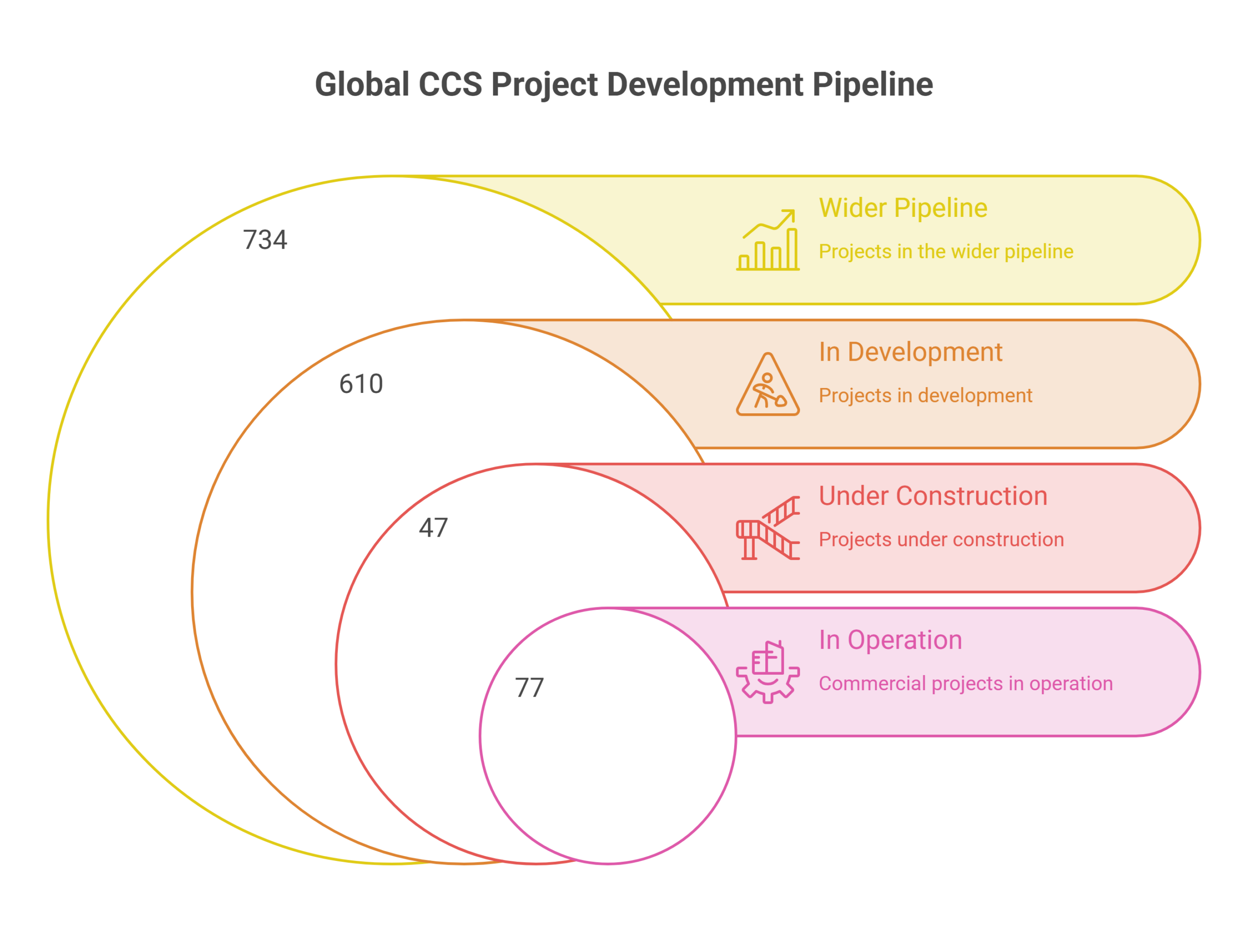
The growing project pipeline shows that carbon management infrastructure is developing beyond individual capture installations.
For steel producers, this broader infrastructure model can influence where future plants are located and whether shared transport and storage networks are available. It also strengthens the value of transparent emissions information as products move through increasingly complex industrial systems, making product level carbon data a natural next step in the decarbonisation discussion. Carbon capture therefore becomes part of a wider industrial network rather than an isolated plant retrofit.
Carbon Management Becoming Part of the Steel Transition
The role of carbon capture is expanding from an individual technology question into a broader infrastructure and value chain issue. For existing steelmaking assets, capture can provide one pathway for addressing residual emissions while alternative ironmaking routes continue to develop.
Its wider relevance depends on conditions across the system:
Conditions For Deployment
• Suitable carbon dioxide streams for capture
• Sufficient energy for capture and compression
• Reliable transport infrastructure
• Suitable geological storage capacity
• Project economics and supportive policy
The evidence does not establish capture as a universal solution for steel. Performance varies by gas stream, technology, plant configuration and energy source. The expanding global CCS project pipeline nevertheless shows that capture, transport and storage infrastructure is developing at increasing scale. This creates a foundation for steel producers to evaluate capture as part of broader decarbonisation strategies while other lower emission production routes mature.
References
- International Energy Agency: Breakthrough Agenda Report 2025: 2025
- Ehsan Soroodan, Graeme Puxty, Sanger Huang, Paul Feron and colleagues: Energy and economic performance of three amine technologies for carbon capture in integrated iron and steel production plants: International Journal of Greenhouse Gas Control: 2026
- Jose Ramon Fernandez, Monica Alonso, Roberto Garcia, Alberto Mendez, Marcos Cano and Carlos Abanades: Pilot scale demonstration of Ca Cu looping for CO2 capture from blast furnace gas: Chemical Engineering Journal: 2026
- Global CCS Institute: Global Status of CCS 2025: 2025