









As mining companies address emissions across power, processing and equipment, methane requires a different approach because the priority is not simply reducing energy consumption. Mine methane is closely connected to how coal deposits are developed, ventilated and managed, making measurement and source identification important parts of credible abatement planning. The International Energy Agency (IEA) estimates that coal operations released 43 million tonnes (Mt) of methane in 2025, highlighting the scale of emissions associated with coal production globally.
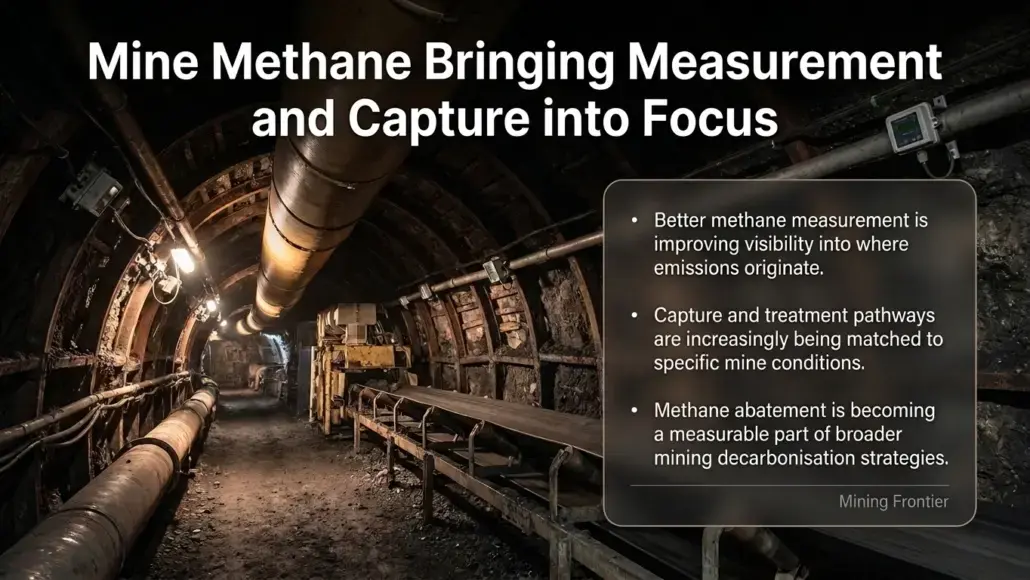
The challenge is particularly pronounced in underground mining, where methane has to be removed from working areas to maintain safe conditions. Ventilation systems therefore serve an essential operational purpose while also creating a pathway for methane to enter the atmosphere. The United Nations Economic Commission for Europe (UNECE) notes that ventilation air in gassy underground coal mines typically contains methane concentrations of 0.1% to 1.0% by volume.
Measurement Becoming the First Abatement Decision
Improving mine methane management begins with determining where emissions originate, how concentrations vary and which streams can realistically be controlled. Measurement is increasingly drawing on different forms of evidence rather than relying on a single estimation method. The IEA’s 2026 assessment combines measured, satellite and inferred data, reflecting the expanding role of multiple approaches in building methane inventories.
Key Measurement Priorities
- Source identification: distinguish ventilation, drainage and other methane-release pathways.
- Emission quantification: establish credible volumes and concentration profiles.
- Operational monitoring: understand how emissions change with mining activity and conditions.
- Verification: compare different measurement approaches and improve confidence in reported data.
For mine operators, measurement is therefore more than an environmental reporting exercise. It provides the foundation for deciding whether methane drainage, utilisation, flaring or ventilation-air treatment is technically appropriate for a particular operation.
Mine Conditions Shaping the Abatement Pathway
The technical response depends heavily on methane concentration, mine design and the characteristics of each emission stream. Drainage systems can provide more concentrated gas that may be suitable for recovery or utilisation, while ventilation air presents a fundamentally different engineering challenge because very large air volumes contain comparatively dilute methane. UNECE’s guidance identifies this low-concentration, high-volume characteristic as a central challenge for ventilation air methane mitigation.
Mine-Specific Abatement Considerations
- Methane concentration and flow rate
- Ventilation and drainage system design
- Safety and operational requirements
- Availability of capture or destruction infrastructure
- Economic value of recovered methane or avoided emissions
This makes mine methane abatement less about selecting one universal technology and more about connecting reliable measurement with mine-specific engineering, safety requirements and the economics of capturing or destroying methane.
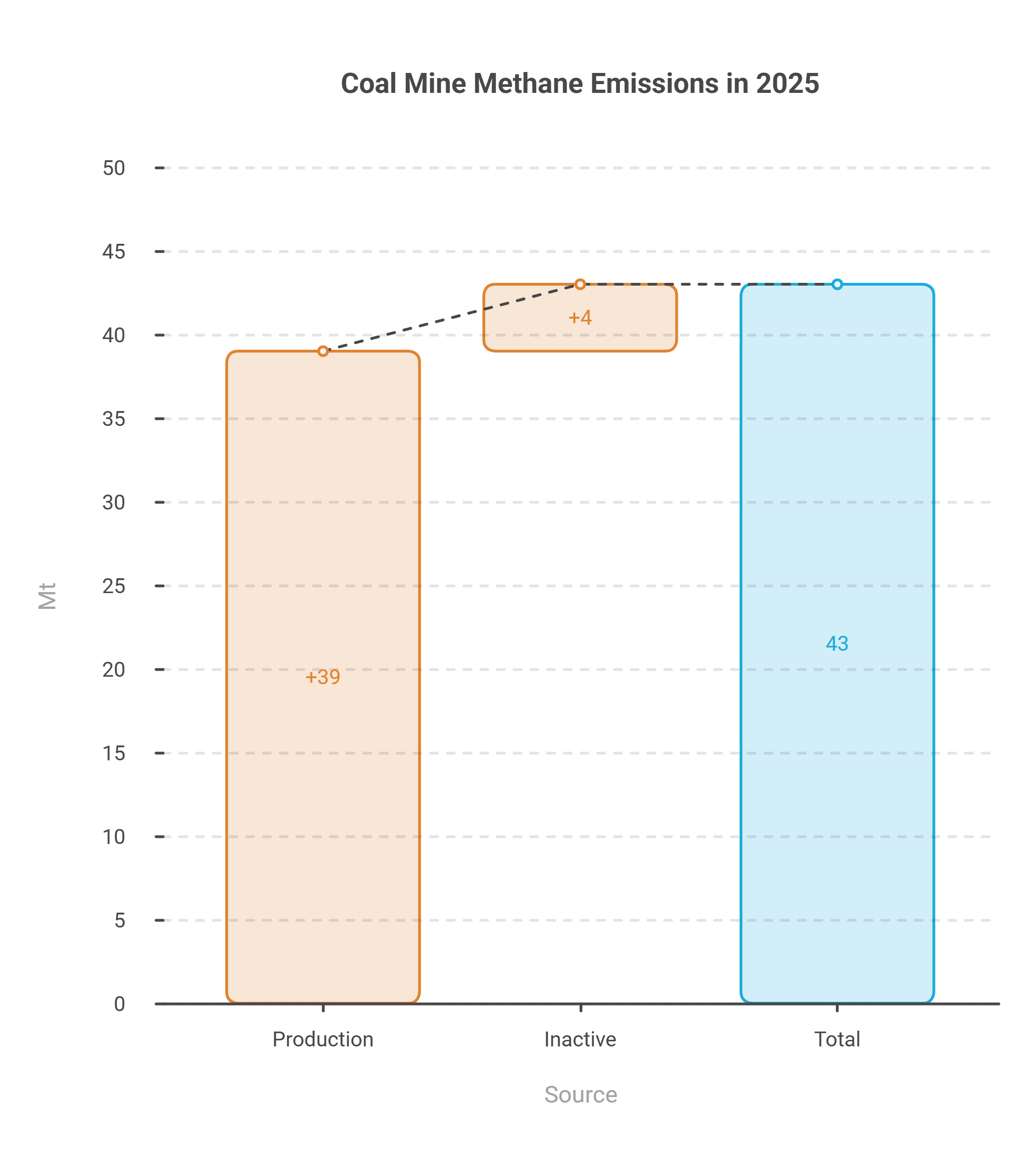
The global emissions scale shows why methane measurement and abatement across operating and inactive coal mines remain important decarbonisation priorities.
The economics, however, remain site-specific. The IEA notes that existing technologies could address about half of coal-related methane emissions, but capturing and using methane is not economically viable at every mine. This makes the value of avoided emissions, policy incentives and available infrastructure important alongside the physical potential for recovery.
For mines assessing mine methane projects, this creates a progression from identifying an emission source to determining whether it can be converted into a controlled abatement project. The same decision framework also becomes relevant when considering hard to electrify mining activities, where the challenge shifts from methane reduction to alternative energy pathways.
Methane Abatement Becoming a Mine-Specific Strategy
Methane management is increasingly shifting from broad emissions estimation toward a more structured process of measurement, source identification and targeted abatement. Mine methane strategies need to reflect the characteristics of individual operations because ventilation systems, drainage infrastructure, gas concentrations and available treatment technologies differ significantly between mines.
The strongest approach connects emissions data with practical engineering and investment decisions:
- Measure consistently: establish reliable emissions baselines and identify major release pathways.
- Match technology to the source: assess drainage, utilisation, flaring or ventilation-air treatment according to gas characteristics.
- Evaluate the economics: consider infrastructure requirements, operating conditions, policy incentives and the value of avoided emissions.
This approach can make methane reduction a more measurable part of mining decarbonisation while maintaining the safety and operational requirements that shape underground mine ventilation.
References
- International Energy Agency – Global Methane Tracker 2026 – 2026
- United Nations Economic Commission for Europe – Best Practice Guidance on Ventilation Air Methane Mitigation – 2025