








The global mining industry faces a persistent challenge as ore grades continue to decline across major commodities, making the efficiency of extraction processes more critical than ever. Operators are increasingly focused on improving mineral recovery rates to maintain economic viability and meet the rising demand for metals essential to the global energy transition. This shift requires a rigorous analytical approach to processing technology, moving away from traditional methods toward more precise, data-driven solutions that maximize the value of every ton of ore processed. By integrating sophisticated metallurgical techniques with modern infrastructure, mining companies can address the complexities of varying ore mineralogy while reducing waste and optimizing operational costs. The pursuit of higher yields is not merely a technical objective but a strategic necessity in an environment characterized by increasing input costs and stringent environmental regulations. Every percentage point gained in recovery translates into significant revenue increases, especially for high-volume operations handling precious or critical metals. Consequently, the adoption of specialized equipment and the refinement of chemical processes have become priority areas for investment across the sector.
Implementation of Advanced Flotation Systems
Flotation remains a cornerstone of mineral processing, particularly for base metal sulfides and gold ores. The evolution of flotation cell design has moved toward larger, more efficient units that provide better bubble-particle attachment and improved froth stability. Recent developments in pneumatic flotation technology allow for the recovery of finer particles that were previously lost to tailings. These systems utilize controlled air injection and intense mixing zones to increase the probability of collision between air bubbles and mineral particles. By enhancing the selectivity of the flotation process, mining operations can significantly boost their overall mineral recovery rates without necessitating a massive increase in energy consumption. The mechanics of bubble generation have been refined to produce a more uniform bubble size distribution, which is essential for carrying different particle sizes to the froth layer. This precision minimizes the occurrence of entrainment, where unwanted gangue minerals are accidentally lifted, thereby improving the grade of the final concentrate.
The chemical aspect of flotation is equally important, with the development of specialized collectors and frothers tailored to specific mineral suites. Reagent optimization involves careful testing of pH levels, pulp density, and dosage rates to ensure that target minerals are effectively separated from gangue materials. Advanced monitoring tools now provide real-time data on froth characteristics, allowing operators to adjust parameters instantly. This level of control is vital when dealing with complex ores where mineralogy changes frequently. Improved flotation kinetics lead to shorter residence times and higher throughput, directly impacting the bottom line of large-scale mining projects. The use of automated reagent dosing systems ensures that chemicals are applied with surgical precision, reducing waste and minimizing the environmental footprint of the processing plant. Metallurgists are also exploring the use of greener reagents that offer high selectivity while being more biodegradable, aligning operational efficiency with modern sustainability goals. These chemical advancements allow for the separation of multiple minerals from a single slurry, maximizing the utility of the existing infrastructure.
Hydrometallurgical Innovations for Enhanced Extraction
Hydrometallurgy offers a versatile set of tools for extracting metals from ores that are not easily processed through traditional smelting or gravity separation. Pressure oxidation and bacterial leaching have become standard for treating refractory gold ores and low-grade copper deposits. These processes involve the use of aqueous solutions to dissolve metals, which are then recovered through solvent extraction and electrowinning. The precision of hydrometallurgical circuits allows for the treatment of complex mineralogy with high efficiency. Innovations in ion exchange resins and solvent extraction reagents have further refined these processes, enabling the recovery of secondary minerals that were historically considered uneconomic. The ability to target specific elements within a solution means that multiple valuable products can be extracted from a single ore stream, enhancing the total value realized per ton of material moved.
The adoption of heap leaching for copper and gold has also seen significant improvements through better liner systems and irrigation techniques. By optimizing the stack height and the concentration of leaching agents, operators can ensure a more uniform distribution of solution through the ore body. This results in more consistent extraction profiles and higher cumulative yields over the life of a project. As the industry looks for ways to process deeper and more complex deposits, the role of hydrometallurgy will continue to expand. The ability to treat ores in situ or through localized leaching facilities reduces the need for extensive haulage and traditional crushing circuits, offering both economic and operational advantages. The development of specialized lixiviants that can selectively dissolve target minerals in the presence of acid-consuming gangue has opened new possibilities for deposits that were previously deemed too expensive to treat. This chemical selectivity is a key driver in the effort to maintain stable extraction profiles as miners move into increasingly difficult geological territories.
High-Pressure Grinding Rolls and Comminution Efficiency
Comminution, the process of crushing and grinding ore, is typically the most energy-intensive part of any mining operation. Reducing energy consumption while achieving the required particle size for downstream processing is a primary objective for mill managers. High-pressure grinding rolls have emerged as an effective alternative to traditional semi-autogenous grinding mills in many applications. These machines use inter-particle breakage to reduce ore size, which often results in the creation of micro-cracks within the mineral grains. This pre-weakening of the ore can lead to improved liberation of target minerals during subsequent grinding and flotation stages, ultimately contributing to higher mineral recovery rates. The reduction in the circulating load within the grinding circuit also means that the overall capacity of the plant can be increased without a corresponding increase in the physical footprint of the equipment.
The selection of grinding media and the configuration of closed-circuit grinding systems also play a critical role in mill performance. Hydrocyclones and high-frequency screens are used to ensure that only properly sized material moves forward in the process, while oversized particles are returned for further reduction. This precision prevents over-grinding, which can lead to the production of slimes that are difficult to recover. By maintaining a tight particle size distribution, operators can optimize the performance of flotation and leaching circuits. The transition to more efficient comminution circuits not only saves energy but also enhances the overall capacity of the processing plant to handle varying ore hardness and mineralogical complexity. Modern grinding circuits are increasingly equipped with variable speed drives and advanced control systems that allow for real-time adjustments based on the characteristics of the incoming ore. This adaptability is essential for maintaining consistent performance in mines where the hardness of the rock can vary significantly from one bench to the next.
Monitoring and Sensor Technology for Yield Maximization
The integration of sophisticated sensors throughout the processing plant provides a wealth of data that can be used to drive continuous improvement. Online analyzers for slurry density, particle size, and elemental composition allow for immediate feedback on circuit performance. These tools enable operators to identify bottlenecks and inefficiencies as they occur, rather than relying on delayed assay results from a laboratory. For instance, X-ray fluorescence and laser-induced breakdown spectroscopy can provide rapid analysis of ore streams, allowing for the dynamic adjustment of reagent dosages or mill settings. The use of thermal imaging and vibration sensors on critical machinery also helps to predict potential failures, reducing unplanned downtime and ensuring that the recovery circuits remain operational for the maximum possible time.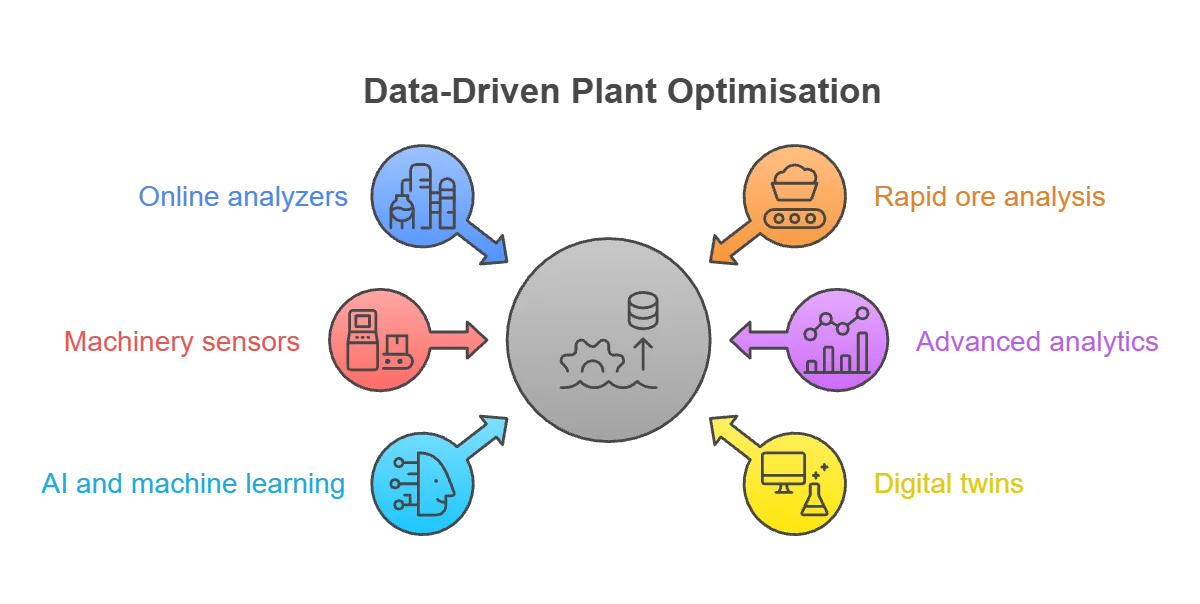
In addition to physical sensors, the use of advanced analytics helps to synthesize vast amounts of operational data into actionable insights. By tracking key performance indicators across different shifts and ore types, management can identify best practices and areas for improvement. This data-centric approach ensures that the processing plant operates at its peak efficiency regardless of external variables. It is through these detailed observations that mining companies find the marginal gains necessary to stay competitive in a volatile market. As these technologies become more accessible, the gap between high-performing operations and those relying on legacy systems will continue to widen. In many cases, it is evident that AI and machine learning are optimising mineral processing plants to ensure that every stage of the recovery process is as efficient as possible. The implementation of digital twins (virtual replicas of the physical plant) allows metallurgists to simulate different operating scenarios and test the impact of process changes without risking actual production. This capability accelerates the pace of innovation and allows for the rapid deployment of optimized strategies across multiple sites.
Strategic Integration of Processing Infrastructure
Success in maintaining high yields depends on a holistic view of the entire mining value chain, from the pit to the final product. Infrastructure design must account for the specific characteristics of the ore body, including mineral associations and geological variability. This involves collaborative efforts between geologists, mining engineers, and metallurgists to ensure that the feed sent to the plant is well-characterized and consistent. Ore blending strategies can be used to stabilize the feed grade and minimize fluctuations that would otherwise disrupt the processing circuits. The use of stockpile management software helps to coordinate the delivery of ore from different parts of the mine, ensuring that the processing plant receives a blend that matches its design parameters.
The long-term sustainability of a mining project is tied to its ability to adapt to changing conditions. This means building flexibility into the processing plant to allow for future upgrades or modifications as new technologies become available. Investing in modular equipment or scalable systems can provide a significant advantage as the ore body evolves. Additionally, the focus on water management and tailings disposal has become an integral part of processing strategy. Efficient dewatering and the recovery of process water not only reduce environmental impact but also lower operational costs. Dry stack tailings and paste thickened tailings are becoming more common as they reduce the risk of dam failures and allow for better land reclamation. By aligning technical excellence with strategic planning, mining operators can secure their mineral recovery rates and ensure the longevity of their assets in an increasingly demanding global environment. The continuous refinement of these processes is essential for the industry to meet the dual challenges of resource scarcity and social responsibility, providing the metals needed for a cleaner future while maintaining the economic health of the mining sector.