






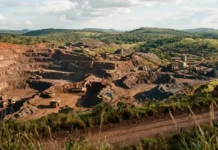
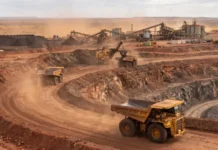
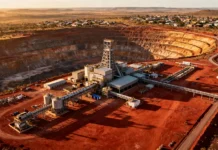
The Kalahari Manganese Field, located in Northern Cape Province, about 700km southwest of Johannesburg, contains around 80% of the world’s known high-grade manganese ore reserves. The district yields about 4Mtpa, mined mainly by two companies: Samancor and Assmang.
Originally established in 1935, Assmang is jointly owned and managed by African Rainbow Minerals and Assore. The company wholly owns Nchwaning and Gloria manganese mines, near the community of Black Rock.
Nchwaning was commissioned in three phases. Nchwaning 1 was commissioned in 1972, Nchwaning 2 in 1981 and Nchwaning 3 in 2001. The Gloria mine, to the south, started production in 1978.
Both the mines had processing plants nominally rated to treat 1Mtpa of ore ore. This capacity has gradually been increased over the years through a series of upgrades.
Expansion
“Assmang announced a capital expenditure programme of R500m to double manganese production by 2010.”
Early in 2000, Assmang announced an expansion involving the development of a new shaft complex at Nchwaning to add about 2Mt/y of run-of-mine ore capacity, to make Nchwaning the world’s lowest-cost underground manganese mine, and to extend its lifetime by about 30 years.
The expansion, including additional treatment capacity, was commissioned in May 2004 and was completed in May 2005 at a capitalised cost of R780m.
In June 2010, Assmang completed the construction of an R500m processing plant and doubled the output from 3 to 6Mtpa. The new plant can process 900t of ore an hour from Nchwaning 2 and 3.
Geology and reserves
The Kalahari Manganese Field lies within a large structural basin that extends approximately 40km south to north and 5km to 15km east to west, dipping gently northwest.
At Black Rock, near the northern end of the basin, the Transvaal System rocks lie about 300m from surface, beneath Kalahari Formation sands and calcretes, Karroo System tillites and Waterberg System shales and quartzites.
The sub-horizontal stratabound manganese ore horizons occur in banded ironstone of the Voëlwater Formation at the top of a sequence of Transvaal System rocks. As well as being faulted, the horizons are folded.
The ore is massive and averages 48% manganese; at Nchwaning it is particularly low in phosphorus while Gloria has a higher manganese-to-iron ratio. At the end of 2006 Assmang’s reserves totalled 192Mt with mineral resources of 428.4Mt.
As of 2010, Nchwaning’s total measured and indicated resources were 30,749Mt and Gloria’s measured and indicated resources were 12,163Mt.
At the end of 2006 Assmang’s reserves totalled 192Mt with mineral resources of 428.4Mt.
Mining
Both mines are underground operations, using the room-and-pillar method. Nchwaning started with one vertical hoisting shaft, with the 450m-deep No 2 vertical skip shaft added and the plant upgraded in 1981.
“At Black Rock, near the northern end of the basin, the Transvaal System rocks lie about 300m from surface.”
Gloria combined a vertical shaft for personnel and materials hoisting with a long incline shaft for vehicle access and conveyor hoisting of the ore to a surface crushing, screening and washing plant.
The 2004 expansion follows this design, having a 2,200m-long incline shaft and the 500m-deep Nchwaning No.3 personnel shaft. There is also a ventilation shaft, and a workshop located on the 400 level.
Bolted development entries access rooms that are 7m to 8m wide and 3.2m to 3.5m high, while the pillars are normally 8m x 8m. Low-grade ore is left to form both the floor and roof of the rooms.
The established areas use Boart Longyear hydraulic drilling rigs and Wagner Load-Haul-Dump (LHD) machines and trucks to transport the ore to storage silos, primary crushers and screens that feed the hoisting systems. Roofs are scaled using a modified three-wheeled loader.
For the new area, Assmang requested a three-boom rig fitted with two rock drills for face work plus one for roof-bolting, so the mine can drill holes for roof bolts and face-blast holes from the same set-up. Atlas Copco has supplied four purpose-designed Rocket Boomer M3D rigs.
Assmang also added to its fleet of Atlas Copco Wagner LHDs but opted for an alternative truck brand, ordering three Caterpillar AD 30 machines.
Processing and production
Shaft complex Nchwaning 3 provides access to high quality ore. Production from this complex commenced in May 2004 and became fully operational in February 2006. This new mining operation is serviced by two shafts; a vertical personnel shaft to a depth of 350m and a decline shaft equipped with conveyors, which is the main hoisting shaft. Hoisting capacity is +/- 200,000t per month.
The existing plant has been upgraded and now treats the ore from both Nchwaning 2 and 3 mines. The run-of-mine ore is crushed, washed and screened, with no other processing needed. After the ore has passed through the plants, it is stacked according to size and grade. The capacities of the stacks vary between 280t and 320t each, and are numbered and sampled.
Exports travel by the main South African Railways route to Port Elizabeth on the Indian Ocean. Lesser tonnages are directed to the domestic steel industry. The feasibility study for exporting manganese through the Saldanha Port were completed in 2012.
The future
Post the 2007-08 recession, Assmang decided to cutback on its steel production and replenish the existing stockpiles.
The company is currently implementing projects to increase mine capacity of Nchwaning 2 and 3 from existing 3.6Mtpa (2010) to 4Mtpa of ore by 2013. A feasibility study to increase the production up to 4MTPA was completed in 2012. Construction on the expansion is expected to start by the end of 2013, post approval.
Along similar lines, Assmang is increasing the ore production at Gloria mine from 0.48Mtpa to 0.96Mtpa.