







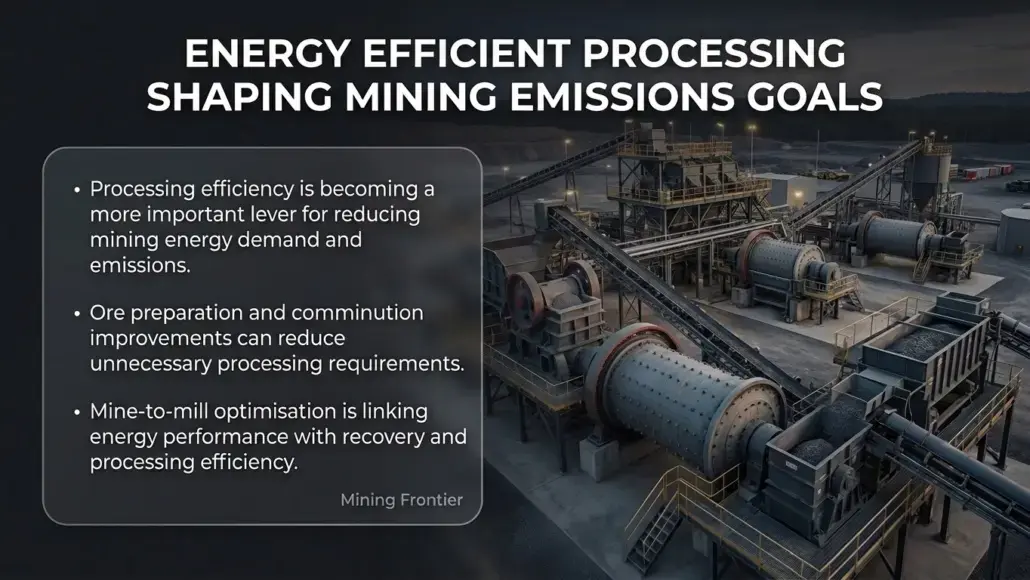

As mines work to reduce emissions while maintaining mineral output, attention is increasingly moving beyond how operations are powered toward how efficiently ore is processed. Crushing, grinding and separation can require substantial amounts of electricity, making processing performance an important part of the wider decarbonisation strategy. This is giving energy efficient processing a more central role in decisions about plant design, operating practices and mine-to-mill optimisation.
The challenge is becoming more significant as processing plants handle variable ore characteristics and increasingly complex resources. Changes in hardness, mineral liberation and gangue content can alter the amount of energy required to achieve the required product size and recovery. Improving efficiency therefore requires a better understanding of the material entering the plant rather than relying solely on equipment-level upgrades.
Comminution Becoming the Primary Efficiency Target
The largest opportunity is concentrated in comminution, where crushing and grinding account for at least 40% of total energy use in mining and mineral processing according to Australian Government guidance. That makes the front end of the processing circuit a particularly important target for energy efficient processing measures.
Processing Energy Priorities
- Crushing and grinding circuit design
- Consistent particle-size management
- Early rejection of gangue
- More efficient comminution technologies
- Integration of ore characteristics into mine-to-mill planning
The relationship between these measures is important. Ore sorting or selective blasting can remove material before it reaches energy-intensive grinding, while circuit design can reduce unnecessary recirculation and improve mineral liberation. The result is a broader approach in which energy efficient processing begins before ore enters the mill and continues through downstream separation.
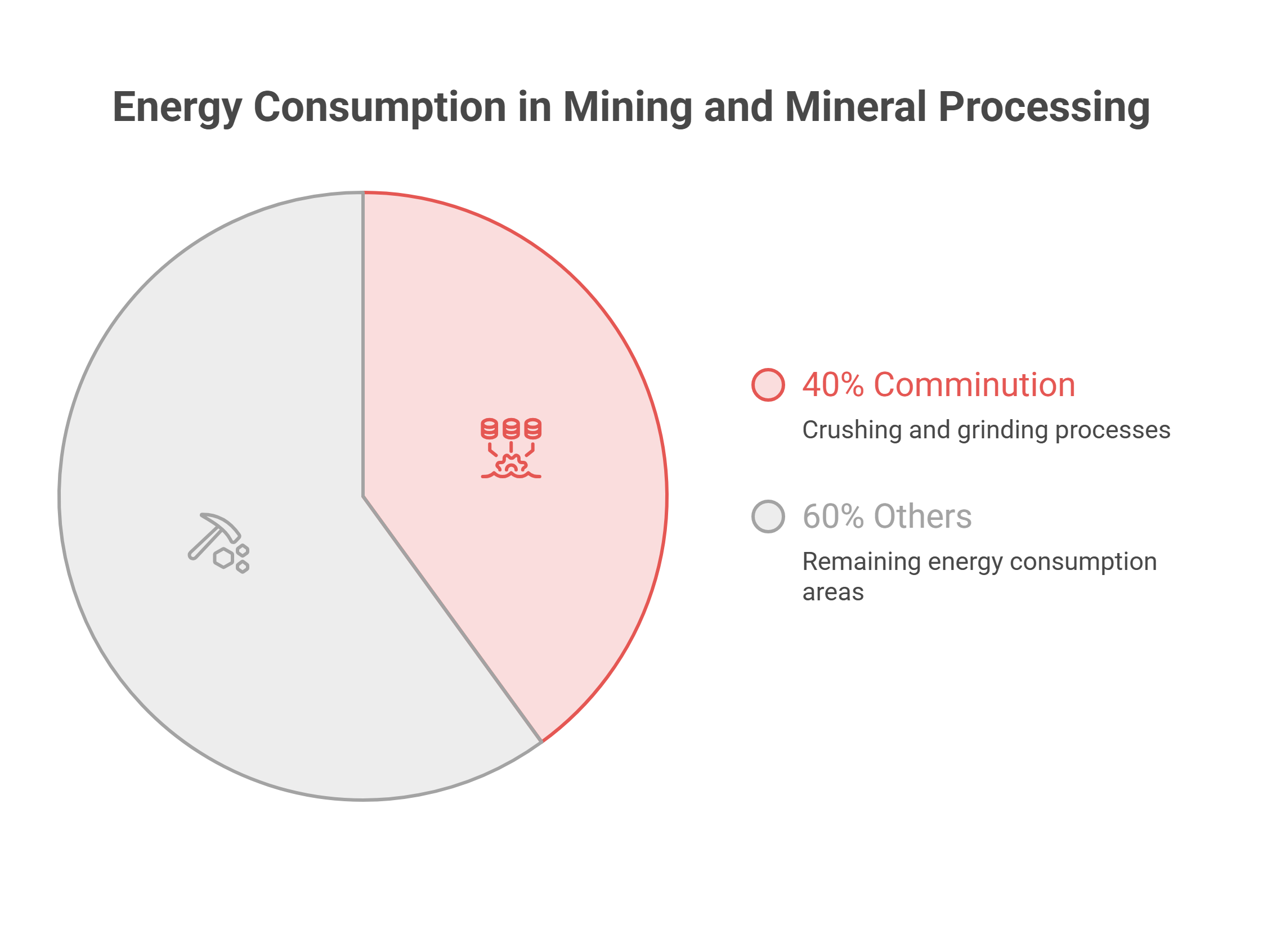
Crushing and grinding represent the largest energy-use area in mining and mineral processing, making comminution efficiency a major decarbonisation lever.
As processing efficiency becomes more closely connected to ore characterisation and mine planning, mine emissions measurement provides the next step in understanding how emissions sources are identified and managed across mining operations.
Ore Preparation Reducing Unnecessary Processing
The next opportunity for energy efficient processing begins before ore reaches the grinding circuit. The amount of material sent through crushing, grinding and separation has a direct influence on the energy required to produce saleable mineral. Improving fragmentation, identifying ore characteristics earlier and rejecting waste before intensive processing can therefore reduce the amount of energy consumed downstream.
This shifts attention toward mine-to-mill coordination. Rather than optimising the processing plant independently, operators can consider how blasting, feed preparation and ore characteristics affect the performance of the entire circuit. Australian Government guidance identifies geometallurgical modelling, smart blasting and ore sorting among approaches that can improve energy performance by influencing what enters the processing system.
Upstream Efficiency Measures
- Better fragmentation can reduce the size-reduction work required downstream
- Ore sorting can reject lower-value or waste material before intensive processing
- Pre-concentration can increase the proportion of valuable material entering the plant
- More consistent feed characteristics can improve circuit stability and equipment utilisation
The importance of these measures increases where ores become harder or more variable. A processing circuit designed around a particular feed profile may require substantially different energy inputs when ore hardness, mineral liberation or gangue content changes. Energy efficient processing therefore depends partly on controlling variability before it reaches the most energy-intensive stages.
Grinding Technology Reshaping Energy Performance
Grinding remains a critical target because comminution represents at least 40% of total energy use in mining and mineral processing according to Australian Government guidance. The same guidance indicates that milling efficiency can vary significantly depending on circuit configuration and technology, highlighting the importance of equipment selection and flowsheet design rather than treating grinding as a fixed requirement.
Alternative comminution technologies are receiving greater attention as operators examine how energy demand can be reduced while maintaining recovery and throughput. High-pressure grinding rolls (HPGR), stirred mills and other circuit configurations can change how size reduction is performed, although their suitability depends on ore characteristics and plant conditions.
Processing Efficiency Trade-Offs
- Lower energy consumption must be assessed alongside recovery
- Throughput cannot be sacrificed simply to reduce power demand
- Water use can change as flowsheets and grinding methods change
- Capital requirements can offset part of the operating-cost benefit
Recent technical research also indicates that processing efficiency can be influenced by fragmentation achieved during blasting. A 2026 study modelled reductions in comminution energy demand of approximately 18% for hard ore and more than 30% for soft ore under its specific Ultra-High-Intensity Blasting conditions. These results are study-specific and should not be treated as universal mine-level savings.
The broader implication for energy efficient processing is that energy performance is increasingly becoming a flowsheet and mine-to-mill question. The most effective reductions may come from changing how material is prepared, rejected and processed across the system rather than simply improving the efficiency of one piece of equipment.
Processing Efficiency Becoming a Long-Term Emissions Strategy
The case for energy efficient processing is increasingly tied to how efficiently mines convert extracted ore into recovered mineral. As ore characteristics become more challenging, reducing unnecessary size reduction, improving comminution performance and controlling material flows can help limit energy demand without treating emissions reduction as a separate plant objective.
The main priorities are:
- Reduce unnecessary material entering energy-intensive stages
- Improve crushing and grinding performance
- Protect recovery while lowering energy intensity
A mine-to-mill approach is important because processing performance can be influenced by decisions made before ore reaches the plant, including fragmentation, ore preparation and feed selection. Measuring where energy is concentrated also helps identify the processes with the greatest potential for improvement. This leads into mine emissions measurement, where identifying and managing emissions sources becomes the next focus in the decarbonisation pathway.
References
- Australian Government Department of Climate Change, Energy, the Environment and Water – Mining – 2026
- Hanrong Huang, Fiacre Rougieux and Seher Ata – Key enablers for techno-economic optimisations of microgrids in advancing the decarbonisation of mineral processing operations in Australia: The case of copper – Energy Conversion and Management: X – 2026
- Metso – Record year for Metso stirred mills as mining industry opts for energy-efficient comminution technology – 2026
- Jacopo Seccatore, Alex Contreras and Tatiane Marin – Reduction in Major Greenhouse Gas Emissions in Mineral Comminution Using Ultra-High-Intensity Blasting (UHIB) – A Study for the Chilean Mining Industry – Minerals – 2026