




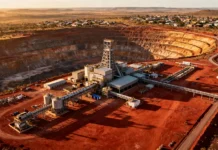
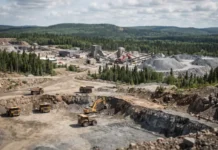
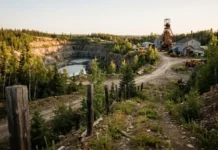
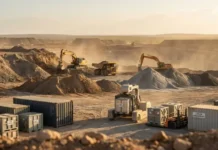

Mining used to be a big part of Missouri’s economy, and a push to bring critical mineral production back to the US has gone ahead and sparked new interest in making the industry stronger.
Rep. Mike Steinmeyer, R-Sugar Creek, has gone on to write a bill that would help the critical mineral production industry even more by working with the University of Missouri-Kansas City. The United States Geological Survey says that Missouri has 36 of the 60 minerals that are most important.
House Bill 2510 would set up a statewide task force in the Missouri Department of Natural Resources in order to come up with a plan for producing important minerals in the state. The House Higher Education and Workforce Development committee heard the bill on March 3, 2026, but it has not yet moved on to floor debate.
Steinmeyer said that the federal government would give money to the Missouri Critical Minerals Task Force.
The federal government has given money to Missouri’s critical mineral industry in four of the last six years. The U.S. Department of Commerce’s Economic Development Administration gave $28.5 million to the Regional Innovation and Technology Hub at Missouri University of Science and Technology in January 2025 in order to help with critical mineral production.
“This puts Missouri as one of the leaders in terms of the mining process, extracting the minerals that we are overly dependent upon. “Internationally, this will help us to become dependent on no one but ourselves as a nation,” said Steinmeyer.
According to Steinmeyer, this bill is a result of the Trump administration’s efforts to make the country less reliant on importing certain minerals. He wants this bill to help UMKC set up a program and a mining site, but the funding decisions haven’t been made yet.
This bill is more about putting things in place, Steinmeyer said. “We know that there’ll be federal grants, possibly some funding down the road, but this bill just essentially establishes the need for funding.”
Steinmeyer opined that important minerals in Missouri could be used in electronics, pharmaceuticals, medical help, and defense technology, among other things.
Three Consulting is a consulting firm that works with the financial and nuclear as well as mining industries. James Kennedy happens to be the president of the company. In addition, he is also the president of Caldera Holding, which owns the Pea Ridge Mine. Kennedy said that the company wants to reopen the mine, which shut in 2001.
Kennedy believes the bill indeed has good intentions, but it could be better. He is concerned about the structure of the advisory panel because there is only one person from the mining industry on it. How is that one person going to tell other mining companies what they need or what they can do?
Kennedy said, “I think that the single representative should have an obligation to consult with producers and potential producers of critical materials and have an obligation to share their needs and desires.”
Kennedy suggested that the U.S. Geological Survey, along with the DNR, check out the unused mine tailings, which are leftover materials from mines that could be processed to get more minerals.
The good thing for the state is that it has a good economy. Kennedy said, “The upside for the state is economic prospects. A mining company would be willing to come in and reprocess the tails, basically cleaning up somebody’s old mess. The state would get the advantage of somebody cleaning up an abandoned property that may have some environmental hazards associated with it.”
He said that cleaning up abandoned mine sites is probably the quickest way to help the critical materials industry and that state support for those efforts would speed up the process.
Kennedy said, “The state going out and looking at abandoned tails, or collaborating with operating mines that have tails, I think they have a vested interest in seeing things cleaned up.”
Kennedy said that the bill does not say anything about permits, but he also thinks they should be included, especially in reference to mine tailings. Steinmeyer also said that permitting will probably be added to the bill after the sites have been chosen.
According to Steinmeyer, “Permitting will probably be required wherever site locations are. You’ll probably have local permitting that’ll be required. So, I would imagine, as it moves forward, these are the types of logistics that we will have to address. We have no site location. They have a wish list of places they’d like to go, but we’ll see how it all pans out.”
Alan Spell, a professor at the University of Missouri Extension who happens to study regional economic development, said that the renewed interest in mining is different from the historical role of Missouri in that industry.
Spell says, “We haven’t really talked about mining in Missouri for a very long time in terms of an economic development activity,” Spell said. “It’s been more of the traditional mining that is iron and lead and so forth and recycling lead that’s been around for quite a while.”
Spell goes on to opine that making a task force doesn’t cost much, but giving money to programs that boost the economy and train workers can be expensive. The fiscal note for this bill says it could cost the state almost $300,000 by 2029, but Spell said that helping the industry could pay off for the state in the long run.
He adds, “Given the fact that we already have some mining infrastructure in the state, I think, just like with other things that we invest in, that it would probably pay dividends,” Spell said. “It just takes a while for those things to obviously come to fruition. They don’t happen overnight.”