












Key Takeaways
- Field-ready analytical technologies shrink the gap between sampling and results, compressing decision cycles at mine sites.
- Portable instruments like handheld XRF and XRD are becoming standard tools from exploration to production.
- Integrating field data into digital workflows unlocks faster, better-informed operational and strategic decisions.
For decades, the rhythm of decision-making in mining has been governed by the pace of laboratories. Samples were collected in the field, labelled, transported, queued, analysed, and finally reported back to geologists, metallurgists, and production teams. Important decisions about drilling, blasting, and blending often waited days or weeks. Field-ready analytical technologies are overturning that pattern. By bringing near-lab accuracy directly to outcrops, drill pads, stockpiles, and plants, they are compressing decision cycles and enabling more agile, data-driven mining.
At the core of these developments are field-ready analytical technologies that combine rugged hardware, advanced sensors, and intelligent software. Portable mining analyzers no longer feel like scientific curiosities; they are everyday tools in the hands of geologists, engineers, and operators. The result is a step change in how quickly and confidently mine site teams can characterise materials, segment ore and waste, and optimise processing.
From Static Samples to Real-Time Geochemical Insight
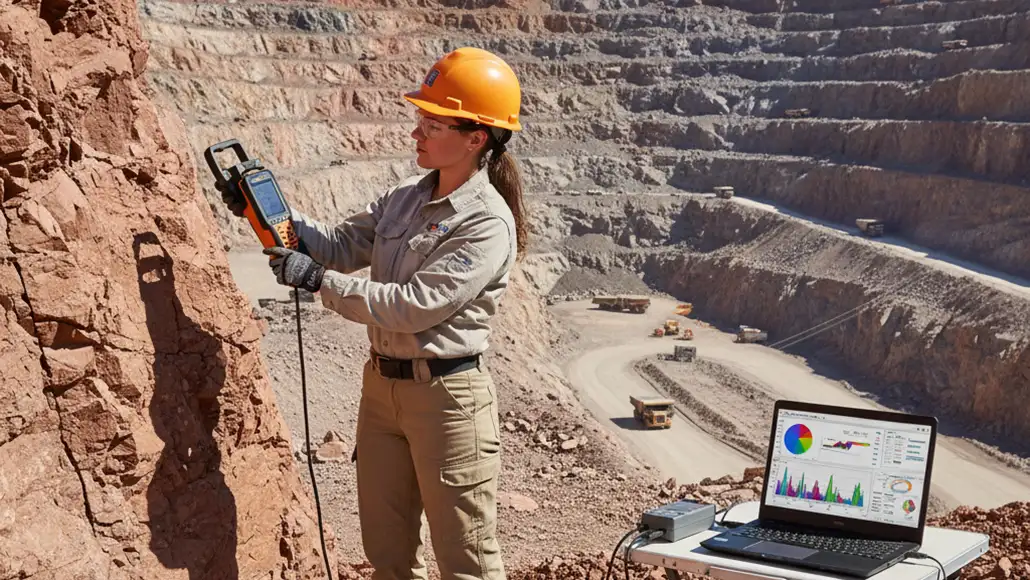
Exploration and resource definition are among the biggest beneficiaries of portable, high-performance instruments. Handheld XRF for mining has become a flagship example of how field-ready analytical technologies can transform workflows. These devices use X-ray fluorescence to provide rapid, multi-element geochemical analysis of rock chips, soils, and drill cuttings within seconds. Instead of waiting for lab assays to identify mineralised trends, geologists can walk across a prospect collecting readings, mapping geochemical anomalies in near real time.
This in-situ geochemical analysis allows drill programmes to be adjusted on the fly. Holes can be extended where mineralisation appears to continue, collar locations can be shifted to better test structures, and non-prospective areas can be deprioritised before costly metres are drilled. Over the lifecycle of an exploration campaign, such responsiveness can have a material impact on discovery costs and timelines.
In addition to speed, portable mining analyzers now offer impressive sensitivity and stability. Calibration routines, internal reference standards, and built-in QA/QC protocols help ensure that data quality is fit for purpose. While they may not fully replace accredited laboratory assays for resource reporting or metallurgical testwork, field-ready analytical technologies provide a powerful screening and vectoring tool that focuses lab resources where they add the most value.
Portable XRD for mineralogy extends this real-time insight from chemistry to crystal structure. Knowing not just what elements are present but how they are bound in mineral phases can be crucial for understanding processing responses, acid-generating potential, or geometallurgical domains. Modern portable XRD units are designed in rugged cases with battery power and simplified workflows, allowing mineralogical analysis to be conducted at exploration camps or even directly at mine sites.
Transforming Ore Grading and Stockpile Management
Once a deposit moves into development and production, the focus shifts from discovery to consistent, predictable delivery of ore to the plant. Here, field-ready analytical technologies help operations move beyond static grade control models toward dynamic, feedback-driven ore management.
Rapid ore grading using handheld XRF for mining can be deployed at the blast face, on muck piles, or across stockpiles to refine the delineation between ore and waste. By scanning representative spots or composite samples, grade boundaries can be tightened, reducing dilution and minimising valuable mineral that is inadvertently sent to waste. In marginal ore zones, fast, portable analysis supports on-the-spot decisions about whether material should be treated, stockpiled, or bypassed.
At larger scales, in-situ geochemical analysis from field-ready analytical technologies allows operations to characterise ore parcels by grade, deleterious elements, and penalty components before they reach the crusher. That information can be integrated into blending plans and stockpile strategies, helping plants maintain more stable feed quality. This, in turn, smooths metallurgical performance, supports higher recoveries, and reduces the risk of processing upsets caused by unexpected feed variability.
Some mines are adopting conveyor-based or drone-assisted systems that pair portable mining analyzers with automated scanning or sampling to broaden coverage. Although these systems may still route samples to nearby field labs, the combination of rapid instruments and streamlined workflows keeps turnaround times short enough to influence same-shift decisions.
Real-Time Quality Monitoring in Processing and Logistics
The influence of field-ready analytical technologies extends well into the processing plant and along the value chain. Portable instruments support real-time quality monitoring of intermediate streams, final concentrates, and even waste products. This continuous or high-frequency sampling and analysis ties directly into process control and commercial decision-making.
In flotation circuits, for example, handheld XRF for mining or benchtop counterparts can be used to monitor concentrate grades and impurity levels. Operators can adjust reagent additions, air rates, or residence times based on near-instant feedback rather than relying solely on delayed lab assays. Similarly, in hydrometallurgical operations, rapid analysis of leach solutions and residues helps maintain optimal operating windows and quickly detect deviations.
Field-ready analytical technologies also add value during shipping and logistics. Quick checks on concentrate consignments before loading or at port can verify that specifications are being met, reducing the risk of contractual penalties or disputes. For bulk commodities, portable mining analyzers support verification of moisture, grade, and contaminant levels, building confidence in both buyers and sellers.
When integrated with mine site decision support systems, these real-time quality monitoring capabilities contribute to a more responsive, optimised value chain from pit to customer.
Data Integration, Digital Workflows, and Decision Support
The true power of field-ready analytical technologies emerges when they are embedded in coherent digital workflows. Modern instruments are designed with connectivity in mind. Wi-Fi, Bluetooth, and cellular links allow results to be transmitted immediately from the field to central databases, mine planning software, or cloud platforms.
This connectivity turns isolated measurements into structured datasets. Results from handheld XRF for mining, portable XRD, and other instruments can be tagged with GPS coordinates, depth intervals, sample metadata, and operator notes. Visualisation tools then display this information as maps, sections, or dashboards, allowing geologists and engineers to spot patterns that would be invisible in a spreadsheet.
Mining digital workflows that incorporate field-ready analytical technologies enable version-controlled, auditable decision-making. For instance, when a blast design is adjusted based on rapid ore grading data, that change and its rationale can be recorded, along with subsequent performance metrics such as fragmentation and recovery. Over time, the operation builds a feedback loop, learning which measurement strategies and decision rules create the greatest value.
Machine learning and advanced analytics are starting to layer on top of these datasets. Algorithms can identify subtle geochemical signatures associated with favourable processing performance, flag anomalies that warrant further investigation, or predict plant responses based on incoming ore characterisation.
Human Factors, Training, and Governance
As field-ready analytical technologies spread across mine sites, human factors become increasingly important. Portable mining analyzers are powerful tools, but they must be used correctly to avoid misleading results. Robust training programmes are essential to ensure that users understand sampling theory, instrument limitations, and appropriate QA/QC procedures.
Clear governance structures also matter. Operations need defined protocols for how data from field-ready analytical technologies will be used in different contexts. For exploration, handheld XRF for mining may guide drilling priorities but still require confirmation by lab assays before resource models are updated. For production, rapid ore grading results might directly trigger shovel allocation or stockpile routing decisions, while certain high-stakes calls still rely on confirmatory tests.
Developing such frameworks helps align expectations between technical teams, management, and external stakeholders such as regulators or auditors. It also mitigates the risk that early missteps with portable instruments undermine confidence in their long-term role.
Looking Ahead: From Tools to Platforms
The trajectory of field-ready analytical technologies points toward tighter integration with automation, remote operations, and closed-loop control. As equipment becomes more connected and intelligent, the line between measurement and action will blur.
Autonomous drill rigs, for example, can be equipped with sensors and sampling systems linked directly to portable mining analyzers. As soon as a new interval is drilled, the system can characterise its geochemistry and pass that information to a central control room. Planners can then update drill plans, adjust patterns, or flag promising zones almost in real time.
In processing plants, inline or at-line instruments derived from the same core technologies as handheld XRF for mining will inform advanced process control systems. Changes in feed chemistry detected by field-ready analytical technologies will trigger automated adjustments in reagent dosing, grind size, or residence time without waiting for human intervention.
Across the mine value chain, what began as a collection of standalone instruments is evolving into an integrated platform for data-driven mining decisions. Operations that take a strategic view – investing not only in devices but also in people, processes, and digital infrastructure – are likely to extract the greatest benefits.
For mining companies aiming to compete in an increasingly complex, cost-pressured, and sustainability-focused environment, field-ready analytical technologies offer a practical, high-impact lever. By shrinking the distance between the rock face and reliable data, they empower teams to act faster, with greater confidence, and with a clearer line of sight from on-site observations to bottom-line outcomes.