















Key Takeaways
- AI real-time mining optimization reduces operational bottlenecks by 37-72% while simultaneously cutting costs by 43-78% compared to conventional mining methods
- Machine learning predictive maintenance systems prevent unexpected equipment failures, extending asset lifespan and reducing maintenance costs significantly
- Real-time monitoring through AI systems improves equipment utilization rates and enables dynamic resource allocation across mining operations
- Energy optimization through AI analytics achieves 5-10% reductions in energy consumption per tonne processed, delivering millions in annual savings
- Productivity improvements reach 15-20% when mining operations implement comprehensive AI optimization systems alongside workforce safety enhancements
- Predictive analytics applications transform reactive maintenance approaches into proactive, data-driven operational strategies
The modern mining industry faces unprecedented operational challenges. Extraction processes run continuously across complex geological formations, equipment operates under extreme conditions, and production flows must maintain consistency despite variable ore compositions and equipment variations. These challenges demand more than traditional management approaches. AI real-time mining optimization represents a fundamental shift in how mining companies approach operational efficiency and cost management.
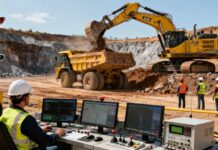
Artificial intelligence systems analyze continuous streams of operational data from thousands of sensors, equipment monitors, and environmental systems deployed across mining sites. Unlike conventional approaches that rely on periodic inspections or historical data analysis, AI real-time optimization processes information instantaneously, identifying patterns and inefficiencies as they develop. This continuous learning capability means that machine learning algorithms improve their accuracy and recommendations over time, creating increasingly sophisticated operational management systems.
The implementation of AI-powered real-time optimization addresses critical pain points throughout mining operations. Equipment failures that once occurred unpredictably now become predictable events, allowing maintenance teams to schedule interventions strategically. Production bottlenecks that previously created cascading delays become visible in advance, enabling operators to adjust processes before disruptions occur. Resource allocation across mining sites improves dramatically as AI systems match equipment, personnel, and materials to operational requirements with unprecedented precision.
Real-Time Data Processing and Predictive Analytics
Successful AI real-time mining optimization depends on sophisticated data infrastructure. Mining operations deploy sensor networks monitoring temperature, vibration, pressure, load, and chemical composition across equipment, processing circuits, and environmental systems. These sensors generate vast quantities of data continuously—often millions of data points per minute across large mining operations. Without intelligent processing systems, this data would overwhelm human analysts and decision-making processes.
Machine learning algorithms process this sensor data in real-time, comparing current operational patterns against historical baselines and known failure signatures. When the system detects anomalies or patterns that precede equipment failures, operators receive immediate alerts. These alerts include specific diagnostic information about the equipment component at risk, the estimated time until failure may occur, and recommended maintenance actions. This specificity transforms generic warning systems into actionable intelligence that maintenance teams can act upon immediately.
The predictive maintenance capability derived from machine learning represents one of the most valuable applications of AI real-time mining optimization. Breakdowns in mining equipment create cascading consequences across operations. A single failed component in a crucial haul truck, crusher, or processing unit can halt production flows affecting multiple operational sections. By preventing these unexpected failures through advance identification, mining operations achieve substantial cost savings and maintain continuous production schedules.
Dynamic Resource Allocation and Operational Bottleneck Reduction
Production flows in mining operations depend on coordinated movement of materials through multiple stages. Ore moves from primary crushing through grinding circuits, floatation or leaching processes, dewatering systems, and finally to final product preparation. Each stage has capacity limits, and when one section becomes constrained, upstream sections back up while downstream sections run below capacity. These bottlenecks create efficiency losses that ripple through entire operations.
AI systems continuously monitor flow rates, processing capacities, and equipment performance across all production circuits. When bottlenecks begin to form, the system identifies their causes and recommends specific adjustments. A grinding circuit operating at suboptimal efficiency might receive recommendations to adjust mill speed, water addition rates, and crusher gap settings—adjustments that optimize the circuit for the specific ore composition being processed. These micro-optimizations accumulate into significant improvements in overall throughput and equipment efficiency.
The dynamic nature of AI-based resource allocation means that mining operations can respond immediately to changing conditions. When new ore stockpiles arrive with different characteristics, the system adjusts processing parameters automatically. When maintenance activities remove equipment from service, the system reconfigures production flows to maintain consistency with available equipment. This adaptive management approach represents a dramatic improvement over static operational procedures established during mine planning and commissioning.
Energy Optimization and Sustainability Benefits
Energy consumption represents one of the largest operational cost categories in mining, particularly in grinding and processing circuits. Research demonstrates that crushing and grinding operations consume over half of a typical mine’s total electricity budget. Rising energy prices and stringent environmental targets make energy optimization a critical business priority for mining companies.
AI systems address energy consumption through continuous optimization of processing equipment. Sensors monitor power draw, ore hardness, and particle size characteristics across grinding circuits. Advanced machine learning models analyze these inputs to recommend optimal equipment settings that minimize energy consumption while maintaining product specifications. When the system detects efficiency drift—gradual increases in energy use or decreases in throughput—it alerts operators and recommends corrective adjustments.
Mining operations deploying comprehensive AI real-time optimization systems report energy reductions of 5-10% per tonne processed. For large mining operations processing millions of tonnes annually, these percentage reductions translate into substantial cost savings measured in millions of dollars. Beyond financial benefits, reduced energy consumption directly supports environmental objectives by lowering greenhouse gas emissions and reducing operational carbon footprints. This alignment between economic and environmental benefits makes energy optimization through AI real-time mining optimization attractive to mining companies pursuing sustainability commitments.
Safety Enhancement Through Predictive Systems
Safety represents a paramount concern in mining operations, where equipment failures, unexpected geological conditions, and hazardous environments create constant risks for workers. Equipment failures that occur unexpectedly create emergency situations that increase injury risk. By transitioning from reactive maintenance to predictive approaches, mining operations reduce unexpected breakdowns and associated emergency scenarios.
The safety benefits extend beyond equipment reliability. Machine learning systems can analyze production data patterns to identify safety-critical conditions forming in advance of actual incidents. Unusual vibrations in equipment might indicate developing conditions that could lead to catastrophic failures. Changes in ore characteristics might signal geological instability developing in specific mine sections. By identifying these warning signs through AI real-time optimization systems, mining companies can deploy preventive interventions before incidents occur.
Personnel safety also improves when operations achieve greater predictability and stability. When unexpected equipment failures decrease and production flows stabilize, workers experience fewer emergency situations. Shift schedules become more reliable, reducing fatigue from unexpected overtime or emergency repairs. Worker stress decreases when operations run predictably and safely. These human factors combine with technical safety improvements to create measurably safer working environments.
Recovery Rate Optimization and Mineral Extraction Efficiency
The economic value of mining depends fundamentally on successful extraction of valuable minerals from ore bodies. Many mining operations fail to achieve optimal recovery rates due to fluctuating ore characteristics and suboptimal processing parameters. Even modest improvements in recovery percentage translate into significant additional value extraction from existing ore reserves.
AI systems optimize recovery rates by learning complex relationships between ore characteristics, processing parameters, and recovery outcomes. In flotation circuits used for many metallic minerals, hundreds of variables influence recovery efficiency. Traditional optimization methods struggled with this complexity. Machine learning algorithms, however, excel at identifying optimal relationships in complex, multivariate systems. As systems process more data, they develop increasingly sophisticated understanding of how parameter adjustments affect recovery rates for different ore compositions.
Mining operations deploying machine learning-based recovery optimization report improvements in metal extraction rates alongside reduced tailings generation. This dual benefit represents both economic improvement—more valuable material extracted per tonne of ore processed—and environmental improvement, as less waste material requires management and disposal.
Integration with Existing Mining Systems
Successful implementation of AI real-time mining optimization requires integration with existing mining control systems. Most mining operations maintain supervisory control and data acquisition (SCADA) systems that manage equipment operation and collect operational data. Modern AI systems integrate with these established systems rather than requiring complete replacement of mining control infrastructure.
The integration approach provides practical advantages. Mining operations can deploy AI optimization gradually across different circuits or operational sections, learning and refining approaches before full-scale implementation. Existing maintenance procedures and workforce training adapt to incorporate AI-generated recommendations rather than requiring complete operational redesign. Equipment manufacturers increasingly design new mining equipment with sensor packages and data interfaces that facilitate AI integration, making future upgrades smoother.
This integrative approach also addresses the significant capital investments mining operations have made in existing infrastructure. Rather than abandoning functional systems, AI optimization works alongside established approaches, capturing benefits from both AI analytics and proven operational practices.
Implementation Considerations and Best Practices
Successful deployment of AI real-time mining optimization requires careful planning and thoughtful execution. Mining companies must ensure sufficient data quality and quantity to train machine learning models effectively. Sensor networks must provide comprehensive coverage of critical operational areas. Data management systems must store and process information reliably, even in remote mining locations with limited connectivity.
Organizations implementing AI optimization benefit from staged approaches. Starting with pilot deployments in specific circuits or operational areas allows teams to understand system capabilities and develop confidence in AI recommendations. These pilots generate performance data demonstrating economic benefits, supporting business cases for broader deployment. Experience with early deployments also identifies integration challenges and operational adjustments needed before full-scale implementation.
Staff training represents another critical success factor. While AI systems generate recommendations automatically, effective implementation requires personnel who understand system capabilities and limitations. Maintenance technicians benefit from understanding how AI systems identify developing equipment problems. Operators improve their effectiveness when they comprehend the logic behind recommended parameter adjustments. Investment in comprehensive training programs ensures that organizations capture the full value from AI real-time mining optimization investments.
Future Evolution of AI in Mining Operations
The capabilities of AI real-time mining optimization continue evolving as machine learning technology advances and mining companies accumulate more operational data. Edge computing—processing data closer to its source rather than transmitting everything to centralized systems—will enable even faster response times and more sophisticated real-time optimization. Autonomous equipment operating under AI guidance will reduce operational risks from hazardous environments while improving efficiency and safety.
Integration of multiple AI systems across entire mining operations will create increasingly coordinated optimization. Rather than optimizing individual circuits independently, mine-wide systems will orchestrate optimization across exploration, extraction, processing, and logistics in coordinated fashion. This holistic approach will unlock efficiency improvements that isolated circuit optimization cannot achieve.
As AI technology matures and mining operations accumulate experience with these systems, competitive advantage will shift toward companies deploying optimization most effectively. Mining companies investing in robust data infrastructure, skilled personnel, and integrated AI systems position themselves to achieve superior operational performance and profitability compared to competitors maintaining traditional operational approaches.