








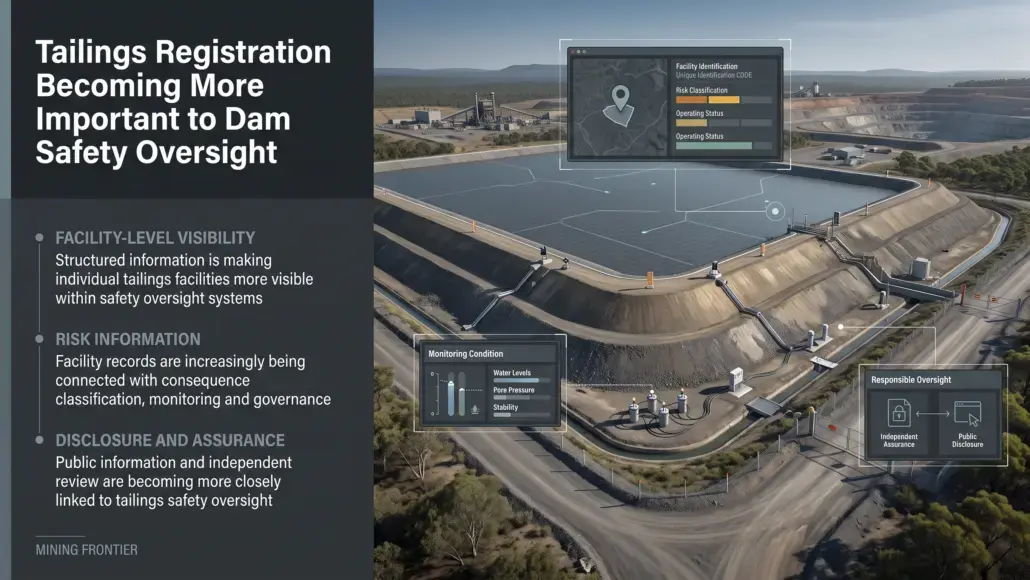

Tailings facilities are increasingly being treated as assets that require structured identification, risk information and continuing oversight throughout their operating life. For Mining Frontier, tailings registration provides a useful lens for examining how the global mining industry is improving visibility around where facilities are located, who operates them and what information is available about their safety characteristics.
The development is broader than creating a single worldwide register. Global industry standards, company disclosures, national inventories and public databases are creating different layers of facility-level information. The Global Tailings Portal provides data on thousands of facilities, while the Global Industry Standard on Tailings Management calls for publicly accessible information and supports initiatives for standardised, independent, industry-wide information. This makes tailings registration increasingly connected with transparency and risk oversight rather than serving only an administrative purpose.
Facility-Level Information Supporting More Structured Tailings Oversight
The value of tailings registration becomes clearer when facility records contain more than location data. Information such as operating status, ownership, storage characteristics, consequence classification and monitoring arrangements can help regulators, operators and other stakeholders understand individual facility risk. Maintaining that information over time is important because facilities can change through expansion, raising, ownership changes, closure or altered downstream conditions.
The move toward structured records also reflects a broader challenge: global tailings inventories remain incomplete and use different definitions, update cycles and levels of risk information. Registration and disclosure can improve visibility without creating the impression that the industry already has a complete, harmonised global registry. The focus is increasingly on building reliable facility-level information that can support continuing safety oversight.
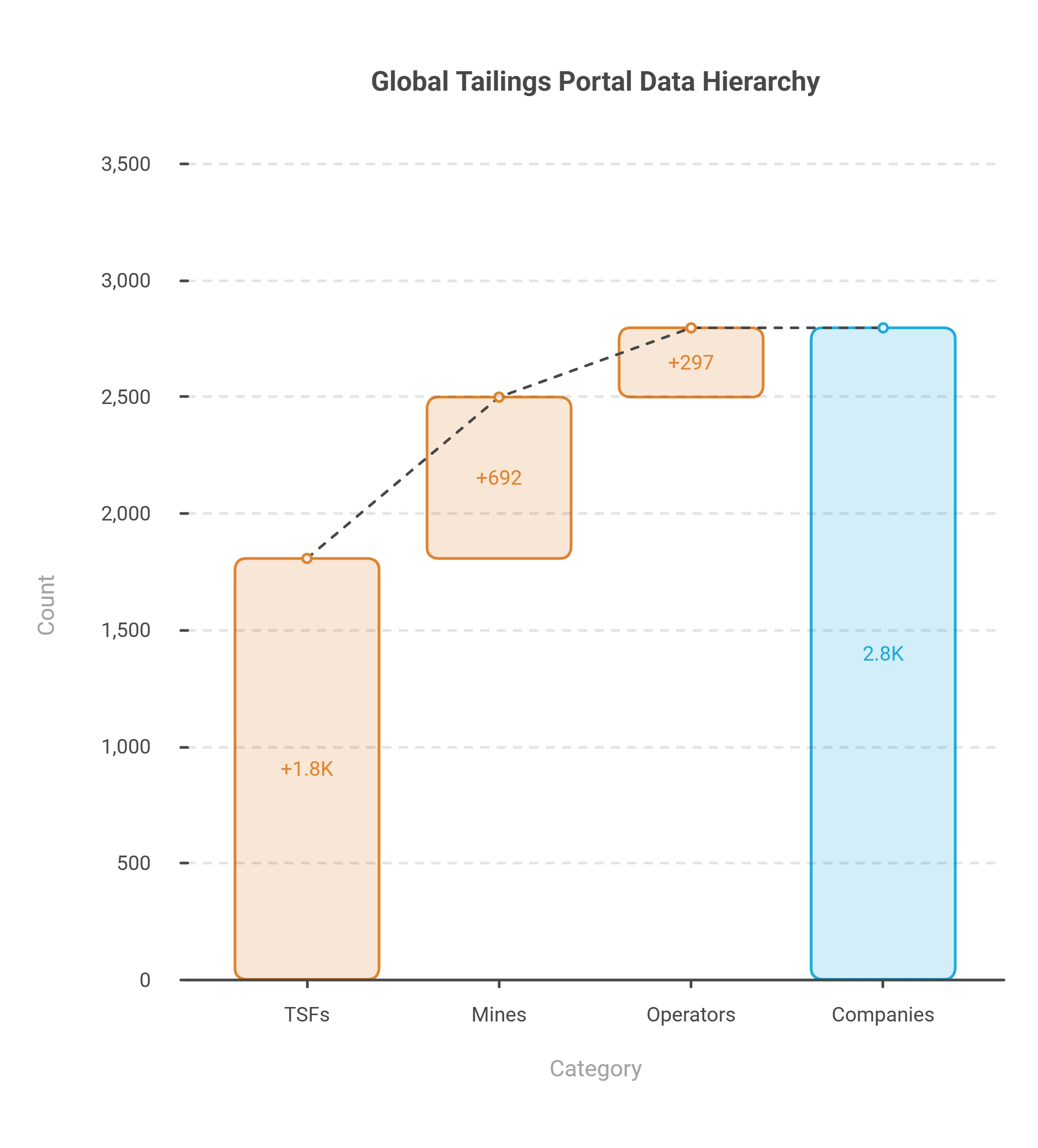
Key Takeaway: Facility-level tailings information is becoming more accessible globally, creating a broader data foundation for safety oversight and accountability.
Registration and Disclosure Becoming More Connected to Tailings Risk Governance
The growing role of tailings registration is also being linked to how facilities are assessed, monitored and governed under international frameworks. The Global Industry Standard on Tailings Management calls for public disclosure of information about tailings facilities and supports the creation of standardised, independent and publicly accessible industry information. This connects facility records with broader questions of accountability, rather than treating registration as an administrative exercise.
Facility information becomes more useful when it is connected to consequence classification, monitoring, emergency preparedness and clearly assigned responsibilities. GISTM establishes requirements covering facility knowledge, risk assessment, monitoring, governance and public disclosure across the tailings lifecycle. The result is a more structured information chain in which tailings registration can help maintain visibility of a facility while other systems provide information about its condition and risk profile.
Independent Assurance Strengthening the Value of Facility-Level Information
The development of the Global Tailings Management Institute adds another layer to this framework. GTMI was established to support implementation and conformance with GISTM and is developing the audit, certification and auditor-accreditation infrastructure for independent assurance. The process remains under development, so the distinction between existing GISTM requirements and the gradual build-out of the assurance system remains important.
This matters because tailings registration becomes more valuable when facility information can be linked to evidence of management performance and independent review. ICMM’s latest tailings progress reporting already uses facility-level conformance information, while public databases and company inventories are expanding the amount of information available outside individual mine sites.
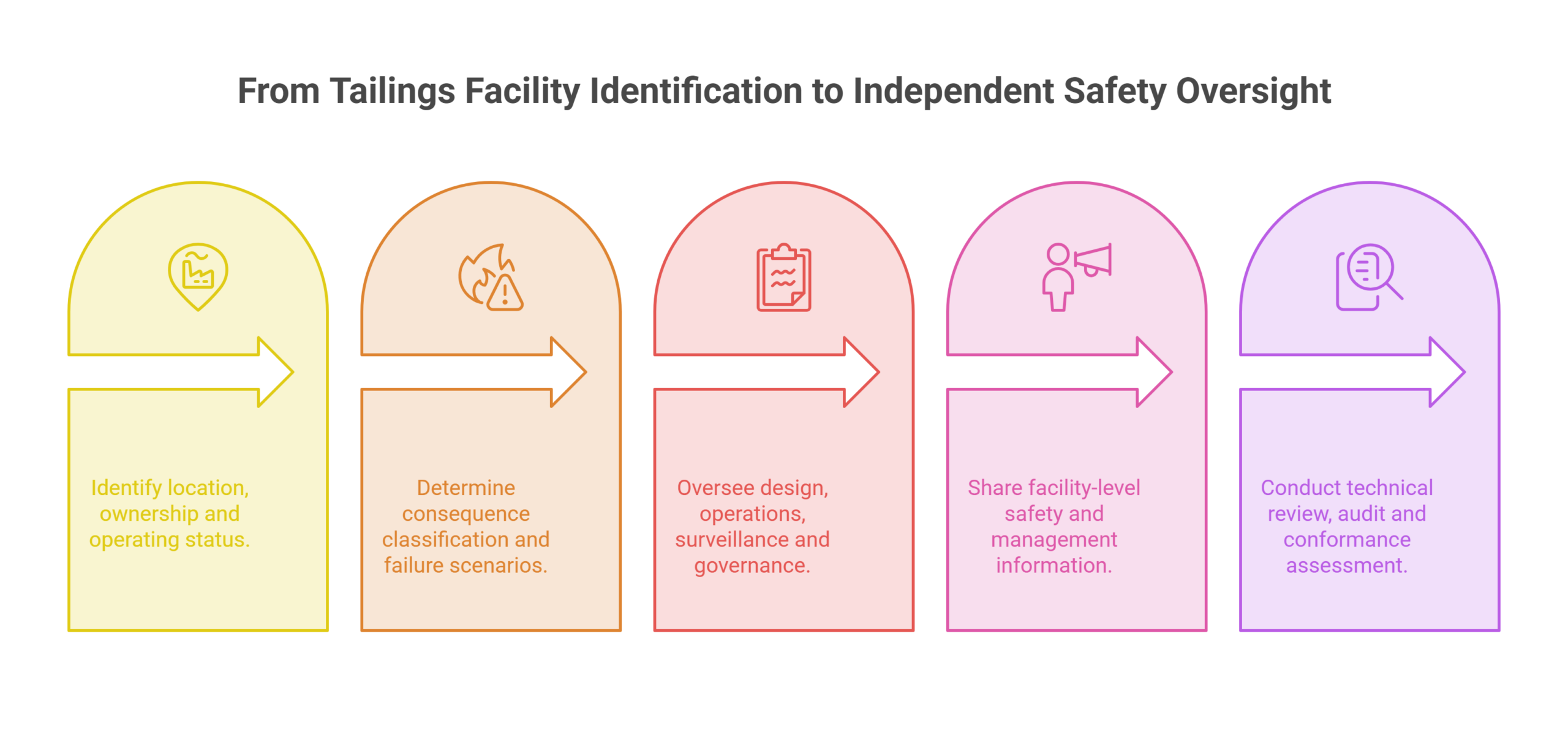
Key Takeaway: Facility records are becoming part of a wider oversight chain linking identification and risk information with monitoring, disclosure and independent assurance.
Registration Becoming Part of Continuing Tailings Oversight
The growing emphasis on tailings registration reflects a broader shift toward maintaining current, facility-level information throughout the tailings lifecycle. A useful record needs to remain relevant as ownership, operating status, storage conditions, consequence classification and monitoring arrangements change. Public disclosure can improve visibility, while independent review and assurance can provide additional confidence that information is maintained within an established safety framework.
The challenge is that global inventories still differ in scope, definitions and update practices. Registration therefore has value when it remains connected to current risk information, clear accountability and ongoing oversight rather than functioning as a static database.
For Mining Frontier, the broader significance is the connection between information and prevention: reliable facility records can support risk assessment, monitoring and governance of high-consequence infrastructure. This also brings the series back to critical control management.