























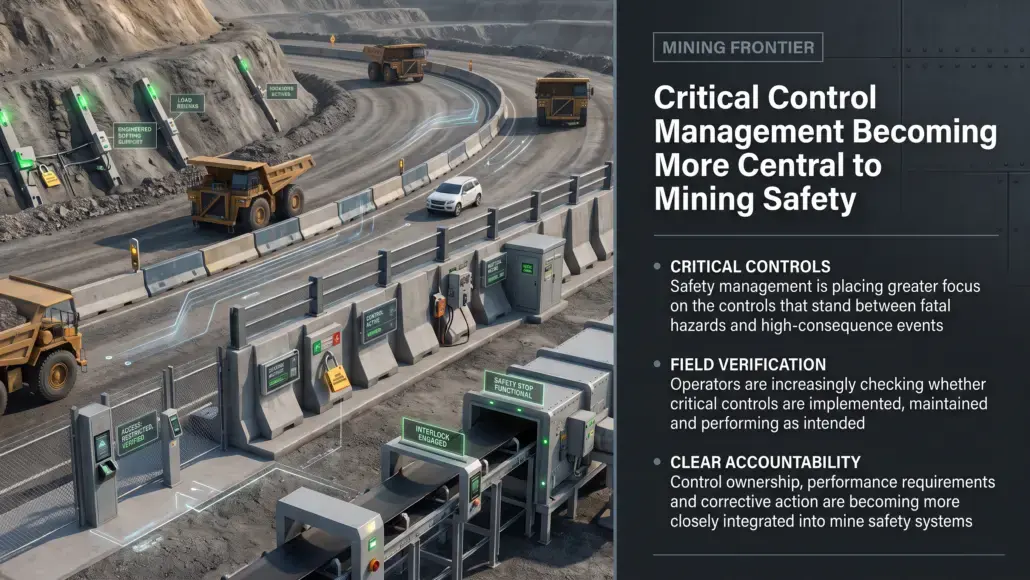

Mining safety is placing greater emphasis on whether controls designed for fatal hazards perform as intended in operating conditions. For Mining Frontier, critical control management provides a useful lens for examining this shift from identifying risks to defining, assigning and verifying the controls that stand between a hazard and a high-consequence event.
The 2026 ICMM Critical Control Management Good Practice Guide strengthens this approach by placing greater attention on governance, accountability, control performance, operational readiness, verification and continuous improvement. The framework covers the process from identifying fatal hazards and selecting critical controls through to checking their effectiveness and improving them when weaknesses are found.
Control Execution Remains a Major Source of Fatal-Risk Exposure
The emphasis is supported by recent ICMM fatality analysis. In 2025, ICMM assessed 26 fatal incidents and found 19 associated with ineffective control execution, compared with five linked to inadequate control design and two where controls were absent or unidentified. This does not represent the global mining industry, but it provides current evidence from a major international mining dataset that control execution remains a central challenge.
The implication for critical control management is that a documented safeguard is not enough. Operators increasingly need to define what a control must achieve, identify who owns it, establish how its performance will be checked and respond when it becomes degraded. This is also where verification differs from a routine compliance exercise: the question is whether the control is present and functioning in the field.
Regulators Increasing Attention on Critical-Control Effectiveness
The change is also appearing in regulatory practice. NSW Resources has made critical-control effectiveness a focus of its 2026–27 compliance priorities, with targeted assessments examining whether controls are implemented, maintained and functioning as intended. Queensland legislation likewise requires principal hazard management plans to include critical controls. Together, these examples show how critical control management is becoming more closely connected with formal risk-management and assurance systems, although regulatory adoption remains uneven across mining jurisdictions.
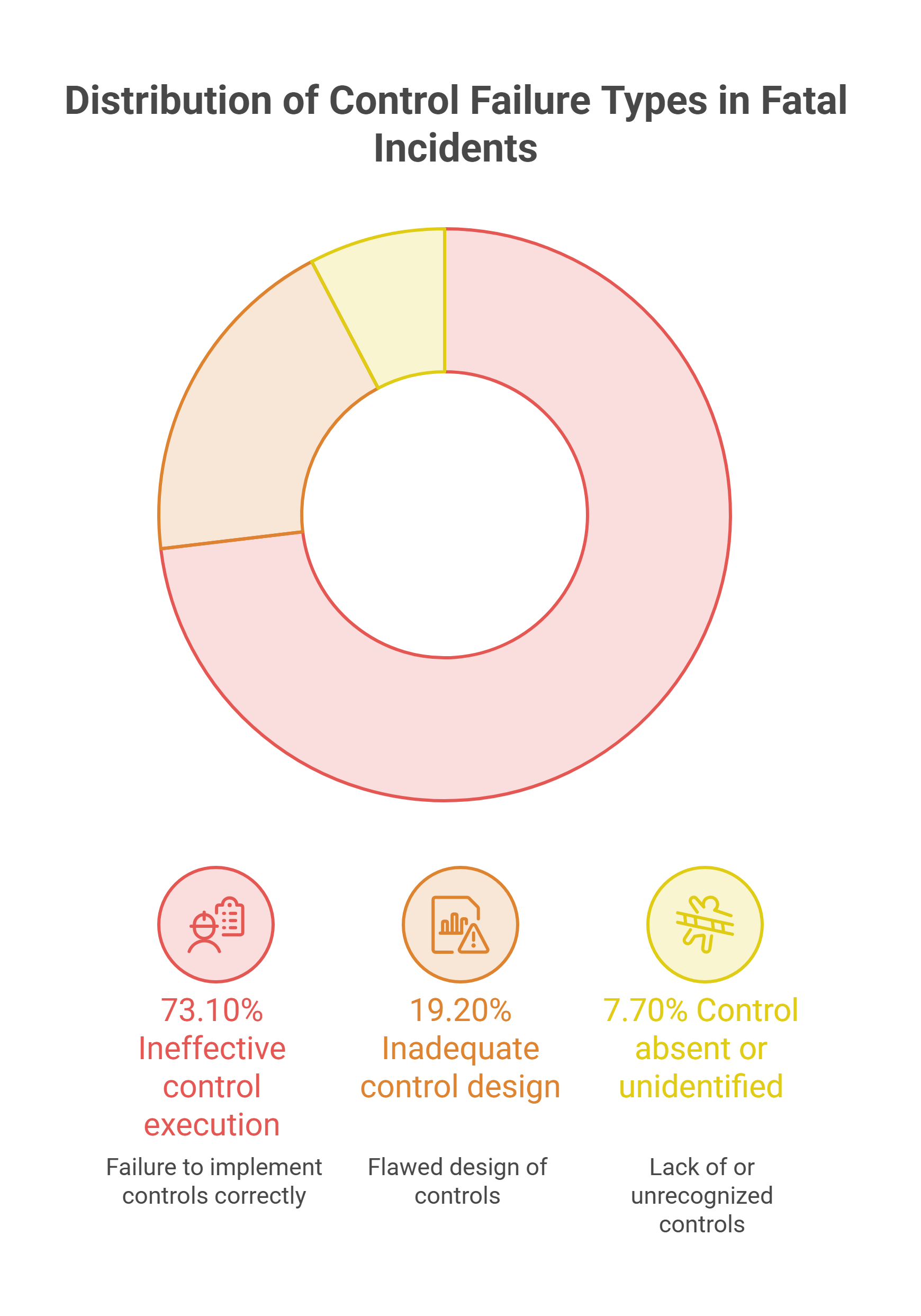
Key Takeaway: The largest category of assessed fatal incidents involved ineffective execution of controls, reinforcing the importance of verifying control performance in operating conditions.
A stronger focus on reliable controls also creates a bridge into automatic vehicle intervention.
Clear Ownership and Field Verification Strengthening Control Assurance
The next stage of critical control management is increasingly concerned with how controls are owned, tested and maintained after they have been identified. The 2026 ICMM guidance places greater emphasis on assigning clear accountability, defining performance requirements and establishing verification activities that can determine whether a control remains effective in the field. This makes control ownership a practical operating responsibility rather than a documentation exercise.
A performance requirement should describe what the control must achieve under the conditions in which it operates. Verification can then test that requirement through observations, inspections, data, maintenance records or other appropriate evidence. The purpose is not simply to confirm that a procedure was completed, but to establish whether the control is capable of preventing or mitigating the targeted unwanted event. Where a control is degraded, organisations can identify the weakness, escalate the issue and take corrective action before it contributes to a serious incident.
Critical Controls Becoming More Integrated into Mine Safety Systems
This approach is also reflected in regulatory practice across major mining jurisdictions. Western Australia’s mining safety framework calls for critical controls to have defined objectives, performance standards, verification methods and trigger points for urgent action. NSW Resources has similarly made the effectiveness of critical controls a focus of regulatory assessment, including whether controls are implemented, maintained and functioning as intended. Queensland’s legislation requires principal hazard management plans to include critical controls, demonstrating how the concept can become embedded within formal safety-management requirements.
The regulatory approaches are not identical, but they point toward a broader shift in emphasis. Rather than treating critical control management as a standalone safety process, mine operators are increasingly expected to connect it with existing risk-management systems, assurance activities and operational decision-making. The 2026 ICMM guide also introduces a maturity model covering planning, design, implementation, leadership and program management, allowing organisations to assess how consistently the framework is embedded across their operations.
This makes critical control management less about producing another layer of safety documentation and more about maintaining confidence in the controls that matter most. The value of the approach depends on whether information from frontline verification reaches control owners and leaders, whether degraded controls receive an appropriate response, and whether lessons from failures are incorporated into subsequent improvements.
Ongoing Verification Becoming Central to High-Consequence Risk Management
The growing emphasis on critical control management reflects a broader change in how mining operators approach fatal-risk prevention. Identifying a control is only the starting point. Its performance must be clearly defined, accountability must be established, and verification must provide evidence that the control remains effective as operating conditions change. This makes control performance an ongoing management concern rather than a one-time risk assessment exercise.
The direction of travel is therefore toward greater visibility of control health across mine operations. Regulatory requirements, industry guidance and company practices differ between jurisdictions, but they increasingly place attention on implementation, verification and corrective action. For mine operators, the practical challenge is maintaining that discipline across changing workplaces, contractors, equipment and production conditions. For Mining Frontier, this places critical controls within a wider safety story focused on whether high-consequence risks are being actively managed throughout the operating lifecycle.