



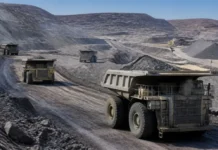






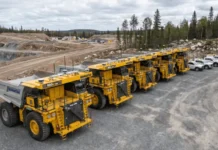

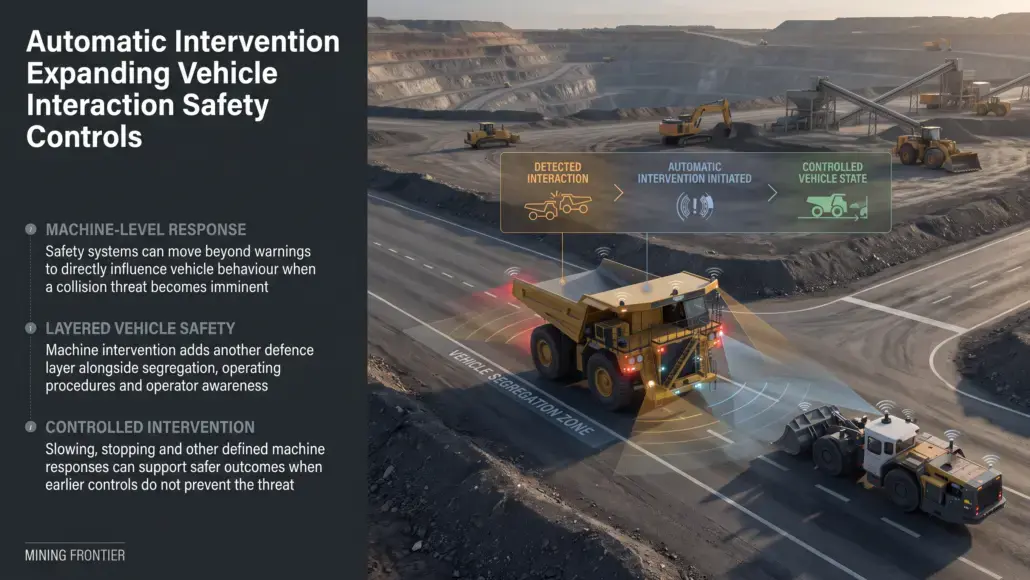
Vehicle interaction remains a significant fatal-risk area across mining operations, where mobile equipment can operate near other vehicles, fixed infrastructure and people. For Mining Frontier, automatic vehicle intervention provides a focused view of how vehicle-interaction controls are extending beyond warnings toward systems capable of influencing machine behaviour when a collision threat becomes imminent.
The development follows the EMESRT nine-layer vehicle-interaction framework, which places machine intervention after site design, vehicle segregation, operating procedures, operator requirements, compliance, awareness and advisory controls. The distinction is important: advisory systems depend on an operator recognising a warning and responding, while intervention systems can initiate a defined machine response during the final stage of an emerging threat.
Vehicle Safety Moving From Warnings Toward Direct Machine Response
Recent safety data provides context for the continued focus on vehicle interaction. ICMM member companies recorded 39 fatalities in 2025, with mobile equipment accounting for 10, equal to the highest number attributed to any individual hazard category in the dataset. The figures cover ICMM’s 26 members and should not be treated as a census of the global mining industry.
Within the EMESRT framework, automatic vehicle intervention represents the transition from notifying an operator to applying a defined machine response. Depending on the system and operating environment, this can include prevent-start interlocks, controlled slowing or stopping, rollback prevention, overspeed retardation and collision-avoidance commands. EMESRT describes Layer 9 as an intervention layer for imminent collision threats, while also stressing that it must operate alongside the preceding layers of defence rather than replace them.
That distinction also keeps automatic vehicle intervention separate from autonomous mining. The technology is not necessarily intended to operate a machine independently; its safety function is to alter machine behaviour under defined conditions when earlier controls or operator response have not prevented the threat. Recent NSW regulatory work similarly continues to examine vehicle-interaction risks through layered controls, including collision-avoidance and proximity-detection systems.
Machine Intervention Expanding Through Technical and Regulatory Frameworks
The development of automatic vehicle intervention is increasingly moving from a conceptual safety layer toward systems that are being technically tested, integrated into mine operations and addressed through regulatory frameworks. The distinction between advisory and intervention systems is becoming more important as operators assess how quickly a vehicle can respond when a collision threat becomes imminent.
EMESRT places machine intervention at Layer 9 of its vehicle-interaction defence model, following operator awareness and advisory controls. The framework describes intervention functions including controlled slowing or stopping, prevent-start interlocks, rollback prevention and overspeed retardation. Its model also places progressively shorter response windows on the final layers, reinforcing the role of machine intervention when there may be insufficient time for an effective manual response.
Technical Validation Supporting Broader Vehicle Intervention Deployment
The technology is also moving through more formal validation processes. In March 2026, a next-generation Level 9 vehicle intervention system completed an independent Technology Readiness Level 4 test conducted by the University of Pretoria under the Minerals Council South Africa framework. The testing examined detection and tracking, warning, vehicle intervention, self-diagnostics, log keeping and compatibility with the relevant ISO standard. The milestone provides evidence of technical verification in controlled conditions, although it does not by itself establish effectiveness across all mining environments.
Automatic vehicle intervention is also being incorporated into broader regulatory approaches. South Africa’s trackless mobile machinery requirements include engineering controls intended to prevent collisions, including automatic intervention where necessary to retard and stop machinery. In Australia, NSW Resources has developed a layered vehicle-interaction framework covering controls from site design through machinery intervention, while a vehicle-interaction ancillary reporting requirement introduced in March 2026 is intended to improve consistent reporting and understanding of control failures.
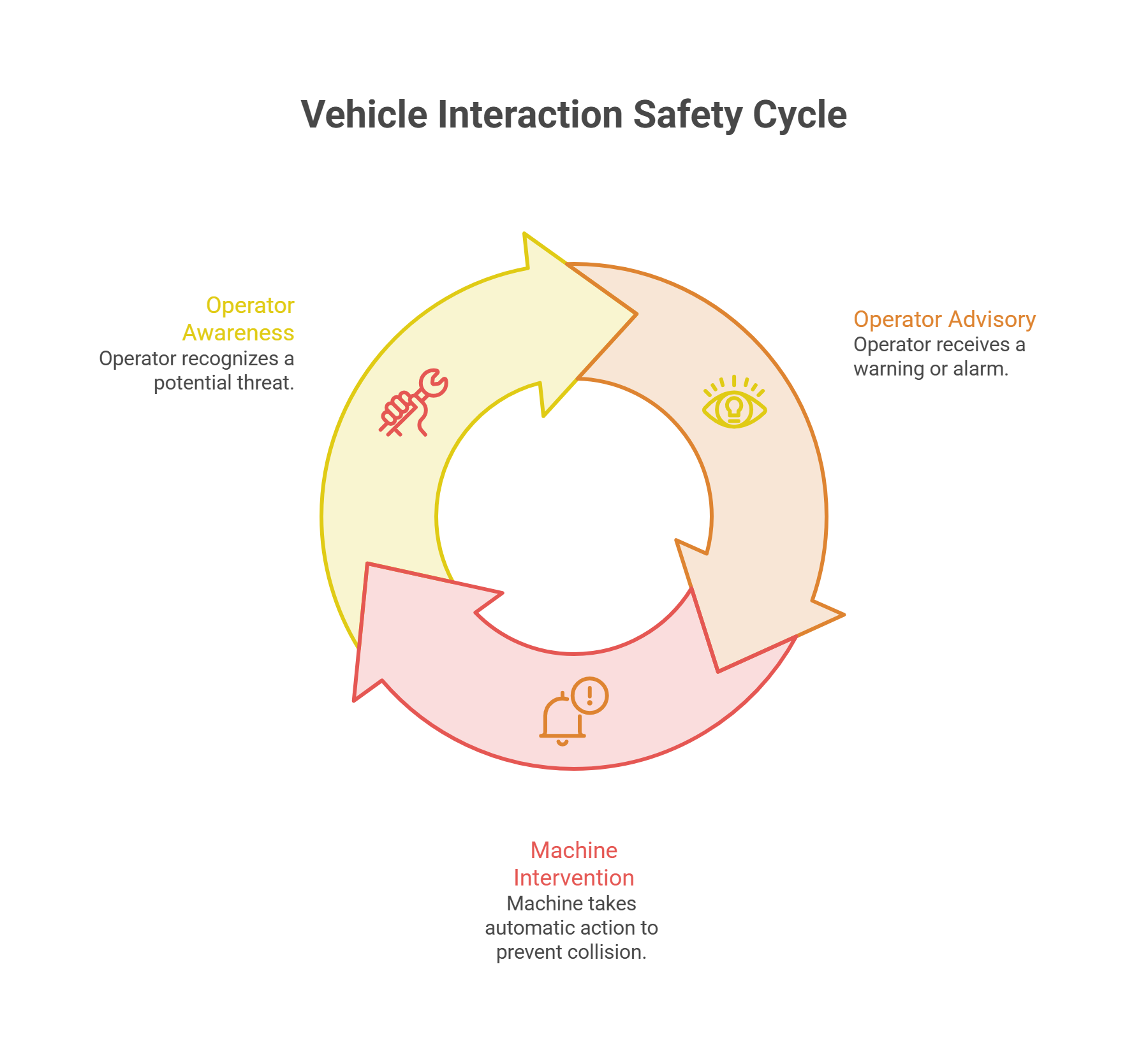

Key Takeaway: Vehicle-interaction safety is progressing from awareness and operator warnings toward machine-level intervention for the final stage of an imminent threat.
The expansion of automatic vehicle intervention does not remove the need for segregation, traffic design, operating procedures or competent operation. Its effectiveness depends on integration with these earlier controls, as well as reliable sensing, machine interfaces, system diagnostics and clearly defined intervention behaviour. Where an intervention occurs or a system fails to perform as intended, the resulting information can also strengthen incident learning.
Machine-Level Intervention Strengthening the Final Safety Layer
The growing role of automatic vehicle intervention reflects a more specific shift in vehicle-interaction risk management: safety systems are being designed not only to detect developing threats but also to influence machine behaviour when an imminent collision leaves limited time for human response. Technical validation and regulatory developments indicate increasing attention to how these systems perform, integrate with existing controls and respond to faults.
The development does not make earlier safeguards less important. Segregation, road design, operating procedures, operator awareness and equipment condition remain essential parts of the vehicle-interaction defence system. The practical challenge is ensuring that intervention technology complements those controls without creating new operational or integration risks.
For Mining Frontier, the wider significance lies in this layered approach. As vehicle-interaction systems become more capable of responding directly to hazardous conditions, their value will depend on how reliably they operate within the broader mine safety system and how effectively sites use resulting information to improve controls over time.