

















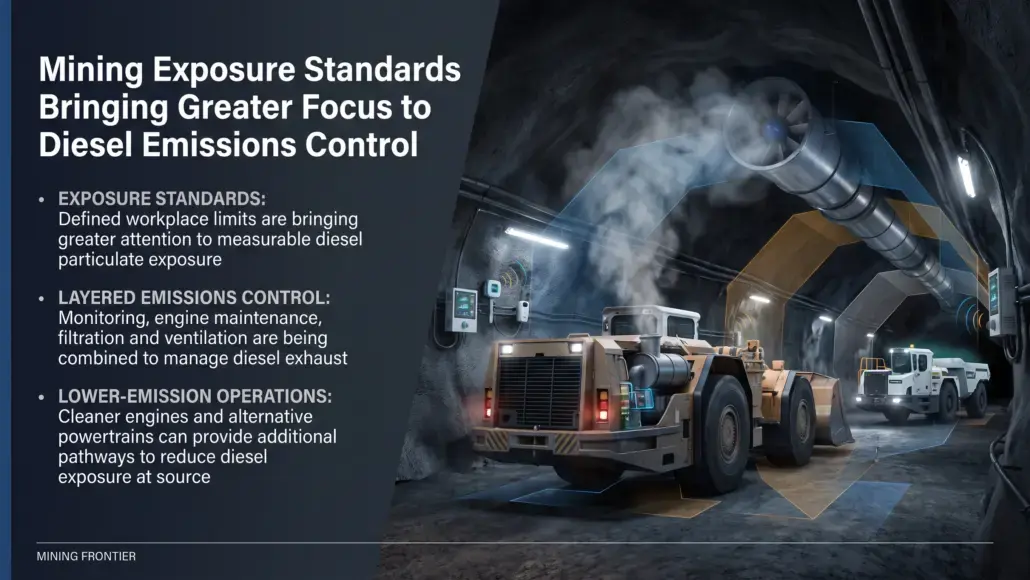

Diesel-powered equipment remains important across mining, particularly underground operations where ventilation conditions can influence exposure to diesel particulate matter. For Mining Frontier, diesel emissions control is increasingly a measurable occupational-health issue as regulators introduce or apply exposure limits that require operators to monitor workplace conditions and maintain effective engineering controls.
The regulatory landscape is not globally harmonised, but several major mining jurisdictions use defined exposure limits or reporting thresholds for diesel particulate matter. The European Union’s diesel-exhaust limit of 0.05 mg/m³, measured as elemental carbon, became applicable to underground mining and tunnel construction from 21 February 2026. Western Australia applies a 0.1 mg/m³ eight-hour TWA exposure standard for diesel particulates, measured as sub-micron elemental carbon. These requirements illustrate how exposure management is becoming more closely connected to measurable occupational-health performance.
Exposure Limits Increasing the Need for Measurable Workplace Controls
The significance of these standards extends beyond the exposure number itself. ICMM identifies monitoring and maintenance as the foundation of effective DPM management, with exposure information helping operators identify problems and support equipment-maintenance decisions. Ventilation, filtration, diesel particulate filters and modern engine technologies can then be used as complementary controls, while electrification provides a longer-term pathway for reducing diesel use underground. This makes diesel emissions control increasingly dependent on a combination of source reduction, engineering measures and workplace monitoring.
The regulatory differences also matter. Exposure limits may use different measurement methods, including elemental carbon and total carbon, meaning values from different jurisdictions should not automatically be treated as directly comparable. Stronger diesel emissions control therefore depends not only on meeting a numerical limit, but on understanding how exposure is measured and which operational controls are responsible for keeping it within the applicable standard. This also provides a natural link to mine workplace exposure controls,
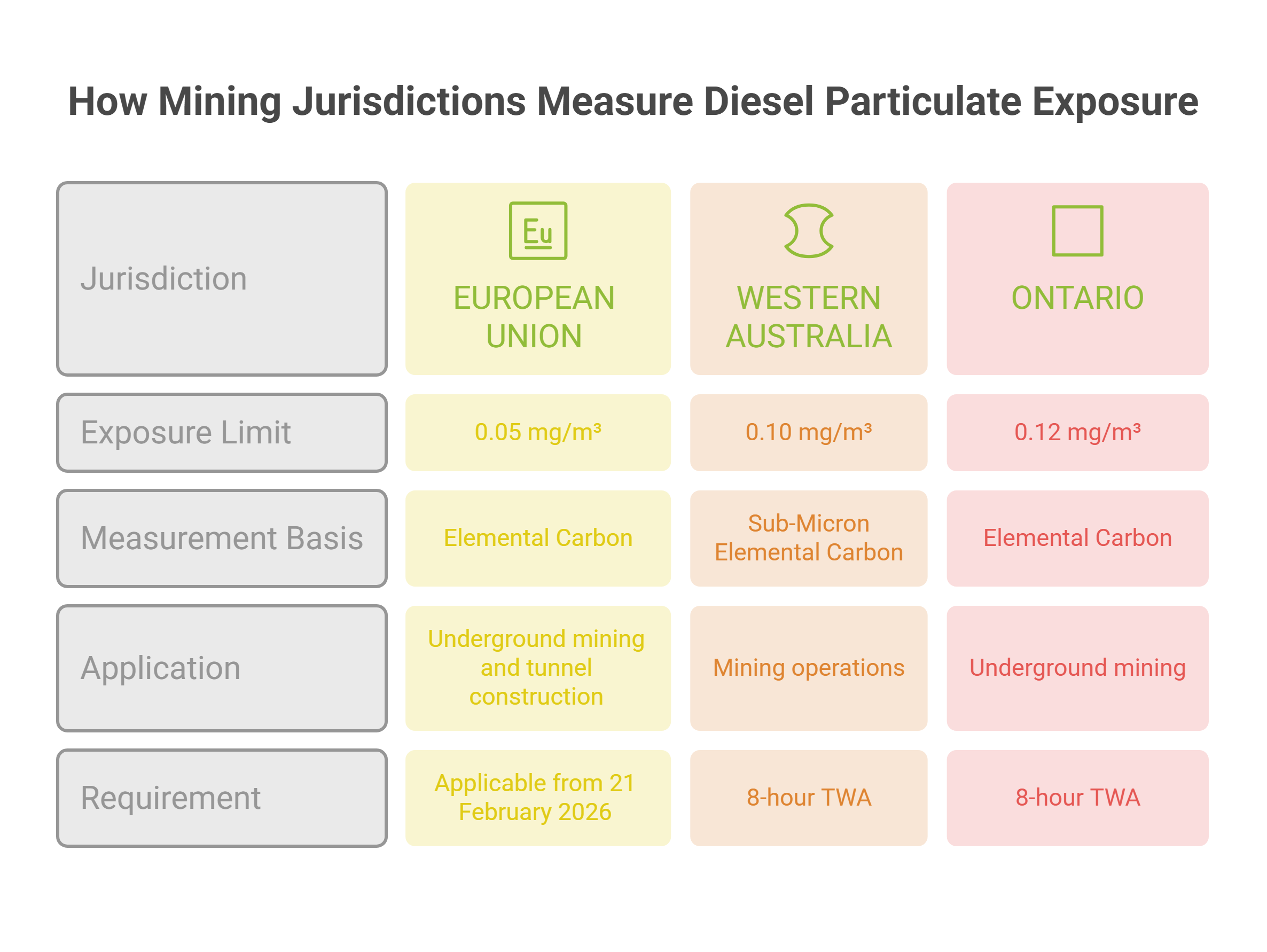
Key Takeaway: Mining jurisdictions are increasingly using defined exposure limits and measurement requirements to strengthen the management of diesel particulate exposure.
Monitoring and Engineering Controls Strengthening Diesel Exposure Management
Meeting an exposure standard depends on more than measuring workplace concentrations. Effective diesel emissions control increasingly requires operators to connect exposure monitoring with the condition of engines, ventilation systems, filtration equipment and work practices. This allows mine sites to identify where exposure is occurring and determine whether existing controls are performing as intended rather than treating occupational monitoring as a standalone compliance activity.
ICMM identifies monitoring and maintenance as a foundation of diesel particulate management, with exposure information able to support maintenance decisions when abnormal emissions are detected. Engine condition is particularly important because poorly maintained equipment can increase emissions, while newer engine technologies and exhaust after-treatment can reduce particulate output. Diesel particulate filters are among the established engineering measures used to reduce emissions, although their performance depends on correct selection, maintenance and operating conditions.
Ventilation and Filtration Remaining Core Exposure Controls
Ventilation remains essential in underground operations because it dilutes and removes contaminants generated by diesel equipment. The effectiveness of ventilation depends on airflow, equipment location, operating activity and the number of diesel sources operating within a particular area. Filtration and enclosed cabs can provide additional protection by reducing the concentration of contaminated air reaching workers.
These controls are increasingly being supported by more detailed exposure monitoring. Research into real-time and time-resolved measurement has shown how exposure peaks can be associated with particular equipment and work activities, providing information that periodic sampling may not capture. Such data can help operators identify recurring exposure locations and assess whether changes to ventilation, equipment allocation or maintenance are producing the intended results. In this context, diesel emissions control becomes a continuous management process rather than a single intervention.
Equipment Transition Expanding the Control Hierarchy
Longer-term changes in mining fleets are also influencing exposure management. Newer low-emission diesel equipment can reduce particulate emissions, while battery-electric equipment can remove diesel exhaust from the point of use altogether. ICMM identifies electrification as a potential long-term pathway for underground operations, while also recognising that adoption requires changes to equipment, infrastructure and operating systems.
This means diesel emissions control is developing across several layers, from maintaining existing engines and improving filtration to strengthening ventilation and gradually introducing lower-emission alternatives. The combination of these measures allows operators to address exposure at its source, within the mine environment and at the point where workers may encounter contaminated air.
Diesel Exposure Management Becoming More Integrated Across Mine Operations
Exposure standards are making diesel emissions control a more structured part of occupational-risk management across mining. The focus is extending beyond individual measurements toward a combination of engine maintenance, ventilation, filtration, exposure monitoring and equipment selection that can reduce worker exposure at different points in the control chain.
For underground operations, this means maintaining ventilation performance while monitoring where and when exposure occurs, investigating elevated results and checking whether engineering measures remain effective. Over time, lower-emission engines and battery-electric equipment can provide additional ways to reduce diesel exhaust at source, although their adoption depends on operational and infrastructure requirements.
The broader development is therefore not a single replacement technology, but a layered approach to occupational exposure management. Standards provide measurable requirements, while monitoring and engineering controls help operators respond to conditions within individual workplaces. For Mining Frontier, this also sets up the next stage of the series, where attention shifts from diesel exhaust to silica exposure and the workplace controls used to manage it.