























While pure copper is celebrated for its unmatched electrical and thermal conductivity, its mechanical limitations such as relatively low strength and hardness have historically restricted its use in heavy-duty structural applications. To overcome these challenges, the field of materials science has seen a remarkable surge in the development of advanced copper alloys. By precisely combining copper with elements such as beryllium, nickel, silicon, chromium, and zirconium, metallurgists have created a new generation of industrial metals that maintain excellent conductivity while rivaling the strength of many steels. These alloy innovations are essential enablers of modern engineering, providing the critical materials needed for everything from high-speed electronic connectors and aerospace components to high-precision manufacturing tools.
The Metallurgical Foundation of Alloy Innovation
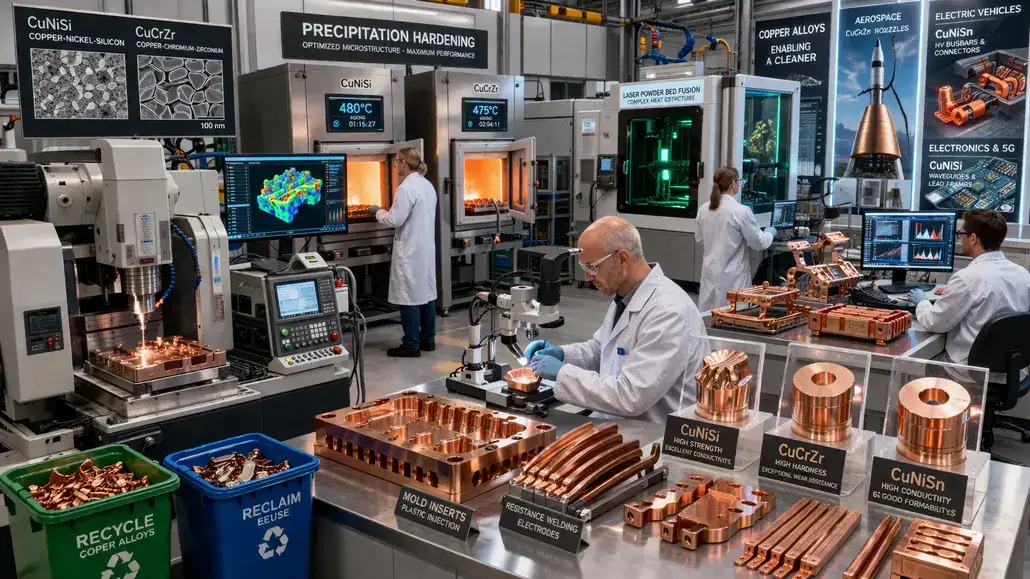
The creation of advanced copper alloys is a sophisticated process that involves manipulating the metal’s internal crystal structure at the atomic level. Traditionally, alloying copper meant sacrificing a significant portion of its conductivity to gain strength. However, modern techniques like “precipitation hardening” and “dispersion strengthening” have allowed for the development of high-strength, high-conductivity (HSHC) alloys. In these materials, tiny particles of secondary elements are distributed throughout the copper matrix, blocking the movement of dislocations that cause deformation without significantly obstructing the flow of electrons.
One of the most notable examples is the copper-nickel-silicon (CuNiSi) family of alloys. Through a carefully controlled heat treatment process, silicon and nickel form nano-scale precipitates that provide exceptional strength and stress relaxation resistance. These advanced copper alloys are increasingly becoming the standard for high-performance automotive terminals and electronic connectors, where they must maintain a secure electrical contact under constant vibration and elevated temperatures. The ability to fine-tune these metallurgical properties is the cornerstone of alloy innovation, allowing engineers to design materials that meet the increasingly stringent requirements of modern industrial applications.
High-Performance Materials in Aerospace and Defense
In the demanding environments of aerospace and defense, advanced copper alloys are used where thermal management and structural integrity are paramount. One of the most critical applications is in the combustion chambers and nozzles of rocket engines. These components are subjected to extreme heat and pressure, requiring materials that can rapidly conduct heat away to prevent melting while maintaining their shape. Copper-silver and copper-zirconium alloys are the materials of choice here, offering a level of thermal conductivity far superior to nickel-based superalloys.
Furthermore, the defense industry utilizes advanced copper alloys in the production of high-velocity kinetic energy penetrators and specialized armor-piercing rounds. In these applications, the high density and excellent ductility of specialized copper-tungsten or copper-nickel alloys allow for devastating performance upon impact. In the realm of telecommunications and radar, copper-beryllium alloys are prized for their non-magnetic properties and high strength-to-weight ratio, making them ideal for mission-critical components that must operate reliably in space or at high altitudes. As the aerospace sector moves toward electric propulsion, the demand for these high-performance conductive materials will only accelerate.
Engineering Metals for High-Precision Manufacturing
The manufacturing sector is perhaps the largest consumer of advanced copper alloys, where they are used to create the tools and components that make mass production possible. In the plastic injection molding industry, beryllium-copper and copper-nickel-silicon alloys are used for mold inserts and cores. Their high thermal conductivity allows for much faster cooling of the plastic part within the mold, which can reduce cycle times by up to forty percent. For a high-volume manufacturer, this increase in productivity translates directly into significant cost savings and faster time-to-market.
Advanced copper alloys also play a vital role in resistance welding and electrical discharge machining (EDM). Welding electrodes made from copper-chromium-zirconium alloys can withstand the intense heat and mechanical pressure of thousands of weld cycles without deforming or losing conductivity. In EDM, where an electrical spark is used to erode metal into complex shapes, copper-tungsten and copper-tellurium alloys provide the high melting point and electrical stability required for precision work. The durability and performance of these manufacturing materials are essential for maintaining the tight tolerances and high quality required in modern engineering.
Electrification and the Rise of High-Conductivity Alloys
The global transition to electric vehicles (EVs) and renewable energy is creating a massive new market for advanced copper alloys. In an electric vehicle, the battery, power electronics, and motor are connected by a complex network of busbars and high-voltage connectors. These components must be able to carry hundreds of amperes of current while remaining compact and lightweight. Standard copper is often too soft to provide the necessary mechanical spring force for these connectors, leading to the use of specialized copper-nickel-tin (CuNiSn) alloys that offer a unique combination of strength and conductivity.
Moreover, the development of ultra-fast charging infrastructure is driving alloy innovation in thermal management. Charging cables and connectors now need to handle power levels that would cause standard materials to overheat rapidly. Advanced copper alloys with optimized thermal properties are being used in liquid-cooled charging systems to ensure safety and efficiency. This integration of material science with electrical engineering is a critical enabler of the EV revolution, as it allows for faster charging times and more reliable vehicle performance. As the energy density of batteries increases, the importance of these conductive materials will only grow.
Copper Alloys in the Era of 5G and Miniaturization
The electronics industry is characterized by a relentless drive toward miniaturization and higher processing speeds. As devices become smaller, the electronic components must also shrink, leading to higher current densities and greater heat generation. Advanced copper alloys are used to manufacture the lead frames that support and connect integrated circuits, as well as the high-speed connectors in data centers and telecommunications equipment. These materials must be extremely thin—often less than a tenth of a millimeter—yet strong enough to survive the assembly process and maintain signal integrity.
The rollout of 5G technology has placed even greater demands on copper-based materials. 5G signals operate at high frequencies, which are highly sensitive to electromagnetic interference and signal loss. Specialized copper alloys with high surface quality and precise micro-structures are being developed to create the filters, waveguides, and shielding required for 5G base stations and smartphones. The ability of these engineering metals to provide both structural support and exceptional electrical performance is essential for the reliability of the global communication network. As we look toward 6G and beyond, the role of alloy innovation in the electronics sector will remain a primary focus for researchers and manufacturers.
Sustainability and the Circular Economy of Industrial Metals
One of the most significant advantages of advanced copper alloys is their inherent sustainability within a circular economy. Copper is one of the few materials that can be recycled indefinitely without any degradation in its physical or chemical properties. This recyclability is particularly valuable for high-performance alloys, which often contain expensive and scarce elements like silver, nickel, or beryllium. Modern recycling facilities are now capable of separating these complex alloys and re-incorporating them into the production of new high-grade materials.
By using recycled copper alloys, manufacturers can significantly reduce their carbon footprint and lower the environmental impact of their products. Furthermore, the increased durability and efficiency provided by these advanced materials lead to longer product lifespans and reduced energy consumption over the lifetime of the component. This aligns with the growing global emphasis on “design for sustainability,” where the choice of material is based not only on its performance but also on its long-term environmental legacy. In this context, advanced copper alloys are a model for the responsible use of industrial metals in a resource-constrained world.
Future Horizons: Additive Manufacturing and Nano-Alloys
The future of advanced copper alloys is being shaped by two exciting frontiers: additive manufacturing (3D printing) and nano-technology. Traditionally, copper has been difficult to 3D print due to its high reflectivity and thermal conductivity. However, new green-laser systems and specialized copper alloy powders are overcoming these barriers, allowing for the creation of complex, topologically optimized components with internal cooling channels that were previously impossible to manufacture. This will revolutionize the design of heat exchangers, rocket components, and high-performance electronics.
At the same time, researchers are exploring “nano-structured” copper alloys, where the grain size of the metal is reduced to the nanometer scale. These materials exhibit extraordinary strength and hardness while maintaining surprisingly high conductivity. By incorporating carbon nanotubes or graphene into the copper matrix, scientists are also creating “copper composites” that could one day replace traditional alloys in the most demanding industrial applications. These innovations represent the next chapter in the long history of copper metallurgy, ensuring that the metal remains at the cutting edge of industrial technology for generations to come.